


Why real rest feels so hard — and how to finally make it simple
Have you ever returned from a vacation more exhausted than when you left?
Picture this: You’ve been planning this trip for months. The suitcase is packed (and repacked three times). You’ve checked your flight status obsessively, made restaurant reservations, created a color-coded itinerary, and reminded everyone in your family to bring their chargers. You rush through security, shuffle onto the plane with a neck pillow you’ll never actually use, and finally arrive at your destination. For the next five days, you race from landmark to landmark, restaurant to beach to museum, phone camera constantly raised, determined to see everything, do everything, prove that this vacation was worth every penny and every ounce of effort.
Then you come home. Laundry piles up. Your body feels like it’s been through a marathon. Your bank account looks thinner. And somehow, inexplicably, you feel like you need a vacation to recover from your vacation.
Sound familiar?
Here’s what nobody tells you: rest doesn’t require a plane ticket. Relaxation isn’t something you can schedule between a snorkeling tour and a sunset cruise. And the peace you’re chasing? It’s not hiding at the end of a perfectly curated Instagram itinerary.
What if we’ve been thinking about rest all wrong? What if the exhaustion you feel isn’t a sign that you didn’t vacation hard enough—but rather that you’ve been taught to approach rest like it’s just another task to optimize, another performance to perfect, another box to check?
Welcome to a different conversation. One where rest isn’t a luxury you have to earn or a destination you have to reach. Where staying home isn’t settling. Where doing less isn’t failing. Where your nervous system gets a vote, your budget doesn’t induce guilt, and “I need to do nothing” becomes a completely valid plan.
Let’s rethink everything you’ve been told about what it means to truly, deeply rest.
The Big Problem Nobody Talks About: Vacations Aren’t Always Relaxing
We don’t say this part out loud enough: sometimes vacations are terrible for your mental health.
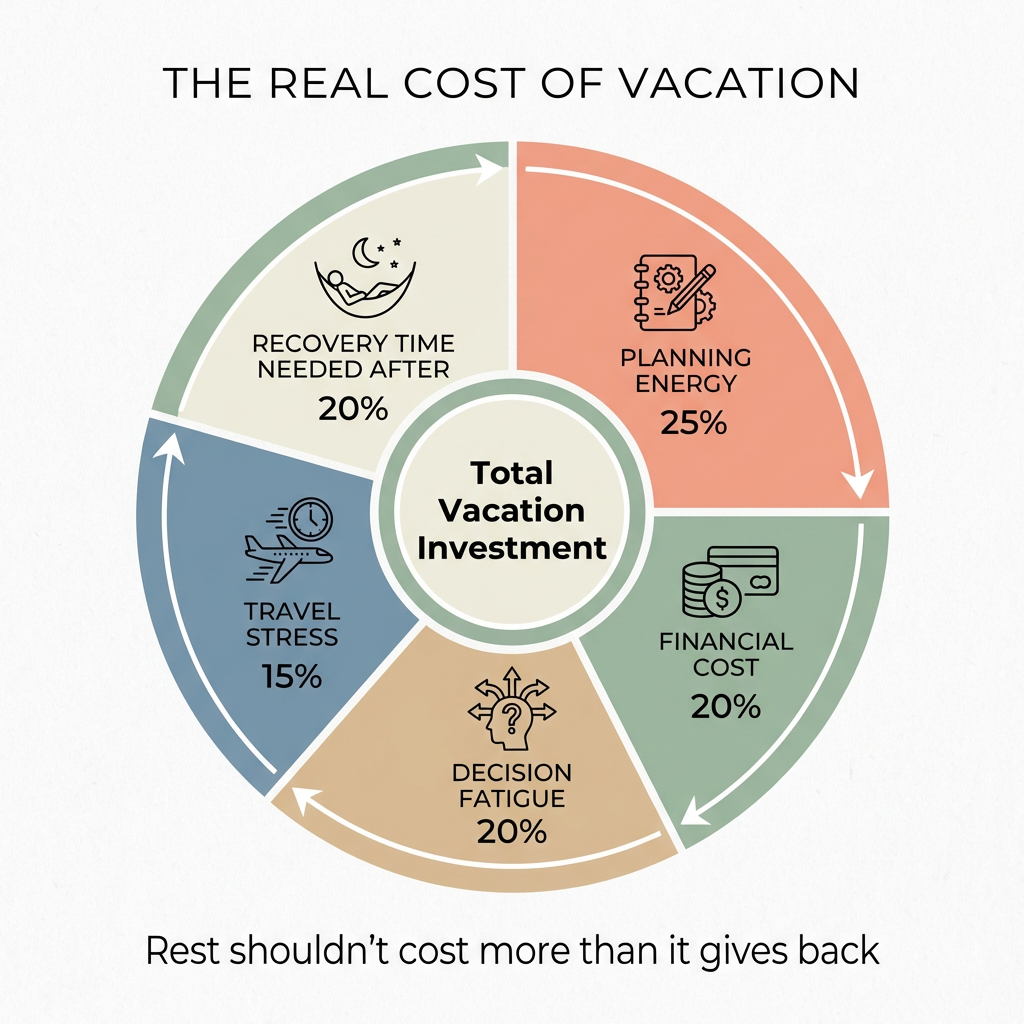
Not because the destination was wrong or the hotel wasn’t nice enough. But because we’ve culturally transformed “time off” into a high-pressure performance that demands perfection, costs a fortune, and leaves little room for actual rest. We’ve turned relaxation into work.
When “time off” turns into another job
Let’s talk about the invisible labor that starts long before you ever board a plane.
First comes the research phase. You open seventeen browser tabs comparing hotels. You join Facebook groups asking strangers whether the blue lagoon tour is “worth it.” You create spreadsheets. You read reviews until your eyes blur, trying to avoid making the “wrong” choice. You calculate exchange rates, compare flight times, debate whether the direct flight is worth the extra $200, and second-guess every decision.
Then comes the planning. You build an itinerary that would make a military strategist proud. Monday: arrival, check-in by 3 p.m., walk to the market, dinner reservation at 7:30. Tuesday: museum opens at 9, allow 2.5 hours, lunch at the place with the good reviews, afternoon at the beach, sunset at the viewpoint everyone photographs. You’ve Tetris-ed your entire trip into a perfect puzzle where nothing is wasted and every moment is optimized.
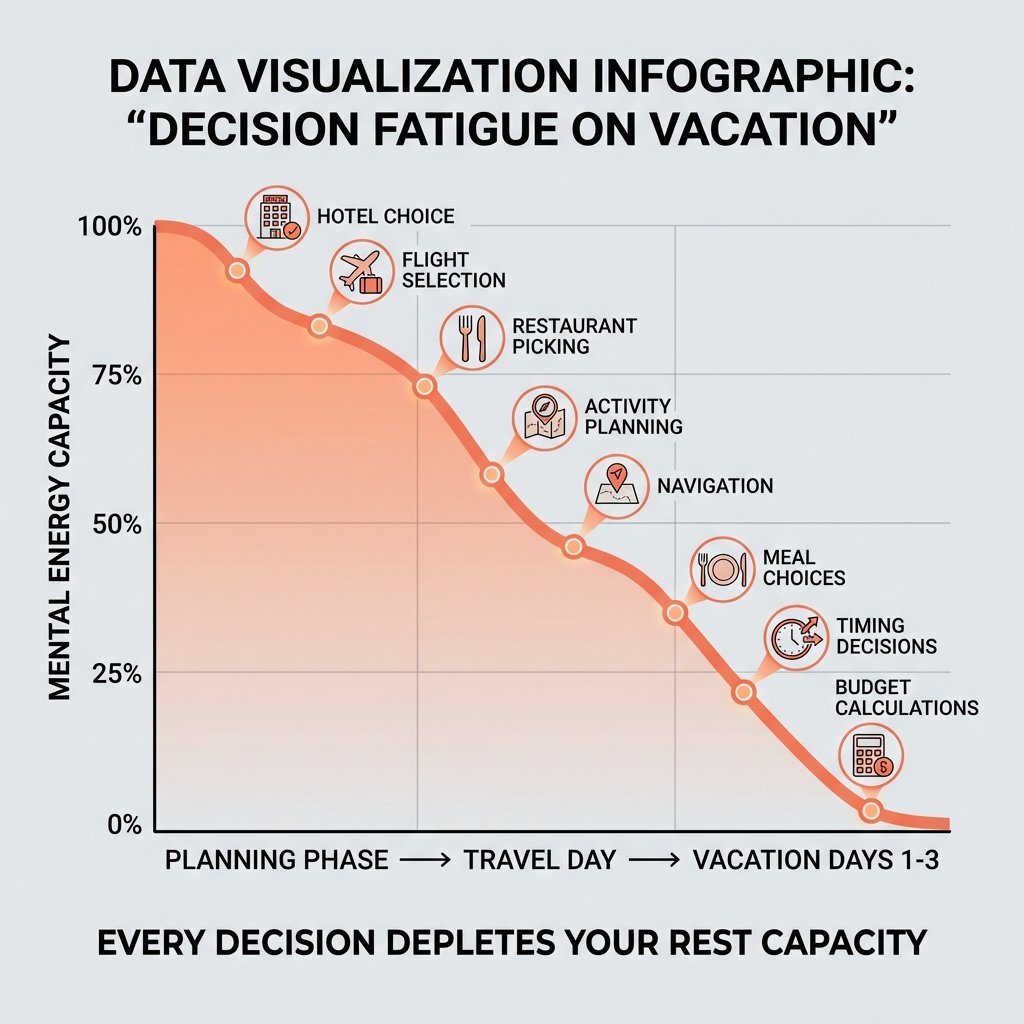
This is called decision fatigue, and it’s stealing your rest before you even leave home.
Your brain has a limited capacity for decision-making each day. Every choice—even small ones—depletes that capacity. Should we eat here or there? Take this tour or that one? Spend money on this experience or save it? Walk or take a taxi? Each decision is a tiny withdrawal from your mental energy account. By the time you’re actually on vacation, you’re already running on empty.
Then there’s the perfection pressure. This trip cost money. It cost time off work. It cost coordination, logistics, maybe even calling in favors for someone to watch your dog. So it better be perfect. It better be worth it. You better enjoy every moment, capture every sunset, taste every local delicacy, and return home with stories that prove the trip was everything you hoped it would be.
Except rest doesn’t work that way. Rest can’t be forced. Peace can’t be scheduled. Your nervous system doesn’t care about your itinerary.
Why you feel guilty for not enjoying it
Here’s the thought pattern that haunts so many travelers:
“We spent all this money. I should be happy right now. Why am I not happy? What’s wrong with me?”
You’re standing in front of something objectively beautiful—a waterfall, a cathedral, a vista that people travel thousands of miles to see—and instead of feeling joy, you feel… tired. Or anxious. Or underwhelmed. And then you feel guilty for feeling that way.
This is emotional labor stacked on top of vacation labor. Not only are you managing logistics, but now you’re also managing your emotions about whether you’re having the “right” emotions.
Social comparison makes it worse. Everyone else’s vacation photos look effortless. Their families are smiling. Their experiences look magical. Their posts say “best trip ever!” while you’re in your hotel room googling “is it normal to feel sad on vacation” and wondering if you’re broken.
The truth? Most of those perfect photos took seventeen tries. Most of those families had at least one meltdown that didn’t make the Instagram grid. Most people come home from vacation with at least some disappointment, frustration, or exhaustion—they just don’t post about it.
And then there’s the fear of “wasting the trip.” You’re already here. You already paid. You already used your limited vacation days. So you push through exhaustion. You say yes when your body wants to say no. You drag yourself to one more sight, one more activity, because the idea of “doing nothing” feels like failure when you’ve invested so much.
This is not rest. This is endurance tourism.
Related Reading: Why Your Vacation Leaves You Exhausted — And How to Fix It

What Your Mind and Body Actually Need (Hint: It Isn’t More Activity)
Let’s get real about what’s happening in your body when you finally stop moving.
The nervous system and rest
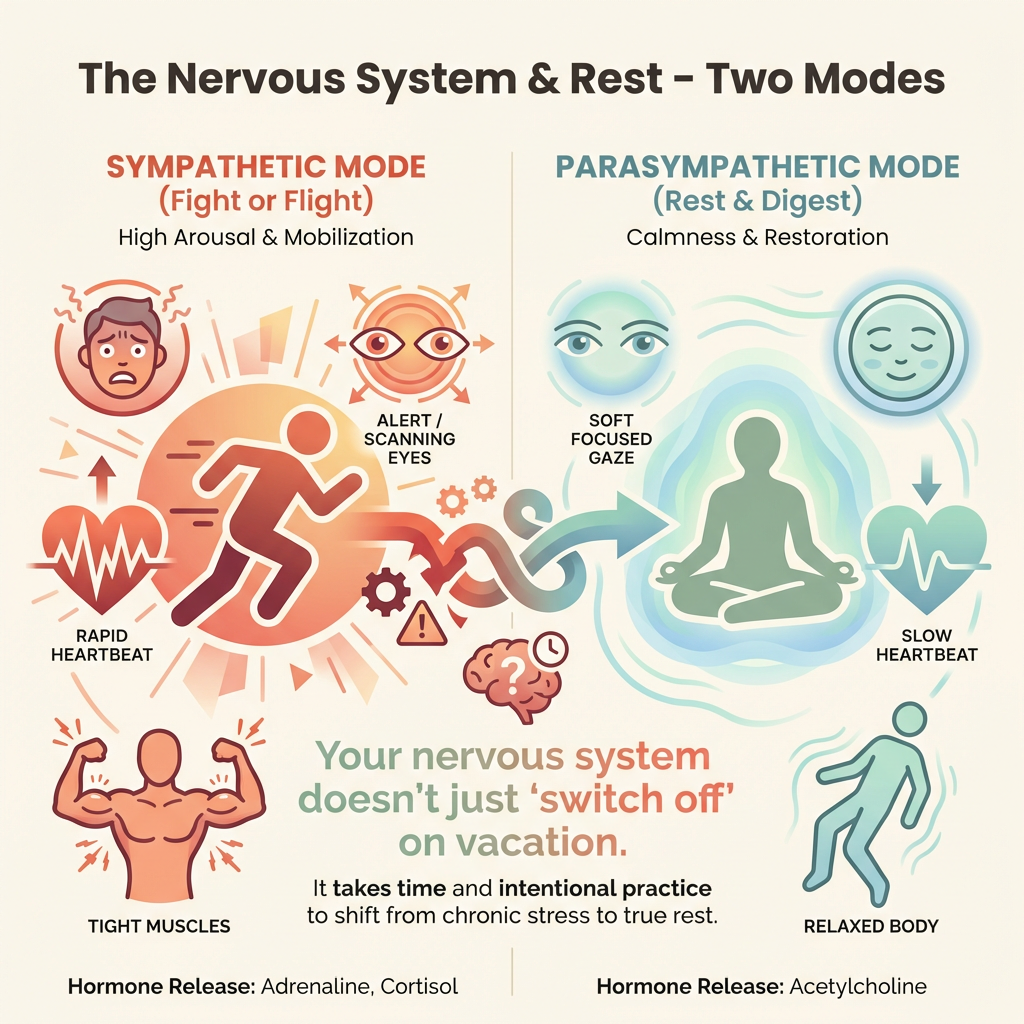
Your nervous system has two modes: sympathetic (go go go) and parasympathetic (rest and digest). Most of us live in sympathetic mode. We’re rushing to work, managing emails, meeting deadlines, coordinating schedules, making decisions, solving problems. Our bodies are in a constant low-grade state of activation.
When you finally take time off, your nervous system doesn’t just flip a switch. It doesn’t instantly say, “Oh, we’re on vacation now! Time to relax!”
Instead, there’s often a crash. Your body, finally given permission to stop, sometimes responds by getting sick, feeling exhausted, or becoming emotionally raw. This isn’t a malfunction—it’s your system finally feeling safe enough to release tension it’s been holding.
True rest isn’t about adding more stimulation. It’s about creating space for your nervous system to downregulate. It’s about reducing inputs, not increasing them. It’s about safety, predictability, and permission to simply be.
Why stillness feels uncomfortable at first
If you’ve ever tried to sit still and do nothing, you know this feeling: the itchiness. The restlessness. The sudden urge to check your phone, clean something, plan something, do anything other than just sit with yourself.
This is normal. This is your body adjusting.
When you’re used to constant motion, stillness feels foreign. It can even feel threatening. Because when you stop moving, you start feeling. All the emotions you’ve been outrunning, all the stress you’ve been postponing, all the discomfort you’ve been distracting yourself from—it surfaces.
This is why some people fill their vacations with activities. Not because they genuinely want to do all those things, but because doing is easier than being. Sightseeing is easier than sitting with your own thoughts. A packed itinerary is easier than confronting the question: What do I actually need?
Real rest requires a tolerance for discomfort at first. It requires sitting with the fidgety feeling. It requires letting yourself be bored, letting your mind wander, letting your body unclench slowly rather than demanding instant relaxation.
Think of it like this: if you’ve been clenching your fist for hours, you can’t just suddenly open it and expect it to feel normal. There’s an ache when you first release. Your muscles are confused. That ache isn’t a sign you’re doing it wrong—it’s a sign you’re finally letting go.
The difference between escape vs. recovery
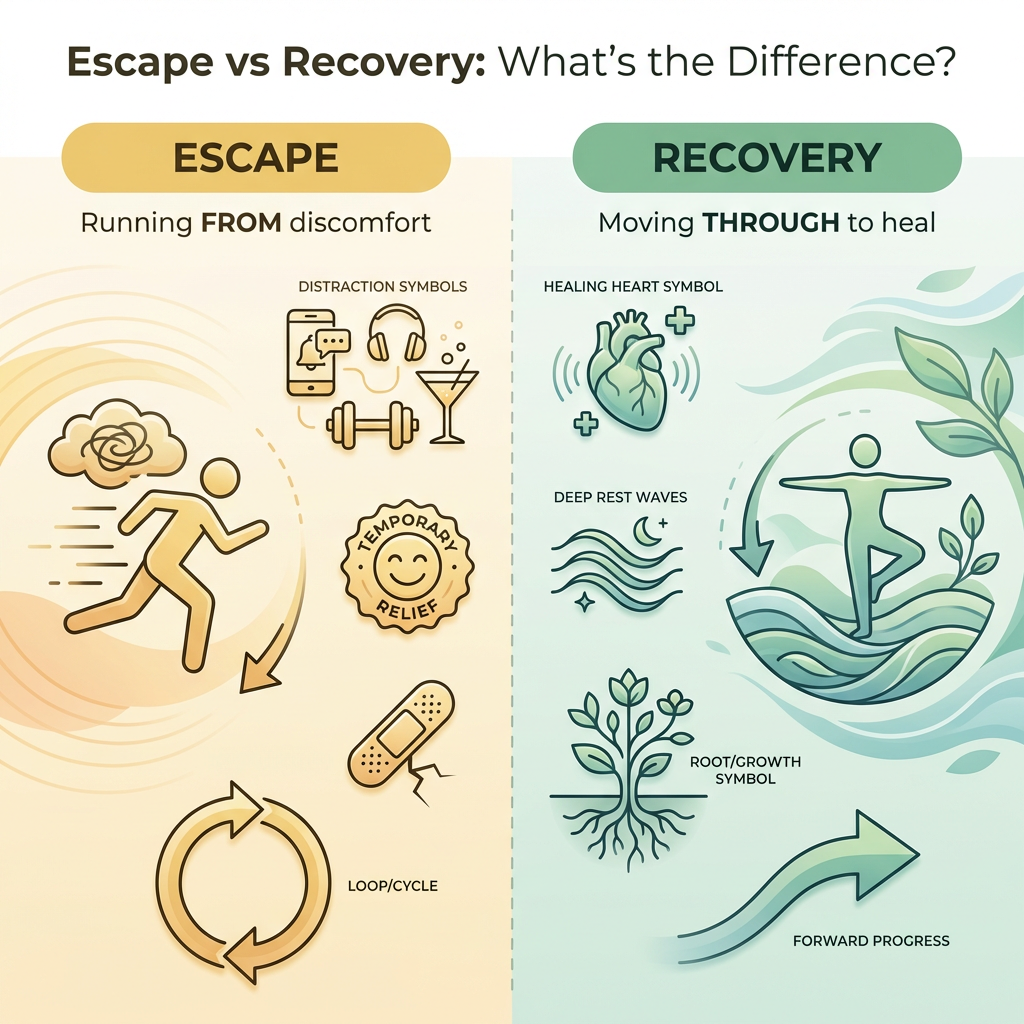
Here’s a distinction that changes everything: escape and recovery are not the same thing.
Escape is running from something. It’s using distraction to avoid feeling bad. It’s filling every moment so you don’t have to face what’s underneath. Escape can feel good temporarily, but it doesn’t restore you. It’s like putting a bandage over a wound without cleaning it.
Recovery is actively healing. It’s creating conditions where your body and mind can repair. It’s not about avoiding discomfort—it’s about moving through it. Recovery might involve rest, but it might also involve crying, journaling, sleeping twelve hours, staring at the ceiling, or finally feeling feelings you’ve been postponing.
You can escape on a vacation. You can pack your schedule so full that you don’t have time to think. You can drink enough wine that you feel temporarily relaxed. You can post enough photos that you feel temporarily validated.
But recovery? Recovery requires something different. It requires honesty. It requires slowing down enough to hear what your body is actually saying. It requires releasing the pressure to perform, to optimize, to make every moment count.
And here’s the most important part: recovery doesn’t require travel. In fact, sometimes travel prevents recovery because it adds more variables, more stimulation, more decisions, more performance pressure.
Sometimes the most healing thing you can do is stay exactly where you are and give yourself permission to rest without the weight of expectation.
Rest Without Overspending — Removing Money Stress from the Equation
Let’s talk about the thing that ruins more vacations than bad weather or lost luggage: money anxiety.
When vacations become financial pressure
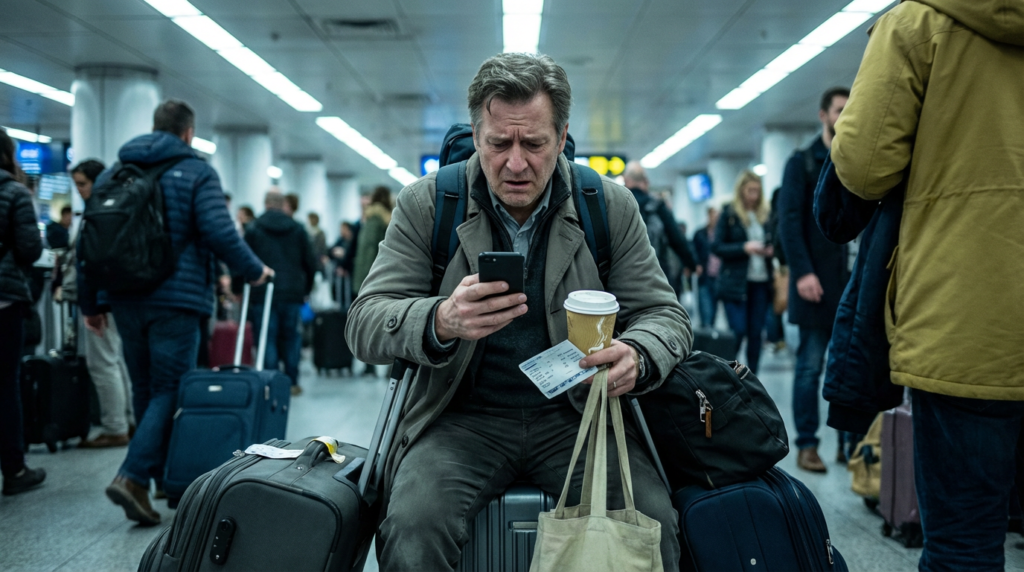
You’ve saved for this. Maybe for months. Maybe you’ve put it on a credit card with the vague plan to “figure it out later.” The vacation represents a significant chunk of your budget—maybe even more than you’re comfortable admitting.
And now every decision comes with a price tag that whispers in the background:
Should we eat at that restaurant? It’s expensive, but we’re on vacation…
Should we skip this tour? But we came all this way…
Should we get dessert? But we’re already spending so much…
Every choice becomes a negotiation between enjoyment and guilt. You’re trying to relax while mentally calculating exchange rates. You’re trying to be present while a voice in your head tallies the running total of how much this day cost.
This is not rest. This is financial stress in a prettier location.
And then there’s the post-vacation dread. You come home to credit card statements, a depleted savings account, and the creeping realization that you’ll be “paying off this trip” for months. The relaxation you gained evaporates under the weight of financial anxiety. You tell yourself it was worth it. You remind yourself that experiences matter more than things. But late at night, when you can’t sleep because you’re worried about money, the vacation feels less like self-care and more like self-sabotage.
How guilt sabotages relaxation
Even if you can technically afford the trip, guilt has a way of sneaking in.
“I should be saving this money for something more important.”
“Other people have real problems, and I’m spending money on vacation.”
“I should be working instead of traveling.”
“I shouldn’t need a vacation. I should be able to handle normal life.”
Guilt is rest’s worst enemy. It sits in the back of your mind like a judgmental passenger, critiquing every choice. You can’t fully exhale because some part of you believes you don’t deserve to.
This guilt is often rooted in messages we absorbed growing up: that rest is earned, that relaxation is selfish, that time off must be justified, that you’re only valuable when you’re productive. These beliefs don’t disappear just because you’re standing on a beach.
What rest looks like when money isn’t driving the decision
Imagine, for a moment, that money wasn’t a factor in your rest decisions.
Not because you’re suddenly wealthy, but because you’ve removed the equation that says “rest must cost money to count.”
What would you do differently?
Maybe you’d stay home more often. Maybe you’d take a Friday off to do absolutely nothing instead of booking a weekend trip to “make the time off worth it.” Maybe you’d say no to expensive group vacations that you don’t really want to go on. Maybe you’d stop scrolling through flight deals trying to convince yourself you need to go somewhere to justify feeling tired.
Rest becomes radically simpler when it’s not tied to spending. When a nap counts. When a quiet morning with coffee counts. When staying in your pajamas until noon counts. When turning off your phone for a day counts.
You don’t need to spend money to give yourself permission to rest. You just need to believe that your tiredness is valid, that your need for peace is legitimate, and that rest without a plane ticket still counts as real rest.
Related Reading: Guilt-Free Rest on Any Budget
Staycations: The Most Underrated Form of Recovery
Let’s rehabilitate a word that’s gotten a bad reputation: staycation.
Somewhere along the way, “staycation” became code for “couldn’t afford a real vacation.” It became the lesser option, the compromise, the thing you do when you can’t do what you really want.
But what if we’ve had it backwards? What if staying home is actually the more sophisticated rest strategy?
Why staying home can be healthier
Travel is stimulating. New environments, new sounds, new smells, new routines. For some people, in some seasons, that stimulation is exactly what they need. But for many of us, especially when we’re depleted, that stimulation is just more input for an already overloaded system.
Staying home removes variables. You know where the bathroom is. You know how the shower works. You know which pillow is yours. Your body doesn’t have to constantly orient itself to new surroundings. Your nervous system can actually relax instead of staying subtly alert to navigate unfamiliar territory.
There’s also the sleep factor. Travel disrupts sleep—different beds, different time zones, different noise levels. Even if you’re exhausted, your body might not fully rest in an unfamiliar environment. At home, you can sleep in your own bed, on your own schedule, without the pressure of “making the most of” limited vacation time.
And then there’s control. At home, you control the sensory environment. Too loud? You can change it. Too bright? You adjust. Hungry? Your kitchen is right there. Overstimulated? You have your own space to retreat to. This control is especially valuable for people with anxiety, sensory sensitivities, or anyone who’s been running on fumes for too long.
Turning your space into a reset zone
The key to a successful staycation isn’t pretending you’re somewhere else—it’s creating intentional conditions for rest right where you are.
This means:
Setting boundaries. Just because you’re home doesn’t mean you’re available. Turn off work notifications. Let calls go to voicemail. Put an out-of-office message on your email that says exactly what you’d say if you were traveling: “I’m taking time off and won’t be checking messages.”
Changing your environment slightly. You don’t need to redecorate. But small shifts signal to your brain that this time is different. Maybe you put fresh flowers on the table. Maybe you light a candle you usually save for special occasions. Maybe you move a chair to face the window instead of the TV. These tiny changes create a sense of occasion without requiring effort or expense.
Protecting your energy ruthlessly. This means saying no to social obligations, errands, and the temptation to “just quickly” do productive things. A staycation fails when you spend it catching up on chores. The laundry will still be there next week. The closet will still need organizing. But this time—this intentional time you’ve carved out—won’t come back.
Giving yourself permission to be “unavailable.” Don’t answer the door if you don’t want to. Don’t make plans just because someone asks. Don’t feel obligated to be productive or social or even pleasant. This time is yours. Guarding it isn’t selfish—it’s essential.
Mini-retreats that require zero travel
Rest doesn’t have to be a week-long event. Sometimes the most restorative experiences are tiny, intentional pockets of peace.
Here are some examples that cost nothing and require no travel:
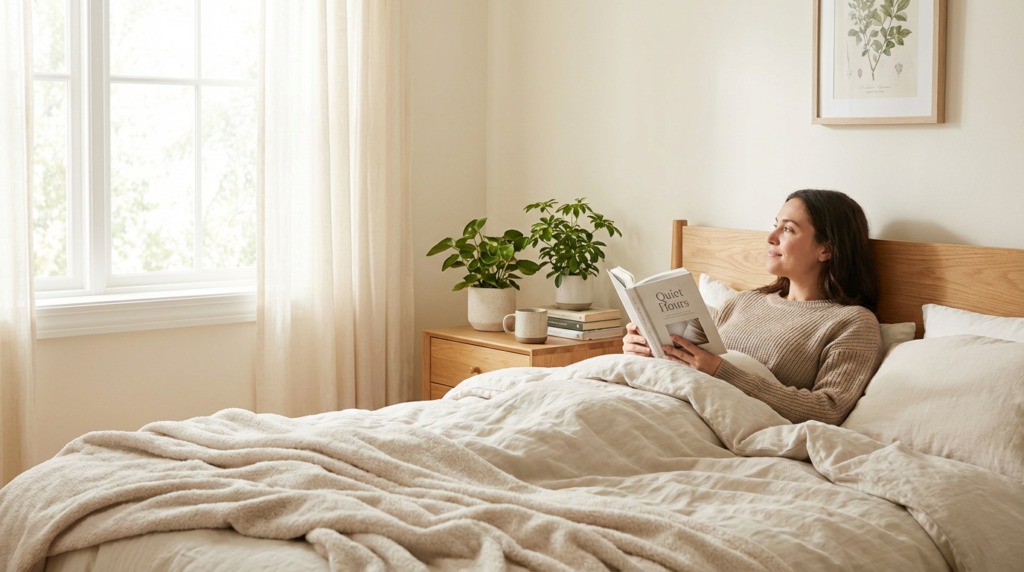
A morning retreat. Wake up and don’t immediately grab your phone. Sit with coffee or tea in the quietest spot in your home. Look out a window. Let your mind wander. Give yourself one hour before the day’s demands begin.
A digital sunset. Pick a time (say, 7 p.m.) and turn off all screens. Spend the evening reading, stretching, cooking slowly, or simply sitting. Notice how different the evening feels when you’re not scrolling.
A bed day. Not because you’re sick, but because you’re tired. Give yourself permission to stay in bed, read, nap, watch comfort movies, and do absolutely nothing productive. No guilt. No justification. Just rest.
A sensory reset. Dim the lights. Play music you love or embrace complete silence. Make your space smell good. Wrap yourself in something soft. Engage your senses in a way that feels nourishing rather than stimulating.
A “no” day. For 24 hours, your default answer to everything is no. No plans. No favors. No obligations. Just space.
These aren’t indulgent extras. They’re maintenance. They’re what keeps you functional. They’re the emotional equivalent of charging your phone before it dies completely.
Related Reading: Designing a Home Retreat That Actually Feels Different
When Travel Anxiety Takes Over — It Isn’t Just “Fear of Flying”
Let’s talk about the anxiety that shows up when you’re supposed to be excited.
You’ve booked a trip. People keep saying, “You must be so excited!” And you smile and nod, but inside, your stomach is in knots. You’re not excited—you’re scared. And then you feel guilty for being scared, which makes the anxiety worse.
Control, unpredictability, and “what ifs”
Travel anxiety often isn’t really about planes or hotels or foreign countries. At its core, it’s about control—or the lack of it.
When you travel, you enter a space where you can’t control most variables. You can’t control flight delays. You can’t control weather. You can’t control other people’s behavior, language barriers, whether your luggage arrives, whether the restaurant has something you can eat, whether the hotel room will be clean, whether you’ll get sick, whether something will go wrong.
For people whose nervous systems are already running on high alert, this loss of control feels threatening. Your brain starts generating “what if” scenarios:
What if I have a panic attack on the plane and can’t escape?
What if I get sick and can’t get home?
What if something bad happens and no one can help me?
What if I can’t handle it?
These aren’t irrational thoughts—they’re your brain trying to protect you. The problem is that overprotection feels like anxiety. Your nervous system is saying, “Too many unknowns. Too much vulnerability. Alert! Alert!”
And here’s what makes it worse: the pressure to “just relax and enjoy it.” People mean well when they say this, but it’s like telling someone with a broken leg to “just walk it off.” Anxiety isn’t a choice. You can’t think your way out of a nervous system response.
Gentle planning frameworks that reduce spirals
If you do want to travel despite anxiety, structure can help. Not rigid, perfectionist structure—but gentle frameworks that give your nervous system something to hold onto.
This might look like:
Creating a “safety file.” A document on your phone with important information: addresses, phone numbers, nearby hospitals, your hotel’s contact info, embassy numbers, medication names, emergency contacts. You might never need it, but knowing it’s there reduces background anxiety.
Building in buffer time. Anxious brains spiral more when things feel rushed. Arriving at the airport extra early might feel excessive, but if it means you can sit calmly instead of panicking about being late, it’s worth it. Give yourself permission to move slowly.
Choosing familiarity. There’s no rule that says travel must be adventurous. Staying at a familiar chain hotel, eating recognizable food, and keeping some routines consistent (like morning coffee the way you like it) can help your nervous system feel safer.
Having an exit plan. Sometimes just knowing you could leave if you needed to reduces anxiety enough that you don’t need to leave. Book refundable options when possible. Know how you’d get home early if necessary. This isn’t pessimism—it’s giving yourself permission to have needs.
Limiting decisions. Decision fatigue amplifies anxiety. The fewer choices you have to make on the trip, the calmer you’ll feel. Pre-plan meals, keep the itinerary simple, and give yourself permission to repeat things instead of constantly seeking novelty.
Deciding when “no” is the calmest option
Here’s something no one says enough: sometimes the right choice is not to go.
Not because you’re weak. Not because you’re broken. Not because you’re less capable than other people. But because your nervous system is telling you that right now, travel isn’t what you need.
There’s a difference between avoidance that limits your life and self-awareness that protects your wellbeing. If the thought of traveling fills you with dread, if the weeks leading up to a trip are consumed by anxiety, if you spend the entire vacation wishing you were home—that’s information.
You’re allowed to say, “Not right now.” You’re allowed to cancel. You’re allowed to choose the option that lets you breathe, even if other people don’t understand.
Rest isn’t always found in new places. Sometimes it’s found in the radical decision to stay exactly where you are and stop forcing yourself into situations that harm your peace.
Related Reading: Travel Anxiety Isn’t About Flying — It’s About Control
Family Trips Without the Pressure Cooker
Let’s be honest: family vacations are often the least relaxing form of vacation.
You’re managing other people’s needs, moods, and expectations while also trying to enjoy yourself. You’re the default planner, the conflict mediator, the snack supplier, and the emotional regulator—all while supposedly “on vacation.”
Why parents rarely feel rested
Because you’re still parenting. The location changed, but your role didn’t.
You’re still responsible for making sure everyone eats, sleeps, stays safe, and doesn’t have a meltdown in public. You’re still anticipating needs, managing logistics, and keeping the peace. You’re still the one who remembers sunscreen, snacks, and where everyone’s shoes are.
Plus, there’s the performance pressure. You want your kids to have magical memories. You  want your partner to relax. You want everyone to be happy, grateful, and bonded. You’ve invested time and money into this trip, so everyone better have a good time, dammit.
Except kids get tired and cranky. Partners have different ideas about what “relaxing” means. Teenagers would rather be on their phones than looking at historical landmarks. And you’re left feeling like a cruise director on a ship where half the passengers are mutinying.
Planning downtime on purpose
The biggest mistake in family trip planning is assuming that doing more equals better. More activities, more sights, more experiences. But “more” is often what breaks everyone.
What if you planned for rest the same way you plan for activities?
This might mean:
Scheduling nothing. Literally put “free time” or “rest block” on the itinerary. Not as a backup plan, but as an intentional part of the day. Kids need downtime. Adults need downtime. Build it in before people start melting down.
Limiting daily activities. One thing per day. Not three museums and a beach and a sunset cruise. One thing. Then rest. Then maybe dinner. That’s a full day. Anything more is pushing it.
Choosing accommodations with space. A rental with separate rooms and a kitchen can be more restful than a hotel where everyone is on top of each other. Space gives everyone room to decompress.
Lowering the bar dramatically. Your kids will remember the hotel pool more than the expensive excursion. They’ll remember laughing together more than checking items off a list. Let the trip be simple. Let it be boring. Let it be whatever it needs to be without forcing magic.
Reset expectations — and stop performing “perfect family travel”
You’re not making a commercial. You’re not creating content. You’re not proving anything to anyone.
Your family vacation doesn’t have to look like anyone else’s. It doesn’t have to include matching outfits, perfectly behaved children, or Instagram-worthy moments. It doesn’t have to be educational, adventurous, or culturally enriching.
It can be messy. It can include tears, arguments, and moments where everyone is cranky. It can include hours in the hotel room because everyone needed a break. It can include pizza three nights in a row because cooking felt like too much.
The goal isn’t perfection. The goal is connection. And sometimes connection looks like sitting in comfortable silence. Sometimes it looks like laughing at inside jokes. Sometimes it looks like everyone reading their own books in the same room.
Give yourself permission to let the trip be what it is, not what you think it should be.
Related reading: Family Trips That Don’t Burn You Out
Neurodivergent Travelers Need Different Kinds of Support
Travel advice is typically written for neurotypical brains. But if you’re neurodivergent—ADHD, autistic, highly sensitive, or otherwise wired differently—standard travel advice can range from unhelpful to actively harmful.
Sensory overload and overwhelm
Airports are sensory nightmares. Bright lights, loud announcements, crowds, unpredictable movements, strong smells, long lines, constant stimulation. For someone with sensory sensitivities, just getting to your destination can be completely overwhelming.
Then there’s the destination itself. New sounds, new textures, new food, new routines. Things that neurotypical people find “exciting” or “stimulating” can feel assaulting when your nervous system processes sensory input differently.
And here’s what makes it harder: you can’t always predict what will be overwhelming until you’re in it. You might think you’ll be fine, and then suddenly you’re in a restaurant that’s too loud, wearing clothes that feel wrong, in a space that’s too crowded, and your whole system is screaming at you to leave.
Predictable routines — even away from home
For many neurodivergent people, routines aren’t optional—they’re regulatory. They’re how your nervous system knows it’s safe. They’re how you manage executive function, process emotions, and stay grounded.
Travel disrupts routines completely. Different sleep schedule. Different food. Different structure. For some people, this disruption is manageable. For others, it’s destabilizing.
If you’re someone who needs routine to function, you’re not “high maintenance” or “inflexible.” You’re working with your actual nervous system needs. And that means travel has to be approached differently.
This might look like:
Keeping some routines consistent. Same morning routine, even in a hotel. Same types of food when possible. Same sleep schedule. Same comforting rituals.
Choosing accommodations carefully. A quiet Airbnb might be better than a busy hotel. A room with a kitchen might be essential. Location matters—proximity to overwhelming areas might be draining even if you’re not actively out in them.
Building in recovery time. For every day of high stimulation, you might need a day of low stimulation. Plan for this. Don’t pack the schedule. Give yourself permission to spend a day in your room if that’s what your system needs.
Having sensory tools. Noise-canceling headphones, sunglasses, fidget tools, comfortable clothes, familiar scents—whatever helps you regulate. Pack these like they’re medication, because for you, they are.
Protecting energy reserves
Neurodivergent brains often have different energy budgets. Masking takes energy. Navigating social situations takes energy. Processing sensory input takes energy. Making decisions takes energy. Being in new environments takes energy.
All of these energy costs compound when you travel. You might hit your limit much faster than neurotypical travelers, and then people wonder why you’re “not enjoying yourself.”
You have to protect your energy differently:
Say no more often. You don’t have to do everything. You don’t have to join every group activity. You don’t have to push through when you’re depleted.
Communicate your needs clearly. “I need alone time to recharge” isn’t rude—it’s essential information. People who care about you want to know how to support you.
Don’t compare your capacity to others. Someone else can go all day without breaks. You can’t. This isn’t weakness—it’s difference. Honor your actual capacity, not the capacity you wish you had.
The best trip for a neurodivergent person might look “boring” to others. It might involve a lot of downtime, repeated activities, and saying no to popular attractions. And that’s perfect. Because the goal isn’t to travel like everyone else—it’s to travel in a way that doesn’t cost you your wellbeing.
Related Reading: Neurodivergent Travel & Planning
The Emotional Crash After a Trip — And How to Recover Gently
You had a good trip. Maybe even a great one. You came home with photos, memories, and stories. You feel grateful. You know you’re lucky.
So why do you also feel… sad?
Why the sadness hits
Post-vacation depression is real, and it’s more common than people admit.
Part of it is contrast. You went from a special, elevated experience back to regular life. Bills still need to be paid. Work emails have piled up. The house is messy. The vacation glow fades fast when you’re standing in front of a sink full of dishes.
Part of it is letdown. You spent weeks or months anticipating this trip. You pinned hopes on it—hopes for rest, for connection, for escape, for feeling different. And even if the trip was good, it’s over now. That thing you were looking forward to has passed. And now there’s nothing on the horizon to anticipate.
Part of it is re-entry shock. Your nervous system adjusted to vacation mode, and now it has to adjust back. This adjustment isn’t instant. Your body might still be trying to relax while your brain is screaming that there’s work to do. This mismatch feels awful.
And part of it is existential. Vacation gives you a glimpse of a different pace, a different life. And coming home forces you to confront: Why is my regular life so much harder than this? Why can’t I feel this peaceful all the time? Is this all there is?
These are big, uncomfortable questions. And your tired, re-adjusting brain isn’t equipped to answer them while unpacking suitcases.
Creating a soft landing instead of a crash
Most people return from vacation and immediately slam back into full-speed life. Work the next day. Catch up on everything immediately. Power through the transition.
This is like going from 60 mph to zero with no brakes. Your system needs a gentler re-entry.
What if you built in a buffer day? A day between returning and going back to work. A day with nothing scheduled. A day to unpack slowly, rest, adjust, and breathe before the demands start again.
What if you didn’t try to “catch up” on everything immediately? The emails can wait another day. The errands can happen gradually. The laundry will get done eventually. Urgency is often a lie we tell ourselves.
What if you acknowledged the sadness instead of fighting it? “I feel sad that the trip is over. That makes sense. I’ll let myself feel this without needing to fix it.” Sometimes just naming the emotion reduces its intensity.
Bringing “vacation peace” into daily life
The real question isn’t “How do I stop post-vacation sadness?” It’s “What was different on vacation that I can bring into my regular life?”
Maybe it was slower mornings. Maybe it was less screen time. Maybe it was more time outside. Maybe it was permission to do less. Maybe it was prioritizing rest over productivity. Maybe it was saying no to obligations.
You can’t recreate vacation every day. But you can identify the elements that made vacation feel different and intentionally weave some of them into your regular rhythm.
Even small changes matter. A weekly “slow morning.” A monthly “nothing day.” A daily practice of putting your phone down an hour before bed. These aren’t vacation—but they’re nods toward the peace you felt when you gave yourself permission to rest.
The goal isn’t to always be on vacation. The goal is to make your regular life feel less like something you need to escape from.
Related reading: Post-Vacation Blues: Recovering Without Shame
Slow Travel: Doing Less on Purpose
There’s a different way to travel. One that rejects the “see everything, do everything” mentality. One that prioritizes depth over breadth, presence over productivity.
It’s called slow travel, and it’s quietly revolutionary.
What happens when you remove the checklist
Typical travel operates on scarcity logic: “I’m only here once. I have to see everything. I can’t miss anything.”
This creates a frantic energy. You race from place to place, collecting experiences like stamps in a passport. You take photos but barely look. You say you were there, but you weren’t really present.
Slow travel flips the script: “I’m here. What do I actually want to do? What would feel good right now?”
This might mean spending three days in one neighborhood instead of trying to see an entire city. It might mean returning to the same café every morning because you like it. It might mean skipping the famous museum because you’re not actually interested in museums.
It means trusting that doing less can give you more.
When you slow down, you notice things. The way light hits a building at a certain time of day. The rhythm of how locals move through a space. The taste of food when you’re not rushing to the next thing. The feeling of being somewhere instead of just passing through.
You also notice yourself. What you’re feeling. What you need. What’s actually restful versus what you think should be restful.
Learning to savor instead of collecting
We’ve been taught that travel is about accumulation. More countries. More experiences. More photos. More stories to tell.
But what if travel was about savoring? About letting one beautiful moment be enough. About sitting with an experience instead of moving on to the next one.
Savoring requires slowness. It requires space. It requires letting go of the idea that you’re supposed to be doing more.
Imagine spending an afternoon sitting by water, just watching. No phone. No agenda. Just you and the movement of waves or a river or a lake. To some people, this sounds boring. To a nervous system that’s been running on overdrive, this sounds like medicine.
Savoring means you might visit fewer places in your lifetime. You might have fewer impressive stories. Your travel resume might look less impressive. But your actual lived experience—the quality of presence, the depth of rest, the genuine peace you feel—will be richer.
Trips built around presence, not pressure
Slow travel requires a mindset shift. You have to let go of:
- Optimizing every moment
- Seeing all the “must-see” sights
- Proving the trip was worth the money
- Keeping up with other travelers
- Documenting everything for social media
- Feeling productive or accomplished
Instead, you prioritize:
- How you feel in your body
- What genuinely interests you (not what you think should interest you)
- Rest and space
- Flexibility to change plans based on energy
- Being present over performing
- Quality of experience over quantity
This isn’t laziness. It’s intentionality. It’s choosing depth. It’s trusting that you don’t have to do everything to have done enough.
Related reading: Slow Travel: Removing Pressure from Your Trip
What Escape to Relax Stands For
This isn’t just a blog. It’s a philosophy. A quiet rebellion against hustle culture, against productivity worship, against the idea that rest must be earned or justified or optimized.
Here’s what we believe:
Permission to slow down. You don’t need a reason to rest. Tired is reason enough. Overwhelmed is reason enough. “I don’t want to” is reason enough.
Emotional honesty. You’re allowed to feel however you feel about travel, rest, and time off. You’re allowed to not enjoy vacations. You’re allowed to prefer staying home. You’re allowed to be anxious, sad, or complicated.
Rest as basic care. Rest isn’t a luxury for when everything else is handled. It’s a fundamental need, like water. You don’t earn it. You require it.
Guilt-free alternatives. There’s no hierarchy where travel is better than staying home. There’s no moral virtue in pushing through exhaustion. There’s no prize for doing more. Different seasons require different approaches. Honor what’s true for you right now.
Travel as an option — not an obligation. You’re not missing out by staying home. You’re not less adventurous, less interesting, or less alive. Travel is one option among many. It’s not the only path to rest, growth, or joy.
We’re here for the people who are tired of pretending. Tired of performing. Tired of forcing themselves into boxes that don’t fit. Tired of feeling guilty for needing what they need.
You belong here exactly as you are.
Not sure where to start? Let’s find the right support for where you are right now.
“I’m completely burned out.”
You need deep rest, and you need it without pressure. Start here: [Vacation Burnout Hub] — gentle practices for nervous system recovery, permission to do nothing, and frameworks for rest that don’t require travel or spending.
“Money stress is stealing the joy.”
Financial anxiety sabotages rest. Let’s remove that weight: [Budget & Guilt Series] — how to rest without spending, how to plan trips that don’t create debt, and how to release guilt around money and self-care.
“I don’t want to travel right now.”
That’s valid. Staying home isn’t settling: [Staycation Library] — practical ideas for home-based rest, how to create retreat experiences without leaving, and why staycations are underrated recovery tools.
“Travel makes me anxious.”
You’re not broken, and you’re not alone: [Calm Travel Toolkit] — understanding travel anxiety, gentle planning frameworks that reduce overwhelm, and knowing when “no” is the right answer.
“I travel with kids.”
Parenting on vacation is still parenting, and it’s exhausting: [Family Peace Guides] — how to plan trips that don’t burn you out, realistic expectations, and making space for rest even with children.
“I just want life to feel slower.”
You’re craving a different pace, and that’s wisdom: [Slow Living Section] — practices for slowing down daily life, bringing vacation peace into regular rhythms, and rejecting the pressure to do more.
Gentle Invitation to Continue
Welcome. You made it here, and that matters.
There’s no rush. No pressure. No expectation that you have to do anything with what you’ve read.
Maybe something here resonated. Maybe it gave you permission for something you’ve been wanting. Maybe it just felt good to hear that you’re not the only one who finds rest complicated.
Whatever brought you here, you’re welcome to stay as long as you need. Come back when you’re ready. Take what helps. Leave what doesn’t.
Rest doesn’t have to look like anyone else’s version. It doesn’t have to be impressive, Instagrammable, or expensive. It just has to be true for you.
If you’d like gentle reminders, small reset practices, and occasional thoughts on rest, calm, and living at a human pace, you’re invited to join our newsletter. No flooding your inbox. No pressure to do anything with what we send. Just quiet support when you need it.
You’re doing better than you think. And you deserve rest—exactly as you are, right where you are.
Take care of yourself. We’ll be here when you need us.