


Last updated: January 15, 2026
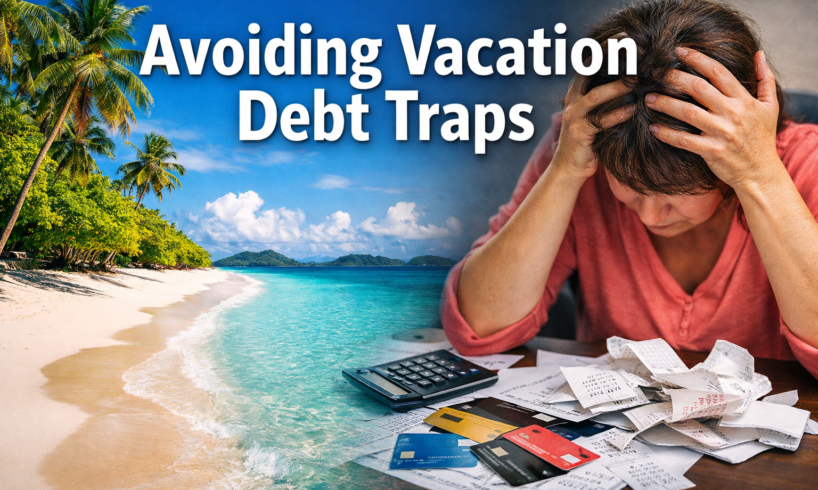
Picture this: Ava returns from her dream Caribbean vacation, tan and relaxed, only to open her credit card statement and find $4,500 in charges she can barely remember making. The post-vacation glow vanishes instantly, replaced by months of financial stress and regret. This scenario plays out thousands of times each year as travelers fall into common vacation debt traps that turn memorable getaways into financial nightmares.
Avoiding vacation debt traps isn’t about sacrificing fun or staying home—it’s about smart planning, realistic budgeting, and making intentional choices that let you enjoy your trip without the financial hangover. The good news? With the right strategies, anyone can take amazing vacations without going into debt.
Key Takeaways
- Set a realistic total budget before booking anything, including a 15-20% buffer for unexpected expenses
- Use cash or debit for daily expenses to avoid the “invisible money” effect of credit cards that leads to overspending
- Book major expenses early when prices are lower and you have time to save rather than charging everything last-minute
- Choose destinations that match your budget instead of forcing expensive locations that require debt financing
- Track spending daily during your trip to catch budget creep before it becomes a debt problem
Quick Answer
Avoiding vacation debt traps requires planning your trip budget months in advance, saving the full amount before you travel, and sticking to spending limits during your vacation. The most effective strategy combines realistic budgeting (including a 15-20% contingency fund), booking major expenses early to lock in lower prices, using cash or debit cards for daily spending to maintain awareness, and choosing destinations that genuinely fit your financial situation rather than aspirational locations that require borrowing.
Why Do Vacations Lead to Debt So Easily?
Vacations create the perfect storm for overspending because they combine emotional decision-making, unfamiliar pricing, relaxed mental guards, and the “special occasion” mentality that justifies purchases you’d never make at home.
When you’re on vacation, your brain shifts into reward mode. You’ve been working hard, you deserve this, and those normal spending inhibitions weaken significantly. Research on consumer behavior shows that people in vacation mode make purchasing decisions based on emotion rather than logic, treating money differently than they would in everyday life.
Common psychological traps include:
- The “I’m already here” fallacy – Once you’ve paid for flights and hotels, additional expenses feel smaller by comparison, even when they’re substantial
- FOMO (fear of missing out) – Worrying you’ll regret not doing an activity or buying a souvenir creates pressure to spend
- Invisible money syndrome – Credit cards make spending feel abstract rather than real, especially in foreign currencies
- Vacation amnesia – Many travelers genuinely forget what they spent by the time they get home
- Social pressure – Traveling with others who have different budgets can push you to spend beyond your means
The unfamiliarity of vacation environments also works against smart spending. You don’t know what things should cost, which restaurants are tourist traps, or where locals shop for reasonable prices. This information gap leads to overpaying repeatedly throughout your trip.
Choose budget-conscious travel if: You have less than three months to save, you’re still paying off previous vacation debt, or your emergency fund has less than $1,000. Choose moderate spending if: You’ve saved the full amount in advance and have a stable financial foundation. Avoid luxury travel if: It requires financing or would deplete your emergency savings.
How Much Should You Really Budget for a Vacation?
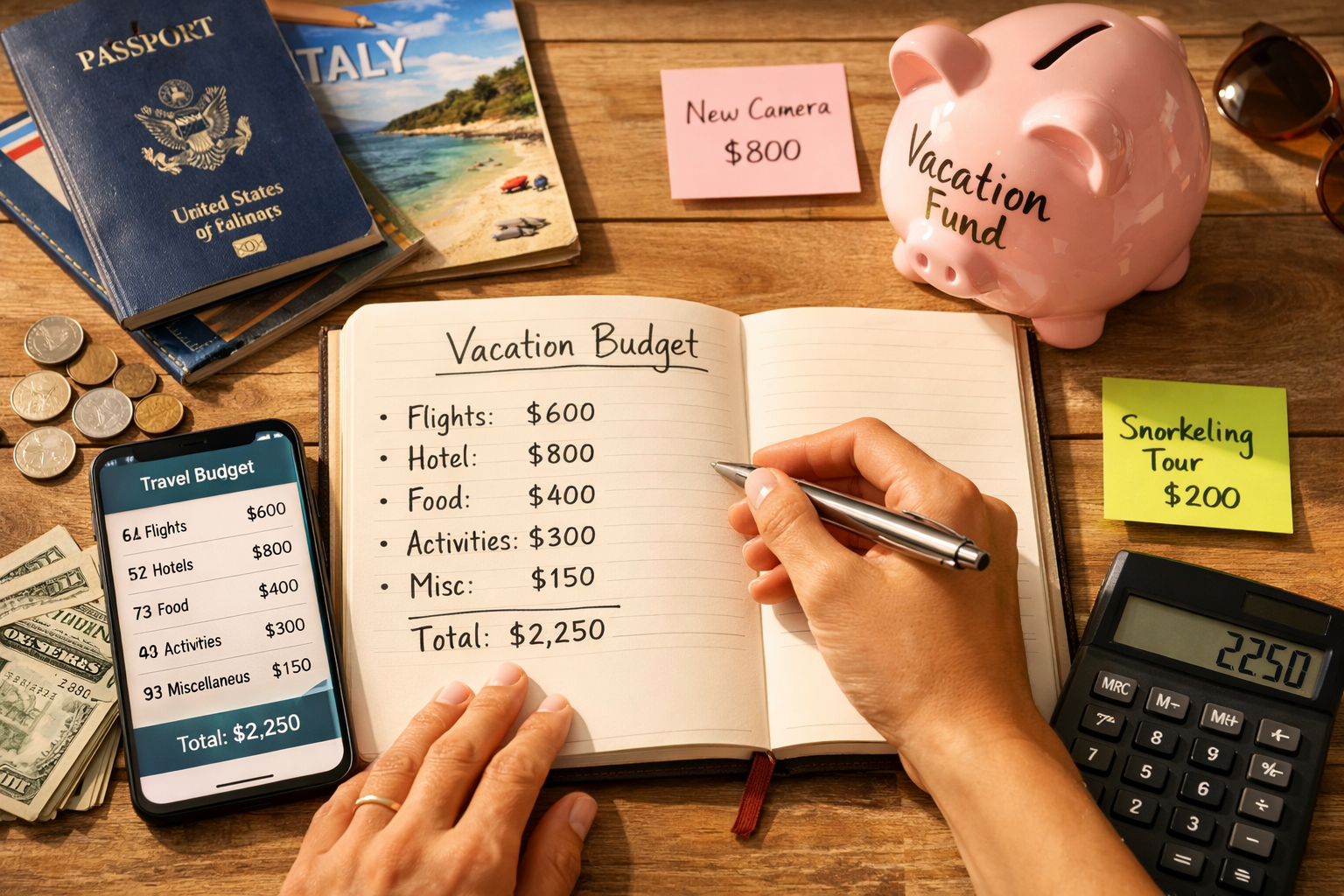
A realistic vacation budget should equal your total saved amount minus a 15-20% emergency buffer, distributed across seven core categories: transportation, accommodation, food, activities, shopping, insurance, and contingency funds.
Most travelers dramatically underestimate vacation costs by focusing only on flights and hotels while ignoring the dozens of smaller expenses that add up quickly. A complete budget accounts for everything from airport parking to the last taxi ride home.
The seven essential budget categories:
- Transportation (25-35% of budget)
- Flights or gas/vehicle costs
- Airport parking or rideshare
- Local transportation (rental car, metro passes, taxis)
- Tolls and parking fees
- Accommodation (25-35% of budget)
- Nightly room rates
- Resort fees and taxes (often 15-25% additional)
- Tips for housekeeping
- Food and drinks (20-30% of budget)
- Breakfast, lunch, dinner
- Snacks and drinks
- Alcohol (often underestimated)
- Special dining experiences
- Activities and entertainment (10-20% of budget)
- Tickets and entrance fees
- Tours and excursions
- Equipment rentals
- Unexpected opportunities
- Shopping and souvenirs (5-10% of budget)
- Gifts for others
- Personal mementos
- Necessary purchases (sunscreen, forgotten items)
- Insurance and fees (5-10% of budget)
- Travel insurance
- Foreign transaction fees
- Baggage fees
- Booking fees
- Contingency buffer (15-20% of budget)
- Medical emergencies
- Flight changes
- Weather delays
- Unexpected opportunities
Example budget breakdown for a week-long trip:
| Category | Budget Amount | Percentage |
|---|---|---|
| Flights | $600 | 30% |
| Hotel (6 nights) | $540 | 27% |
| Food ($60/day) | $420 | 21% |
| Activities | $200 | 10% |
| Local transport | $100 | 5% |
| Shopping | $80 | 4% |
| Contingency | $300 | 15% |
| Total | $2,240 | 100% |
Common mistake: Budgeting only for the “fun” parts and treating necessities like airport transportation as afterthoughts. This leads to charging $75 for an Uber on the last day because you didn’t plan for it.
What Are the Biggest Vacation Debt Traps to Avoid?
The most dangerous vacation debt traps are last-minute bookings that eliminate saving time, all-inclusive packages that hide true costs, destination inflation where you choose locations beyond your budget, activity creep from saying yes to everything, and the “vacation credit card” that separates spending from immediate consequences.
Last-Minute Booking Trap
Booking flights and hotels weeks or days before departure typically costs 30-50% more than booking months in advance, and it forces you to charge expenses rather than save for them. When you book a $1,200 flight three weeks before departure instead of the $650 price available three months earlier, you’ve lost $550 and guaranteed you’ll start the trip in debt.
How to avoid it: Set a firm travel date at least 3-4 months in advance, book major expenses immediately, then save monthly toward the remaining costs.
The All-Inclusive Illusion
All-inclusive resorts seem like debt-proof options, but they often encourage overspending on premium upgrades, off-resort excursions, spa treatments, and specialty dining that aren’t included. The psychology of “I already paid for most of it” makes additional charges feel negligible.
How to avoid it: Research exactly what’s included versus excluded before booking, set a strict limit for extras, and bring cash only for additional spending.
Destination Inflation
Choosing destinations based on Instagram appeal rather than budget reality creates debt before you even leave home. Paris, Maldives, and Dubai are stunning, but if your budget is $2,000 and these destinations require $5,000, you’re setting yourself up for debt.
How to avoid it: Choose your budget first, then research destinations that fit within it. Amazing experiences exist at every price point.
Activity Creep
Saying yes to every excursion, tour, and experience because “we’re already here” can double your vacation costs. A $50 snorkeling trip, $80 sunset cruise, $120 spa day, and $200 helicopter tour add $450 you probably didn’t budget for.
How to avoid it: Pre-select and budget for 2-3 priority activities before the trip. If opportunities arise, something else must come off the list to maintain the budget.
The Vacation Credit Card
Opening a new credit card specifically for vacation or designating one card for “travel only” psychologically separates vacation spending from real money, making it easier to overspend without immediate pain.
How to avoid it: Use the same accounts you use daily, or better yet, use cash and debit to maintain spending awareness.
Currency Confusion
When traveling internationally, unfamiliar currency makes it difficult to track actual spending. Converting prices mentally is exhausting, so many travelers stop doing it and lose track of costs.
How to avoid it: Use a currency conversion app, withdraw a set amount of local cash for each day, and track spending in your home currency daily.
How Can You Save Money Before Your Vacation?
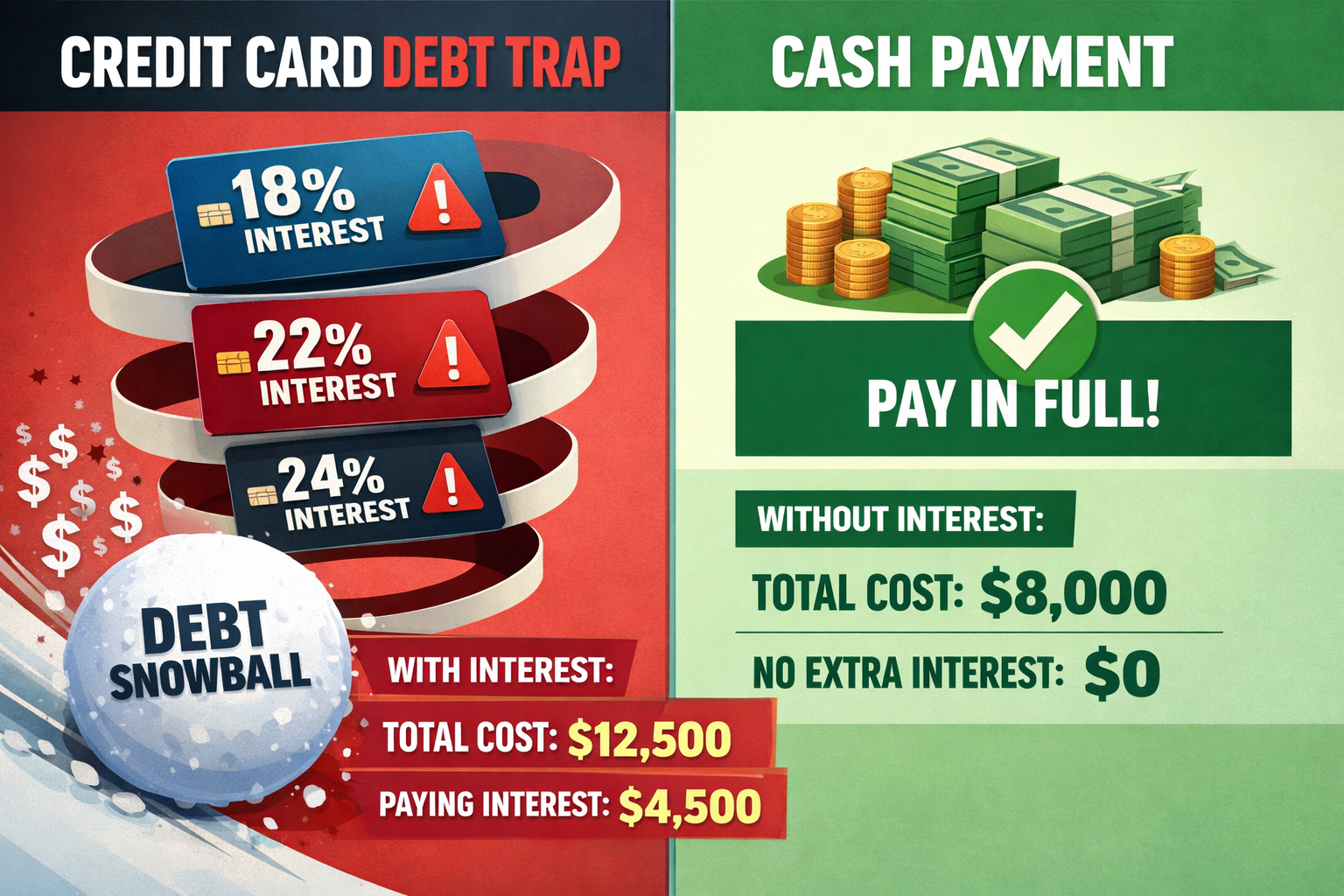
Saving money before vacation requires opening a dedicated savings account, calculating your total trip cost, dividing it by the number of months until departure, and automatically transferring that amount on payday while cutting discretionary spending in 2-3 categories.
The vacation savings formula:
(Total trip cost + 20% buffer) ÷ Months until trip = Monthly savings needed
For example: ($2,000 + $400) ÷ 6 months = $400/month
If $400 per month feels impossible, you have three options: extend your timeline, reduce trip costs, or increase income temporarily.
Practical pre-vacation saving strategies:
Automate the savings
- Set up automatic transfers on payday to a separate vacation account
- Treat it like a non-negotiable bill
- Use a high-yield savings account to earn interest while saving
Cut temporary expenses
- Pause subscription services you can live without for a few months
- Reduce dining out by half and redirect that money to vacation savings
- Skip one regular expense category (coffee shops, entertainment, shopping)
Increase income temporarily
- Take on overtime if available
- Sell items you no longer need
- Do freelance or gig work specifically for vacation funding
Use windfalls strategically
- Direct tax refunds entirely to vacation savings
- Put bonuses, gifts, or unexpected money toward the trip
- Use cashback rewards for travel expenses
Book strategically to save
- Use flight comparison tools and set price alerts
- Book Tuesday through Thursday when prices typically dip
- Choose shoulder season dates (just before or after peak season)
- Consider alternative airports within driving distance
Common mistake: Saving some money but not the full amount, then justifying charging the difference because “I saved most of it.” This still creates debt and interest charges.
What Money Management Strategies Work Best During Your Trip?
The most effective vacation money management strategy is the daily cash envelope system where you withdraw the total budgeted amount for food, activities, and miscellaneous spending, divide it into daily envelopes, and spend only that day’s cash while keeping cards locked away for emergencies only.
This physical cash system creates immediate spending awareness that credit cards can’t match. When you see your daily $100 envelope getting thin, you make different choices than when you’re tapping a card without thinking.
Daily money management steps:
- Before you leave: Calculate your daily spending budget for variable expenses (food, activities, shopping)
- Day one: Withdraw the full amount in local currency for your entire trip
- Divide it up: Put each day’s allocation in separate envelopes labeled by date
- Spend only that day’s cash: If you run out, the day’s spending ends
- Roll over unused amounts: If you have $30 left from Monday, add it to Tuesday’s envelope
- Track in a simple app: Note what you spent each day in a notes app or spreadsheet
For couples or groups traveling together:
- Agree on the total daily budget before the trip
- Decide who manages the cash or split it evenly
- Have a quick daily check-in about spending
- Avoid judgment—focus on staying within the total budget together
When to use credit cards on vacation:
- Booking hotels and rental cars (for deposit holds)
- Emergencies only (medical issues, urgent flight changes)
- Large purchases with strong fraud protection needs
Choose cash if: You tend to overspend with cards, you’re traveling to a destination where cash is preferred, or you want maximum spending awareness. Choose debit if: You want electronic tracking but need spending limits. Avoid credit if: You have a history of vacation overspending or existing credit card debt.
Real example: Mike and Jennifer used the envelope system for their Hawaii trip. They budgeted $120 per day for food and activities. On day three, they found an amazing local food truck and spent $45 on lunch, leaving $75 for dinner and evening activities. Instead of adding a pricey sunset cruise, they chose a free beach sunset and a moderate dinner, staying within their $120. With credit cards, they would have “just charged” the cruise and exceeded their budget by $80.
How Do You Handle Unexpected Expenses Without Going Into Debt?
Handle unexpected vacation expenses by using your pre-planned 15-20% contingency buffer first, cutting planned future expenses from the trip to rebalance, or choosing free alternatives for remaining days rather than charging additional costs to credit cards.
Unexpected expenses fall into two categories: true emergencies (medical issues, urgent flight changes, lost luggage) and opportunity costs (an amazing excursion you didn’t plan for, a special restaurant recommendation). Your response should differ based on the category.
For true emergencies:
- Use your contingency fund immediately—this is exactly what it’s for
- Contact your travel insurance if applicable
- Document everything for potential reimbursement
- Adjust remaining trip spending to rebuild a smaller buffer
For opportunity expenses:
- Apply the “swap, don’t add” rule: if you want to add something, remove something else of equal value
- Sleep on it—wait 24 hours before committing to unplanned expensive activities
- Look for free or low-cost alternatives that provide similar experiences
- Remember that saying no to one thing means saying yes to financial peace
The expense priority framework:
- Health and safety – Always prioritize, use contingency fund
- Necessary logistics – Transportation to airport, essential rebookings
- Pre-planned priority experiences – The activities you specifically came for
- Spontaneous opportunities – Only if budget allows through swaps
- Impulse purchases – Almost always skip these
Common mistake: Treating every unexpected opportunity as a “once in a lifetime” experience that justifies debt. In reality, opportunities exist everywhere, and protecting your financial health is more valuable than any single activity.
What Should You Do If You’re Already in Vacation Debt?
If you’re already carrying vacation debt, immediately stop adding to it, transfer the balance to the lowest interest option available, create a debt payoff timeline using either avalanche or snowball method, and commit to cash-only travel until the debt is completely eliminated.
Vacation debt is particularly painful because unlike a car or home, you have nothing tangible to show for the debt—just memories and interest charges. The emotional weight of paying for a trip that’s already over can be demotivating, but a clear action plan makes it manageable.
Immediate actions (this week):
- Calculate the total damage
- Add up all vacation-related charges across all cards
- Note the interest rate on each
- Calculate monthly interest you’re accruing
- Stop the bleeding
- Commit to no new vacation charges until this debt is paid
- Remove saved payment methods from booking sites
- Unsubscribe from travel deal emails that tempt new bookings
- Choose your payoff strategy
- Avalanche method: Pay minimums on all debts, put extra money toward highest interest rate first (saves most money)
- Snowball method: Pay minimums on all debts, put extra money toward smallest balance first (provides psychological wins)
- Find the money
- Review last month’s spending for cuts
- Redirect any discretionary spending to debt payoff
- Consider a temporary side income source
Debt payoff timeline example:
| Debt Amount | Interest Rate | Monthly Payment | Payoff Time |
|---|---|---|---|
| $2,500 | 18% APR | $150 | 20 months, $480 interest |
| $2,500 | 18% APR | $250 | 12 months, $270 interest |
| $2,500 | 18% APR | $400 | 7 months, $145 interest |
The difference between a $150 and $400 monthly payment is $335 in interest charges—money that could fund your next vacation instead.
Motivation strategies:
- Create a visual tracker showing debt decreasing
- Calculate how much interest you save with each extra payment
- Plan your next trip for after the debt is paid, using savings only
- Join online communities focused on debt payoff for accountability
Avoid these common mistakes:
- Taking another vacation before the debt is paid
- Making only minimum payments while the balance grows
- Opening new credit cards for balance transfers without addressing spending habits
- Hiding the debt from a partner or family member who should know
How Can You Plan Affordable Vacations That Don’t Feel Cheap?

Affordable vacations that feel luxurious focus on experiences over accommodations, prioritize one or two splurges while cutting costs everywhere else, choose destinations where your currency goes further, and travel during shoulder seasons when prices drop but weather remains good.
The secret to satisfying budget travel isn’t deprivation—it’s strategic allocation. Spending $300 on an incredible experience you’ll remember forever while staying in a $60 Airbnb feels better than spending $250 per night on a hotel while skipping activities due to budget constraints.
Strategic splurge framework:
Choose 1-2 categories to splurge on and go budget-friendly on everything else:
- Splurge on experiences + Budget accommodation and food = Adventure-focused trip
- Splurge on accommodation + Budget activities and food = Relaxation-focused trip
- Splurge on food + Budget accommodation and activities = Culinary-focused trip
Affordable destination strategies:
Choose locations where your money stretches:
- Southeast Asia (Thailand, Vietnam, Indonesia)
- Central America (Guatemala, Nicaragua, Costa Rica)
- Eastern Europe (Poland, Hungary, Romania)
- Portugal and Greece (within Europe)
- Mexico and Colombia (in the Americas)
Domestic alternatives to expensive international destinations:
- Instead of Hawaii → Gulf Shores, Alabama or San Diego, California
- Instead of Paris → Montreal or New Orleans
- Instead of Switzerland → Colorado or Montana
- Instead of Caribbean islands → Florida Keys or South Carolina coast
Timing strategies that save 30-50%:
- Travel shoulder season (April-May, September-October for many destinations)
- Book Tuesday-Thursday flights instead of weekend departures
- Choose weekday hotel stays over weekends in business destinations
- Visit beach destinations in early fall instead of summer
- Visit ski destinations in summer for hiking instead of winter skiing
Free and low-cost experiences that feel premium:
- Free walking tours (tip-based) in most major cities
- Hiking and nature activities
- Local markets and street food exploration
- Free museum days (most cities offer these)
- Beach and park access
- Self-guided neighborhood exploration
- Sunset viewing from free vantage points
- Local festivals and cultural events
Real example: Rachel wanted a European vacation but had only $1,800 saved. Instead of forcing Paris or London, she chose Porto, Portugal. She found a beautiful Airbnb for $45/night ($315 for 7 nights), budget flights for $550, spent $400 on amazing Portuguese food and wine, $200 on a Douro Valley wine tour (her splurge), $150 on local transportation, and had $185 left for contingencies. She had an incredible trip without debt, while her friend who insisted on Paris spent $4,000 and charged half of it.
What Role Does Travel Insurance Play in Avoiding Debt?
Travel insurance prevents vacation debt by covering expensive emergencies like medical evacuations, trip cancellations, and lost luggage that would otherwise require thousands in unexpected charges, but only when you purchase comprehensive coverage that matches your trip’s risk level and total cost.
Many travelers skip travel insurance to save $50-150, then face $5,000 in charges when something goes wrong. Others buy inadequate coverage that doesn’t actually protect them when needed. The key is understanding what coverage you need and what you’re actually buying.
When travel insurance is essential:
- International trips (medical coverage especially important)
- Expensive trips over $2,000 per person
- Non-refundable bookings
- Travel during hurricane season or winter weather
- Trips involving adventure activities
- Travel for older adults or those with health conditions
- Cruises (which have specific cancellation policies)
What comprehensive travel insurance should cover:
- Trip cancellation/interruption – Reimburses non-refundable costs if you must cancel for covered reasons
- Medical emergencies – Covers treatment abroad (your health insurance likely doesn’t)
- Emergency evacuation – Pays for medical transport, which can cost $50,000+
- Lost/delayed baggage – Reimburses essential purchases if bags are delayed
- Travel delays – Covers accommodation and meals during covered delays
- 24/7 assistance – Help with emergencies, rebooking, and logistics
What’s typically NOT covered:
- Cancellations due to “changing your mind”
- Pre-existing medical conditions (unless you buy coverage within 14 days of initial trip deposit)
- High-risk activities unless specifically added
- Losses due to alcohol or drug use
- Travel to countries with State Department warnings
Cost expectations:
- Basic coverage: 4-8% of total trip cost
- Comprehensive coverage: 8-12% of total trip cost
- Example: $2,000 trip = $80-240 for insurance
Common mistake: Buying the cheapest insurance without reading what’s covered, then discovering your specific situation isn’t included when you file a claim.
How Do You Resist Social Pressure to Overspend on Group Trips?
Resist social pressure to overspend on group trips by communicating your budget honestly before booking, suggesting affordable alternatives proactively, opting out of specific activities rather than the entire trip, and finding a budget-conscious ally within the group for mutual support.
Group travel creates unique financial pressure because money discussions feel awkward, nobody wants to be “that person” who limits the group’s fun, and there’s often an assumption that everyone has similar financial situations. In reality, honest communication prevents resentment and debt.
Before the trip:
- Have the budget conversation early
- “I’m excited about this trip! I’m working with a budget of $X total. Let’s find options that work for everyone.”
- This gives others permission to share their limits too
- Suggest budget-friendly alternatives
- Instead of saying “that’s too expensive,” propose specific cheaper options
- “Instead of that $200/night hotel, what about this $90 Airbnb that fits more people?”
- Be specific about your limits
- “I’ve budgeted $500 for the trip total, so I need to keep daily spending around $60”
- Specific numbers are harder to pressure than vague “I can’t afford it”
During the trip:
- Opt out of specific activities, not the whole trip
- “You guys go to the spa—I’m going to explore that market we passed. Meet for dinner?”
- This maintains group connection without overspending
- Suggest free group alternatives
- “Instead of the $80 sunset cruise, want to grab drinks and watch sunset from that beach?”
- Often others are relieved someone suggested a cheaper option
- Use the “I’m good” technique
- When the group orders another round: “I’m good with water, thanks”
- When shopping: “I’m just browsing—you guys go ahead”
- Simple, non-defensive, no explanation needed
- Split strategically
- If the group wants to split bills evenly but you ordered much less, politely decline
- “I’ll just pay for my items separately—I only had the salad and water”
Finding your budget ally:
- Usually at least one other person in the group is also budget-conscious
- A quick private conversation can create mutual support
- “Want to grab breakfast at that local cafe instead of the hotel?”
What to say when someone pressures you:
- “I appreciate the invite, but I’m sticking to my budget on this trip”
- “That sounds fun, but it’s not in my plan for today”
- “I’m saving my budget for [priority activity] tomorrow”
Real example: Tom joined a bachelor party in Vegas where the group wanted to book a $300/person VIP club experience. Instead of going into debt or skipping the trip, he said: “That’s not in my budget, but I’ll meet you guys after for late-night food.” He spent $40 on dinner and gambling instead, had a great time, and three other guys quietly thanked him later for giving them permission to skip the club too.
Frequently Asked Questions
How much should I save for a week-long vacation?
For a domestic week-long vacation, budget $1,500-2,500 per person including flights, accommodation, food, and activities. For international trips, budget $2,000-4,000 per person depending on destination. Always add a 15-20% buffer for unexpected expenses. Calculate based on your specific destination’s costs rather than using generic estimates.
Is it ever okay to use a credit card for vacation?
Using credit cards is acceptable only if you pay the full balance immediately when the statement arrives and you’re using the card for rewards or fraud protection rather than financing. Never carry a vacation balance month-to-month. If you can’t pay it off in full within one billing cycle, you can’t afford the trip and should wait until you’ve saved the cash.
What’s the best way to save for a vacation in 6 months?
Calculate your total trip cost, add 20% for contingencies, divide by 6 to get your monthly savings target, then set up automatic transfers to a separate high-yield savings account on each payday. Cut one or two discretionary spending categories temporarily and redirect that money to vacation savings. Book major expenses early to lock in lower prices.
Should I take a vacation if I have credit card debt?
Generally no—focus on eliminating high-interest debt before taking vacations that require new spending. However, a modest local trip using money you’ve specifically saved (not charged) can provide mental health benefits without worsening your financial situation. Never add vacation debt on top of existing debt, as the compounding interest makes both balances harder to eliminate.
How can I afford a vacation on a tight budget?
Choose destinations where your money stretches further (Mexico, Southeast Asia, Eastern Europe), travel during shoulder season for 30-50% savings, stay in budget accommodations like Airbnbs or hostels, eat most meals from markets and local spots instead of tourist restaurants, focus on free activities like hiking and beaches, and give yourself a longer timeline to save smaller amounts.
What percentage of my income should go toward vacation savings?
A sustainable vacation budget is 3-5% of your annual gross income, which allows for one or two modest trips per year without compromising other financial goals. Someone earning $50,000 annually could reasonably budget $1,500-2,500 for annual vacation spending. Adjust based on your other financial priorities like debt payoff, retirement savings, and emergency funds.
How do I track spending while on vacation?
Use a simple notes app or spreadsheet on your phone to record every expense daily, preferably at the end of each day while it’s fresh. Alternatively, use the daily cash envelope system where you physically see what’s left. Take photos of receipts if needed for later review. The key is daily tracking rather than waiting until you return home when you’ve forgotten half of what you spent.
What should I do if my travel companion wants to spend more than I can afford?
Have an honest conversation before booking anything: “I’m working with a budget of $X for this trip. Can we plan around that?” Suggest splitting costs proportionally rather than evenly if income levels differ significantly, opt out of specific expensive activities while joining for budget-friendly ones, and establish that each person pays for their own extras rather than splitting everything.
Are all-inclusive resorts worth it for avoiding debt?
All-inclusive resorts can help control costs if you genuinely stick to what’s included and avoid upcharges for premium dining, spa services, excursions, and specialty activities. However, many travelers end up spending significantly on extras anyway. They work best for people who want to relax at the resort rather than explore the destination, and who have strong willpower to decline upsells.
How far in advance should I book to get the best prices?
For domestic flights, book 1-3 months in advance for best prices. For international flights, book 2-6 months ahead. For hotels, book 1-2 months ahead, though last-minute deals sometimes appear. For vacation rentals, book 2-4 months ahead for popular destinations. Set price alerts on comparison sites to track when prices drop for your specific route.
What’s the biggest mistake people make with vacation budgeting?
The biggest mistake is budgeting only for major expenses (flights and hotels) while treating daily costs like food, transportation, activities, and shopping as afterthoughts. These “small” expenses typically represent 40-50% of total trip costs. People also fail to include a contingency buffer, leading to debt when anything unexpected happens.
Can I take a vacation while building an emergency fund?
Yes, but prioritize getting your emergency fund to at least $1,000 before taking vacations, and never use emergency fund money for vacation expenses. Save for both simultaneously if possible, perhaps allocating 70% to emergency savings and 30% to vacation savings until you hit your emergency fund goal, then shift the ratio. A modest vacation using specifically saved money won’t derail financial progress if you’re strategic.
Key Takeaways
- Budget realistically with all seven categories: transportation, accommodation, food, activities, shopping, insurance, and a 15-20% contingency buffer—most people underestimate total costs by 30-40%
- Save the full amount before you travel rather than charging expenses and hoping to pay them off later, which rarely works and creates expensive interest charges
- Use the daily cash envelope system during your trip to maintain spending awareness and prevent the “invisible money” effect that credit cards create
- Choose destinations that match your actual budget instead of forcing expensive locations that require debt—amazing experiences exist at every price point
- Book major expenses 2-6 months in advance when prices are lowest and you have time to save rather than charging last-minute bookings
- Communicate budget boundaries clearly with travel companions before booking to prevent social pressure and resentment during the trip
- Apply the “swap, don’t add” rule for unexpected opportunities—if you want to add an unplanned activity, remove something else of equal value from your budget
- Invest in comprehensive travel insurance for trips over $2,000 or international travel to prevent medical emergencies and cancellations from creating massive debt
- If you’re already in vacation debt, immediately stop adding to it, choose avalanche or snowball payoff method, and commit to cash-only travel until the debt is eliminated
- Focus on experiences over accommodations by splurging on one or two meaningful activities while choosing budget options for lodging and routine meals
Conclusion
Avoiding vacation debt traps comes down to one fundamental principle: only take vacations you can afford to pay for in cash, and plan far enough ahead to save that cash without financial stress. The memories from debt-free travel are infinitely sweeter than those shadowed by months of interest charges and financial regret.
The strategies mentioned—realistic budgeting across all expense categories, advance booking to secure lower prices, daily cash management during trips, strategic destination selection, and honest communication about financial boundaries—work together to create a sustainable approach to travel that enhances life rather than creating financial burden.
Your next steps:
- This week: If you have existing vacation debt, calculate the total, choose your payoff method, and make your first accelerated payment
- This month: Open a dedicated vacation savings account and set up automatic transfers based on your next planned trip
- Before your next trip: Create a complete budget using the seven categories, add a 20% buffer, and commit to the daily cash envelope system
- Long-term: Establish a sustainable vacation budget of 3-5% of annual income to enjoy regular travel without compromising other financial goals
Remember Ava from the beginning of this article? She exists in two versions. In one, she returns from vacation to $4,500 in debt and months of stress. In the other, she plans ahead, saves $2,200 over six months, uses the daily cash system, and returns home with incredible memories and zero debt. The only difference between these versions is the decision to prioritize planning over impulse.
The world is full of amazing destinations waiting to be explored. With smart planning and intentional choices, you can experience them all without the financial hangover that turns dream vacations into debt nightmares. Your future self will thank you for every dollar you save now and every charging decision you avoid later.
Start planning your next debt-free adventure today—because the best trips are the ones you can actually afford.