


Last updated: February 21, 2026
Key Takeaways
- Burnout recovery begins in your physical environment, and transforming your home into a restorative space can significantly reduce stress and exhaustion
- Creating dedicated zones for rest, work, and rejuvenation helps establish boundaries that protect your mental and physical energy
- Simple changes like decluttering, adjusting lighting, and adding natural elements can trigger your body’s relaxation response
- Healing burnout from the inside out requires both internal mindset shifts and external environmental changes that support recovery
- Sustainable recovery happens when your home actively supports rest rather than adding to your stress load
Quick Answer
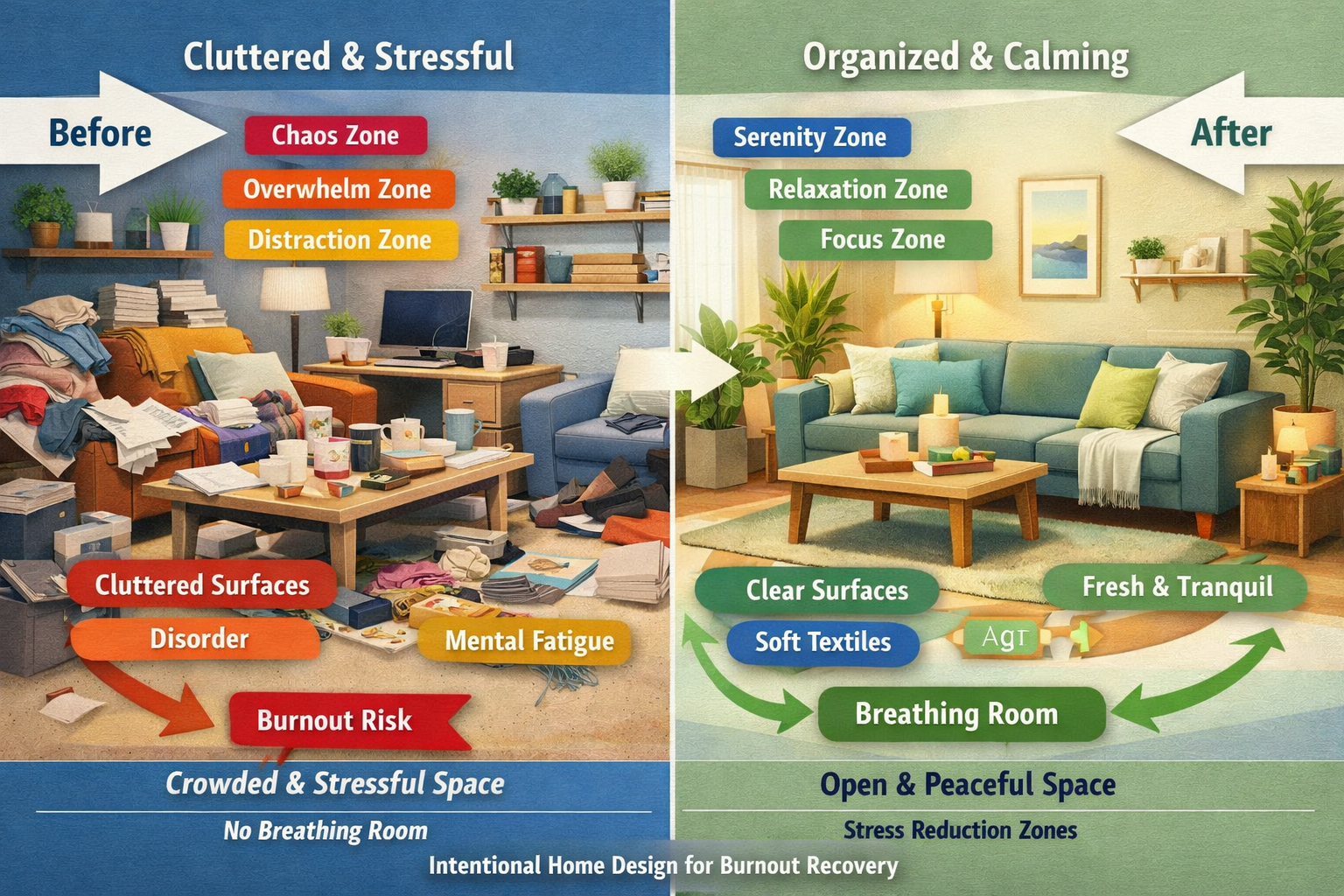
Healing burnout from the inside out starting at home means transforming your living space into a recovery sanctuary while simultaneously addressing the internal patterns that led to exhaustion. This approach combines environmental changes (decluttering, creating rest zones, adjusting sensory inputs) with intentional practices (setting boundaries, establishing routines, prioritizing rest) that your home environment supports. Recovery starts where you spend most of your time, and your home should actively reduce stress rather than contribute to it.
Picture coming home after a draining day and actually feeling your shoulders drop, your breathing slow, and your mind quiet. That’s not a fantasy reserved for expensive retreats or vacation homes. Healing burnout from the inside out starting at home is about creating that experience in your everyday space, right now, with what you already have.
Burnout doesn’t announce itself with a single catastrophic moment. It creeps in through months of ignored exhaustion, blurred boundaries, and spaces that never let you truly rest. By 2026, more people are recognizing that recovery isn’t just about taking a vacation or getting more sleep—it’s about fundamentally changing the environments and patterns that drain energy in the first place.
Your home plays a bigger role in burnout than most people realize. If your living space feels chaotic, cluttered, or indistinguishable from your workplace, it’s actively working against your recovery. The good news? Small, intentional changes to your home environment can create powerful shifts in how your nervous system responds to stress.
What Does Healing Burnout from the Inside Out Actually Mean?
Healing burnout from the inside out means addressing both the internal state (your thoughts, beliefs, and nervous system responses) and the external environment (your physical space and daily routines) simultaneously. Neither approach works well in isolation.
The “inside” component includes recognizing your limits, challenging perfectionism, processing emotions, and retraining your stress response. The “outside” component involves creating physical spaces and structures that support those internal shifts rather than undermine them.
When your home environment contradicts your recovery goals, you’re fighting an uphill battle. If you’re trying to rest but your bedroom doubles as an office with work notifications pinging all evening, your space is sabotaging your intentions. True recovery happens when your environment and your internal state work together.
Why Starting at Home Makes Sense
Your home is the one environment you have the most control over. Unlike your workplace, commute, or social obligations, you can make immediate changes to your living space without needing permission or navigating office politics.
Choose to start at home if:
- You spend significant time in your living space (remote workers, parents, anyone with flexible schedules)
- You notice your stress levels don’t drop even when you’re “off the clock”
- Your home feels more like a storage unit or office extension than a sanctuary
- You have the authority to make changes to your space (owned home or flexible rental situation)
Consider additional support if:
- Your burnout includes severe symptoms like chronic insomnia, panic attacks, or physical health issues (medical guidance is important)
- Your living situation is temporary or highly restrictive (focus on portable changes)
- Financial constraints limit physical changes (emphasize free or low-cost environmental shifts)
How Do You Know If Your Home Is Contributing to Burnout?
Your home contributes to burnout when it fails to provide genuine rest, constantly reminds you of unfinished tasks, or lacks clear boundaries between work and recovery time.
Common signs your space is working against you:
- You can see work materials, unfinished projects, or to-do lists from your relaxation areas
- Clutter creates a constant low-level sense of things being “undone”
- Lighting is harsh, artificial, or doesn’t adjust for different times of day
- Noise levels prevent deep rest (traffic, neighbors, appliances, notifications)
- Every room serves multiple conflicting purposes with no dedicated rest zone
- Your bedroom has become an office, gym, dining room, and entertainment center
- You feel more tense at home than you do in other environments
A simple test: sit in your main living area for five minutes without distractions. Notice your body’s response. Does your breathing deepen? Do your muscles relax? Or do you immediately notice things that need fixing, cleaning, or organizing? Your nervous system’s reaction tells you whether your space supports rest.
The Sensory Overload Factor
Burnout makes you more sensitive to sensory input. What once felt like background noise—humming appliances, bright overhead lights, visual clutter—can become genuinely overwhelming when your nervous system is depleted.
Your home might be contributing to sensory overload if you notice:
- Difficulty concentrating even during downtime
- Irritability that seems disproportionate to minor annoyances
- Preference for being in dark, quiet spaces
- Physical tension that doesn’t release even when lying down
Common mistake: Trying to power through sensory overwhelm instead of reducing the inputs. When recovering from burnout, your tolerance for stimulation is legitimately lower. Adjusting your environment isn’t weakness—it’s strategic recovery.
What Are the First Steps for Healing Burnout from the Inside Out at Home?
Start by creating one genuinely restful space before trying to overhaul your entire home. Choose the area where you spend the most recovery time—usually the bedroom or a favorite sitting area.
Step 1: Establish a work-free zone
Remove all work materials, devices with work apps, and visual reminders of professional obligations from this space. If you work from home and space is limited, use a room divider, curtain, or even a decorative screen to create visual separation.
Step 2: Reduce visual clutter
Clear surfaces of everything except 1-3 intentional items. Put away papers, random objects, and anything that creates a sense of “I should deal with that.” Use closed storage (baskets, boxes, drawers) for items that need to stay in the room.
Step 3: Adjust the lighting
Replace harsh overhead lights with softer options: table lamps, floor lamps, or string lights. Add dimmer switches if possible. Use warm-toned bulbs (2700-3000K) rather than cool white. Natural light during the day, dim warm light in the evening.
Step 4: Control the soundscape
Identify and minimize controllable noise sources. Use white noise machines, fans, or apps to mask unavoidable sounds. Create a “quiet hours” routine where you minimize your own noise contributions (TV volume, music, appliance use).
Step 5: Add something living
Bring in at least one plant (even a low-maintenance pothos or snake plant). The presence of living things has measurable effects on stress reduction and air quality.
Step 6: Designate a transition ritual
Create a simple routine that signals “work is over, rest begins.” This might be changing clothes, lighting a candle, making tea, or sitting in your rest space for three intentional breaths.
Quick Win: The Five-Minute Reset
When you’re too exhausted for major changes, use this rapid reset for any room:
- Set a timer for five minutes
- Remove everything that doesn’t belong in this room (use a basket to collect items)
- Put away or hide anything work-related
- Adjust lighting to softer settings
- Open a window for fresh air or adjust temperature
This creates immediate sensory relief without requiring decision-making energy.
How Does Decluttering Support Healing Burnout from the Inside Out?
Decluttering reduces the cognitive load your brain carries every time you look at your space. Each visible item represents a micro-decision or reminder, and when you’re burned out, your decision-making capacity is already depleted.
Visual clutter triggers the same stress response as an overflowing inbox. Your brain unconsciously processes every visible object, categorizing it as something that might need attention. In burnout recovery, you need your home to quiet that mental chatter rather than amplify it.
Decluttering for burnout recovery is different from organizing:
- Standard organizing: Make everything accessible and efficiently stored
- Burnout recovery decluttering: Reduce the total number of visible items and decisions
Focus on these high-impact areas first:
Bedroom surfaces: Nightstands, dressers, and any surface visible from bed should have minimal items. Charge phones outside the bedroom or face-down in a drawer.
Entryway: Create a landing zone for keys, bags, and shoes so you’re not greeted by chaos when entering your rest space.
Bathroom counters: Keep only daily-use items visible. Store everything else in drawers or cabinets.
Living area sightlines: From your main sitting position, remove visual clutter from your direct line of sight.
What to Do With Sentimental Clutter
Burnout often comes with guilt about not being “enough,” which extends to feeling guilty about letting go of items with emotional attachments. Permission granted: you can honor memories without keeping every physical object.
Choose to keep sentimental items if:
- They genuinely bring joy when you see them (not guilt or obligation)
- You have a specific, intentional place to display or store them
- They support your current life rather than anchoring you to the past
Consider letting go if:
- You feel obligation rather than genuine warmth
- They remind you of expectations you’re trying to release
- They take up space needed for current recovery
Take photos of items before releasing them. The memory is preserved without the physical burden.
How Do You Create Boundaries Between Work and Rest at Home?
Physical boundaries help your brain and body recognize when it’s time to shift from productive mode to recovery mode. Without clear separation, your nervous system stays in a low-level alert state even during supposed downtime.
Spatial boundaries are the most effective for burnout recovery:
Dedicated work zone: If possible, work in a specific area that you can physically leave. Close a door, turn off a light, or cover your workspace with a cloth at the end of the work day.
Visual cues: Use different lighting, seating, or even a specific cushion that only appears during work hours. Your brain will learn to associate these cues with different states.
Temporal boundaries: Establish specific times when work materials are completely off-limits. Create a ritual that marks the transition (closing the laptop, putting work items in a drawer, changing locations).
The Remote Work Challenge
For remote workers, the lack of commute eliminates the natural transition between work and home. Your brain never gets the signal that the workday has ended.
Create an artificial commute:
- Take a 10-minute walk around the block before starting work and after finishing
- Change clothes between work and personal time (even if it’s just swapping one comfortable outfit for another)
- Use different rooms or corners for work versus rest
- Play a specific song or podcast that signals the transition
Common mistake: Thinking you’re “saving time” by skipping transition rituals. The mental cost of never fully disengaging from work mode far outweighs the five minutes spent on a boundary ritual.
What Role Does Your Bedroom Play in Healing Burnout?
Your bedroom should be the most protected space in your burnout recovery plan. Sleep quality directly impacts your ability to recover from chronic stress, and your bedroom environment significantly affects sleep.
Non-negotiable bedroom boundaries for burnout recovery:
No work materials: Zero tolerance for laptops, work documents, or professional tasks in the bedroom. If space is extremely limited, use a folding screen or curtain to completely hide work areas from view when in bed.
Limited screens: Remove TVs if possible. Keep phones charging outside the bedroom or in a drawer. If you use your phone as an alarm, switch to a dedicated alarm clock.
Temperature control: Keep the room cool (60-67°F is optimal for most people). Use fans, adjust heating, or change bedding weight to achieve comfortable coolness.
Darkness: Use blackout curtains, eye masks, or cover small light sources (chargers, electronics). Even small amounts of light can disrupt sleep quality.
Comfortable bedding: Invest in the best sheets, pillows, and mattress topper you can afford. When recovering from burnout, physical comfort during rest is not a luxury—it’s medicine.
The Bedroom as Sanctuary Concept
Beyond sleep, your bedroom can serve as a refuge during particularly difficult days. Consider adding:
- A comfortable sitting area (chair, floor cushion, or reading nook) separate from the bed
- Soft textures (throw blankets, plush rugs, velvet cushions)
- Calming scents (lavender sachets, essential oil diffuser, unscented candles)
- A small collection of genuinely comforting items (favorite books, journal, soft lighting)
Choose to create a bedroom sanctuary if:
- You need a space to retreat when overwhelmed
- You live with others and need a private recovery zone
- You experience anxiety or sensory overload regularly
How Can You Use Lighting to Support Burnout Recovery?
Lighting affects your circadian rhythm, mood, energy levels, and nervous system activation. Harsh overhead lighting keeps your body in alert mode, while softer, warmer lighting signals safety and rest.
Morning and daytime: Maximize natural light exposure, especially in the first hour after waking. Open curtains, sit near windows, or take your morning beverage outside. Bright light in the morning helps regulate your sleep-wake cycle.
Evening transition (2-3 hours before bed): Begin dimming lights throughout your home. Switch to lamps instead of overhead fixtures. Use warm-toned bulbs (2700K or lower).
Night: Keep only minimal, very dim lighting. Use motion-sensor night lights for bathrooms and hallways. Avoid bright lights if you wake during the night.
Practical Lighting Changes
| Time of Day | Lighting Goal | Practical Changes |
|---|---|---|
| Morning | Bright, energizing | Open all curtains, use cool-toned lights if needed, spend time near windows |
| Midday | Natural, balanced | Rely on natural light when possible, use task lighting for work |
| Late afternoon | Begin softening | Switch to lamps, reduce overhead lighting, add warm tones |
| Evening | Dim, warm | Only lamps and indirect lighting, use 2700K bulbs, consider salt lamps or candles |
| Night | Minimal, red-toned | Night lights only, use red bulbs if light is needed, blackout sleeping area |
Budget-friendly options:
- Replace just 2-3 bulbs in your most-used evening spaces with warm-toned versions
- Use lamps you already own instead of overhead lights
- Hang sheer curtains to soften natural light without blocking it
- Use candles (safely) or battery-operated flameless candles for evening ambiance
What Natural Elements Help With Healing Burnout from the Inside Out at Home?
Incorporating natural elements—plants, natural materials, fresh air, and nature sounds—helps regulate your nervous system and creates a sense of connection beyond the walls of your home.
Plants for burnout recovery:
Plants improve air quality, add visual softness, and provide a living element that changes and grows. For burnout recovery, choose low-maintenance varieties that won’t add to your stress:
- Pothos: Tolerates neglect, grows in low light, hard to kill
- Snake plant: Needs minimal water, thrives on neglect, improves air quality
- Spider plant: Forgiving, produces offshoots, adapts to various conditions
- ZZ plant: Extremely drought-tolerant, glossy attractive leaves
- Philodendron: Easy care, trailing or climbing varieties available
Start with just one or two plants. Place them where you’ll see them during rest time—near your favorite chair, on a bedroom dresser, or in your bathroom.
Natural materials:
Replace synthetic materials with natural alternatives where possible:
- Cotton, linen, or wool textiles instead of polyester
- Wood, bamboo, or stone surfaces instead of plastic
- Natural fiber rugs (jute, wool, cotton) instead of synthetic carpeting
- Ceramic, glass, or wood containers instead of plastic storage
These changes create subtle sensory differences that feel more grounding and less stimulating.
Fresh air circulation:
Stale air contributes to that trapped, stagnant feeling that amplifies burnout. Open windows for at least 10 minutes daily, even in cold weather. Use fans to create gentle air movement. Consider an air purifier if outdoor air quality is poor.
Nature sounds:
When silence feels too empty but music or TV is too stimulating, nature sounds provide a middle ground. Use apps or devices to play gentle rain, ocean waves, forest sounds, or birdsong. These sounds can mask disruptive noise while supporting relaxation.
How Do You Maintain a Burnout-Healing Home Without Adding More Tasks?
The goal is to reduce burden, not create new obligations. Maintenance systems for a healing home should be minimal, automatic, and forgiving.
The “good enough” standard:
Perfectionism often contributes to burnout in the first place. Your home doesn’t need to be Instagram-worthy or spotless. It needs to be restful. Embrace “good enough” as your new standard:
- Surfaces mostly clear, not perfectly styled
- Dishes done within 24 hours, not immediately after every meal
- Floors clean enough to walk barefoot comfortably, not spotless
- Laundry done before you run out of essentials, not always put away immediately
Five-minute daily reset:
Instead of marathon cleaning sessions, do a quick five-minute reset each evening:
- Return items to their rooms (use a basket to collect)
- Clear kitchen counters and sink
- Fluff couch cushions and fold throw blankets
- Quick sweep of main walking paths if needed
- Dim the lights and adjust temperature for evening
This prevents buildup without requiring significant energy.
Weekly minimal maintenance:
Choose one day for slightly deeper tasks:
- Change bed sheets
- Wipe down bathroom surfaces
- Vacuum or sweep main areas
- Take out trash and recycling
- Water plants
Set a timer for 30-45 minutes and stop when it goes off, even if everything isn’t perfect.
When Maintenance Feels Impossible
During acute burnout phases, even minimal maintenance can feel overwhelming. Give yourself permission to:
- Use paper plates and disposable utensils temporarily
- Hire help if financially possible (even once a month makes a difference)
- Ask friends or family for specific support (“Can you help me declutter my bedroom this Saturday?”)
- Focus only on the absolute essentials: clean clothes, clean dishes, clear sleeping space
- Let everything else wait until you have more capacity
Common mistake: Feeling guilty about lowering standards during recovery. Your current capacity is what it is. Working within it rather than fighting it is the faster path to recovery.
How Do Routines and Rituals Support Healing Burnout from the Inside Out?

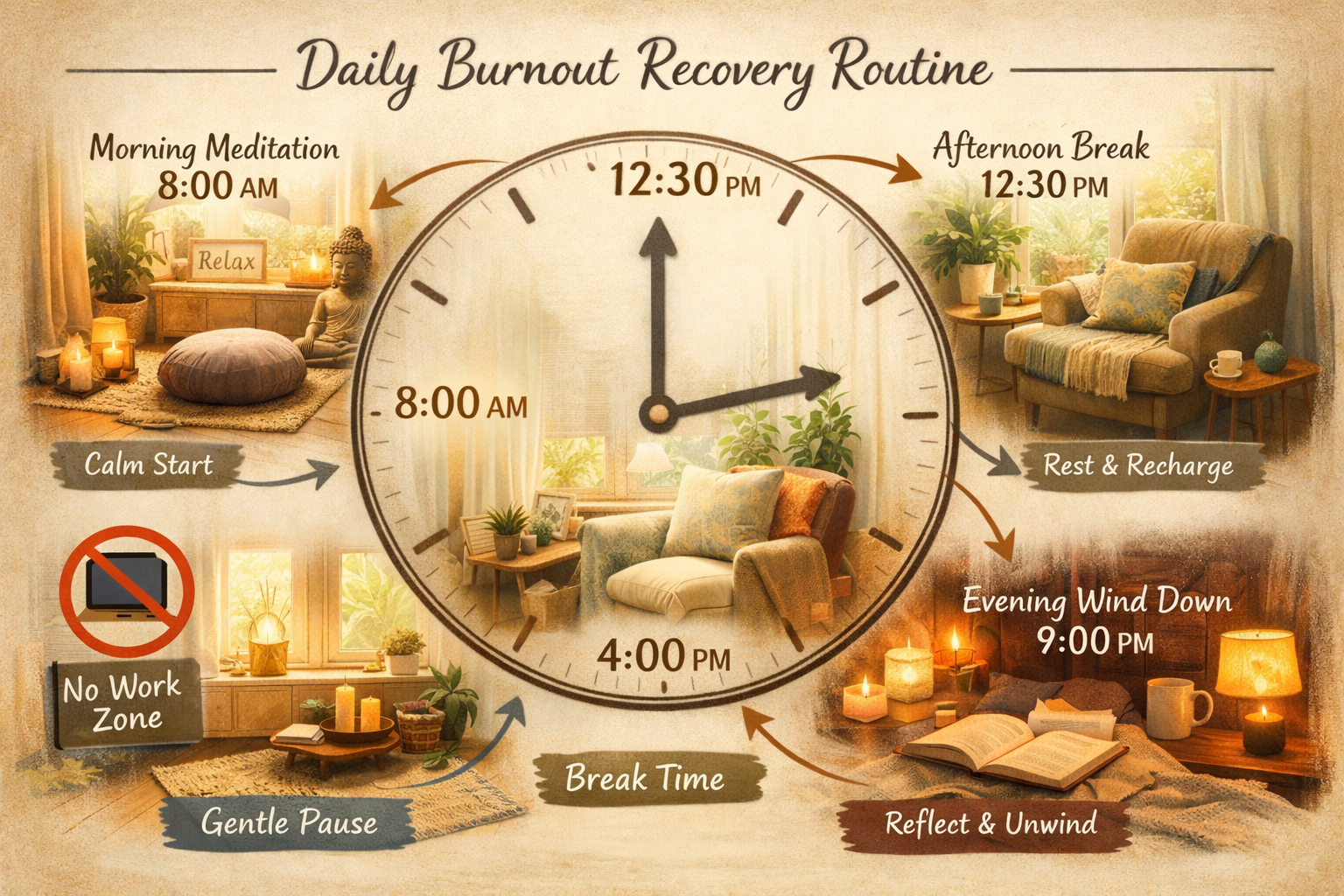
Routines reduce decision fatigue and create predictable patterns that help regulate your nervous system. Rituals add meaning and intentionality to transitions, signaling to your body and mind that it’s time to shift states.
Morning routine for burnout recovery:
Keep it simple and focused on gentle activation rather than productivity:
- Wake without an alarm if possible (or use a sunrise alarm clock)
- Avoid checking phone or email for the first 30-60 minutes
- Drink water before coffee or tea
- Spend 5-10 minutes near natural light
- Eat something nourishing without multitasking
- Move gently (stretch, walk, yoga) for 10-15 minutes
Evening wind-down routine:
Create a consistent sequence that signals rest:
- Set a specific “work ends” time and stick to it
- Change clothes (even if just to different comfortable clothes)
- Dim lights throughout the home
- Prepare something comforting (tea, light snack, warm beverage)
- Engage in a calming activity (reading, gentle music, bath, journaling)
- Complete a simple hygiene routine
- Spend 5 minutes in your bedroom with minimal light before sleep
Weekend reset ritual:
Use one weekend morning to intentionally reset your space:
- Open all windows for fresh air
- Change bed linens
- Do a quick declutter of surfaces
- Water plants and tend to any living things
- Light a candle or use essential oils
- Prepare a nourishing meal
- Spend time in your most restful space doing nothing productive
The Power of Transition Rituals
Transitions between activities are when burnout often intensifies—you’re neither fully engaged nor fully resting. Intentional rituals create clarity:
Work to rest transition:
- Close laptop and put it in a drawer or different room
- Wash hands and face with cool water
- Change into comfortable clothes
- Take three deep breaths in your rest space
- Light a candle or turn on a specific lamp
Weekend to weekday transition:
- Sunday evening preparation: lay out clothes, prep lunch, tidy main areas
- Create a calming Sunday night routine (bath, early bedtime, gentle activity)
- Avoid work thoughts or planning on Sunday evening
- Set intentions for the week that include rest, not just productivity
What Common Mistakes Do People Make When Trying to Heal Burnout at Home?
Mistake 1: Trying to change everything at once
Burnout depletes your energy and decision-making capacity. Attempting a complete home overhaul adds stress rather than reducing it.
Better approach: Choose one room or one category (lighting, decluttering, or boundaries) and focus there for 2-4 weeks before adding more changes.
Mistake 2: Buying solutions instead of simplifying
The wellness industry markets endless products for relaxation and recovery. Buying things creates clutter, decision fatigue, and often financial stress.
Better approach: Start with free or minimal-cost changes (decluttering, rearranging furniture, adjusting lighting, creating boundaries). Only add purchases after you’ve identified specific, genuine needs.
Mistake 3: Maintaining the same productivity standards
Expecting yourself to keep your home as organized and maintained as you did before burnout sets you up for failure and guilt.
Better approach: Explicitly lower your standards during recovery. “Good enough” is excellent when you’re healing.
Mistake 4: Ignoring sensory overwhelm
Pushing through sensory discomfort (bright lights, noise, clutter, temperature extremes) because “it shouldn’t bother me” delays recovery.
Better approach: Honor your current sensitivity levels. Reduce sensory inputs even if it feels excessive. Your tolerance will increase as you recover.
Mistake 5: Skipping boundaries because they feel inconvenient
Thinking “it’s easier to just check this one email” or “I’ll work from bed just this once” erodes the boundaries that protect your recovery.
Better approach: Treat boundaries as non-negotiable during the acute recovery phase (first 3-6 months). Consistency builds the neural pathways that support lasting change.
Mistake 6: Isolating completely
While rest is essential, complete isolation can deepen burnout and depression. Your home should support connection, not just solitude.
Better approach: Create spaces that accommodate low-energy socializing (comfortable seating for conversations, ambient lighting for small gatherings, simple hospitality like tea and cookies). Invite trusted people into your healing space occasionally.
How Long Does It Take to Feel the Effects of These Changes?
Some changes create immediate relief, while others build cumulative benefits over weeks or months. Your nervous system responds to environmental changes faster than you might expect.
Immediate effects (within days):
- Reduced visual stress from decluttering
- Better sleep from improved bedroom environment
- Lower sensory overwhelm from lighting adjustments
- Clearer mental space from work-rest boundaries
Short-term effects (2-4 weeks):
- Improved sleep quality and duration
- Reduced anxiety when at home
- Better ability to actually rest during downtime
- Increased energy levels
- Fewer stress-related physical symptoms (headaches, tension, digestive issues)
Medium-term effects (1-3 months):
- Nervous system regulation improves
- Capacity for decision-making and focus increases
- Emotional resilience strengthens
- Physical health markers improve (blood pressure, inflammation, immune function)
- Relationships benefit from increased capacity
Long-term effects (3-12 months):
- Sustained energy levels
- Clearer sense of priorities and boundaries
- Reduced risk of burnout recurrence
- Home consistently feels restorative rather than draining
- New patterns become automatic rather than effortful
Choose to seek additional support if:
- You’ve made consistent changes for 4-6 weeks with no improvement
- Symptoms worsen despite environmental changes
- You experience severe depression, anxiety, or physical health issues
- Burnout stems from trauma, chronic illness, or systemic issues beyond environmental factors
Recovery isn’t linear. You’ll have better days and harder days. The trend over time matters more than daily fluctuations.
Frequently Asked Questions
What if I live with other people who don’t understand burnout recovery?
Start with your personal spaces (bedroom, bathroom) where you have more control. Communicate your needs clearly: “I need the bedroom to be work-free to sleep better” is more effective than “I’m burned out and need everything to change.” Invite others to try small changes and notice how they feel. Many people discover they also benefit from dimmer evening lighting or decluttered spaces.
Can you heal burnout without therapy or medical intervention?
Environmental changes and rest support recovery, but severe burnout often benefits from professional guidance. If you experience symptoms like chronic insomnia, panic attacks, severe depression, or physical health problems, medical and mental health support is important. Home environment changes work best alongside, not instead of, professional care when needed.
How much does it cost to create a burnout-healing home?
Most effective changes cost nothing: decluttering, rearranging furniture, adjusting routines, creating boundaries, and using natural light. Budget-friendly additions include a few warm-toned light bulbs (under $20), one or two plants (under $30), and basic organizational containers (under $50). You can create significant change for under $100 total, or even free.
What if my home is too small to create separate work and rest zones?
Use visual and temporal boundaries instead of spatial ones. Cover your work area with a cloth after hours. Use a folding screen or curtain to hide work materials. Designate specific times when work items are completely off-limits. Change your seating position or orientation to signal different modes. Small spaces can still support recovery with creative boundaries.
How do you maintain a healing home with kids or pets?
Focus on your bedroom as your protected sanctuary. Create age-appropriate routines that include quiet time or rest periods. Teach children that certain spaces or times are for calm activities. For pets, establish consistent routines and designated spaces. The goal isn’t perfection—it’s creating pockets of rest within the reality of your household.
Should you tell people you’re recovering from burnout?
Share with people who will support your recovery and respect your boundaries. You might say “I’m prioritizing rest right now” or “I’m making some health changes” without using the word burnout if that feels safer. Set boundaries around visits, calls, and social obligations without needing to justify them extensively.
What’s the difference between burnout and depression?
Burnout typically relates to chronic work or caregiving stress and improves with rest and boundary changes. Depression can occur independently of external stressors and often requires professional treatment. They can coexist. If rest and environmental changes don’t improve your symptoms within 4-6 weeks, or if you experience thoughts of self-harm, seek professional support.
How do you know when you’ve recovered from burnout?
Recovery signs include: waking feeling somewhat rested, having energy for activities you enjoy, being able to concentrate, feeling emotions without being overwhelmed, physical symptoms improving, and being able to work or care for responsibilities without constant depletion. Full recovery often takes 6-12 months, but you’ll notice improvements much sooner.
Can you prevent burnout from happening again?
Environmental changes help prevent recurrence by creating structures that support ongoing rest and boundaries. Long-term prevention also requires addressing the patterns, beliefs, and external demands that contributed to burnout initially. Maintain the boundaries and routines that supported your recovery even after you feel better.
What if you can’t make physical changes to your rental or living situation?
Focus on portable changes: lighting (lamps and bulbs you can take with you), textiles (curtains, rugs, bedding), plants in pots, organizational containers, and routine changes. These create significant impact without permanent modifications. Even temporary housing can support recovery through intentional use of space and time.
How important is minimalism for burnout recovery?
Minimalism is one approach, not a requirement. The goal is reducing visual and cognitive clutter to a level that feels restful to you. Some people need very minimal spaces; others find comfort in more items as long as they’re organized. Your ideal level of “stuff” is whatever allows your nervous system to relax.
Should you work with a professional organizer or interior designer?
Professional help can jumpstart changes if you have the resources and feel too overwhelmed to start alone. Choose professionals who understand that the goal is stress reduction and functionality, not aesthetic perfection. Many people successfully create healing spaces without professional help by making gradual, intentional changes.
Key Takeaways
- Healing burnout from the inside out starting at home combines environmental changes with internal recovery work, creating spaces that actively support rest rather than adding to stress
- Start with one protected space (usually the bedroom) before attempting to change your entire home, focusing on removing work materials, reducing clutter, and adjusting lighting
- Physical boundaries between work and rest zones help your nervous system recognize when it’s safe to shift out of alert mode, even in small spaces
- Decluttering reduces cognitive load by eliminating visual reminders and micro-decisions that drain already depleted mental energy
- Lighting significantly impacts your circadian rhythm and stress response—maximize natural light during the day and switch to warm, dim lighting in the evening
- Natural elements (plants, natural materials, fresh air) help regulate your nervous system and create grounding sensory experiences
- Maintain a healing home with minimal effort by embracing “good enough” standards, using five-minute daily resets, and focusing only on essentials during acute burnout phases
- Routines and rituals reduce decision fatigue and create predictable patterns that signal safety to your body and mind
- Common mistakes include trying to change everything at once, buying solutions instead of simplifying, maintaining pre-burnout productivity standards, and ignoring sensory overwhelm
- Recovery happens in stages: immediate relief from environmental changes, improved sleep and reduced anxiety within weeks, and sustained nervous system regulation over months
Conclusion
Your home should be the place where your nervous system finally gets to rest, not another source of stress or obligation. Healing burnout from the inside out starting at home isn’t about creating a perfect space—it’s about intentionally shaping your environment to support the recovery your body and mind desperately need.
The changes don’t have to be expensive, extensive, or Instagram-worthy. They need to be genuine, consistent, and aligned with what actually helps you rest. Start small. Pick one room, one boundary, or one sensory adjustment. Notice how your body responds. Build from there.
Burnout happened gradually, through months or years of ignored signals and eroded boundaries. Recovery also happens gradually, through consistent small choices that prioritize rest over productivity, boundaries over availability, and genuine restoration over pushing through.
Your home is waiting to support you. The question isn’t whether you have the perfect space or enough resources—it’s whether you’re ready to give yourself permission to rest, to lower your standards, to create boundaries, and to let your environment hold you while you heal.
Next steps to start today:
- Choose one room to focus on this week
- Remove all work materials from that space
- Reduce visual clutter to just essential items
- Adjust lighting to softer, warmer options for evening
- Create one simple transition ritual between work and rest
- Set a boundary around one specific time or space
- Notice how your body feels in the changed environment
- Add one change per week rather than trying to transform everything at once
Recovery is possible. It starts right where you are, in the space you’re in right now, with the energy you have available today. Your home can become your greatest ally in healing burnout from the inside out.