


Last updated: February 21, 2026
Key Takeaways
- Physical boundaries like dedicated workspaces help your brain separate work mode from relaxation time
- Time boundaries including set work hours and digital cutoffs prevent burnout and protect personal time
- Mental boundaries require intentional rituals to transition between professional and personal mindsets
- Communication boundaries with colleagues and family members set clear expectations about availability
- Technology boundaries reduce work creep by limiting notifications and work apps outside designated hours
Quick Answer

Creating work-life boundaries when you work from home requires establishing clear physical, temporal, and mental separations between professional responsibilities and personal life. Remote workers who set dedicated work hours, create distinct workspaces, and develop transition rituals report better work-life balance and reduced burnout compared to those who let work bleed into all hours of the day. The key is treating your home-based job with the same structure you’d have in a traditional office while protecting the relaxation time that makes working from home worthwhile.
Why Creating Work-Life Boundaries When You Work from Home Matters More Than Ever
Remote work has blurred the lines between professional obligations and personal life in ways that office workers never experienced. When your bedroom is twenty steps from your desk and your laptop sits on the kitchen table, work can invade every corner of your home and every hour of your day.
Without clear boundaries, remote workers face a paradox: the flexibility that makes working from home attractive becomes the very thing that destroys work-life balance. Emails at 9 PM feel normal. Weekend work sessions become routine. The mental separation between “at work” and “at home” disappears because you’re always in both places simultaneously.
The cost shows up quickly. Burnout rates among remote workers have climbed as people struggle to “turn off” work mode. The spaces meant for relaxation—your living room, bedroom, even your kitchen—start triggering work stress instead of providing refuge from it.
Creating work-life boundaries when you work from home isn’t about being less productive or less committed to your job. It’s about protecting the mental and physical spaces that allow you to recharge, maintain relationships, and actually enjoy the benefits remote work promises.
What Are Work-Life Boundaries and Why Do They Break Down at Home?
Work-life boundaries are the physical, temporal, and psychological separations that prevent professional responsibilities from consuming personal time and vice versa. These boundaries include when you work, where you work, how you communicate about work, and how you mentally transition between roles.
In traditional office settings, these boundaries exist by default. The commute provides transition time. The office building creates physical separation. Standard business hours establish temporal limits. Your colleagues can’t walk into your bedroom at 8 PM with a question.
Working from home removes all these automatic boundaries. Your workspace is wherever you set your laptop. Your work hours are whenever you feel like checking email. The transition between work and personal life shrinks to closing a laptop lid—or doesn’t happen at all if you leave tabs open “just in case.”
The breakdown happens gradually:
- You check one email during dinner
- You finish a project on Saturday because it’s “easier” when the house is quiet
- You take a work call from your bed because you’re already there
- You skip lunch breaks because the kitchen is right there (but so is your work)
- You work later because there’s no commute to catch
Each small boundary violation makes the next one easier until work and life become completely entangled. The home that should provide relaxation becomes another office, and the flexibility that attracted you to remote work becomes a trap.
How to Create Physical Boundaries in Your Home Workspace
Physical boundaries start with designating a specific area exclusively for work. This doesn’t require a spare room or fancy home office—it requires consistency about where work happens and where it doesn’t.
Choose one location for work and stick to it. This could be a desk in a corner, a specific chair at the dining table, or a converted closet. The key is that when you’re in this space, you’re working, and when you leave it, work stays behind.
Setting Up Your Dedicated Work Zone
If you have a separate room:
- Set up a complete office with a door you can close
- Keep work materials contained to this room
- Establish a rule that family members knock before entering during work hours
- Leave this room at the end of your workday and close the door
If you’re working in a shared space:
- Use a specific desk or table section that’s “yours” during work hours
- Store work materials in a dedicated drawer, basket, or cabinet
- Use a room divider, bookshelf, or even a decorative screen to create visual separation
- Put away all work items at the end of the day so the space transforms back to personal use
If space is extremely limited:
- Designate one chair as your “work chair” and sit nowhere else while working
- Use a laptop stand or monitor that you only set up during work hours
- Create a “work box” that contains everything you need, then put it away when done
- Never work from your bed or primary relaxation spots
Visual Cues That Reinforce Boundaries
Physical boundaries work better when they’re visible. Small changes signal to your brain (and others in your home) when you’re in work mode:
- Lighting changes: Use a desk lamp during work hours, turn it off when done
- Door signs: A simple “Working” sign tells household members you’re unavailable
- Clothing changes: Change out of work clothes even if they’re just “nice loungewear”
- Desk setup: Arrange your workspace differently than personal areas
The goal is creating a mental association between the physical space and work mode. When you enter your work zone, your brain switches on. When you leave it, work thoughts stay behind.
Establishing Time Boundaries That Protect Your Personal Life
Time boundaries mean setting specific work hours and actually stopping when those hours end. This sounds simple but becomes challenging when your office is always accessible and colleagues may work different schedules.
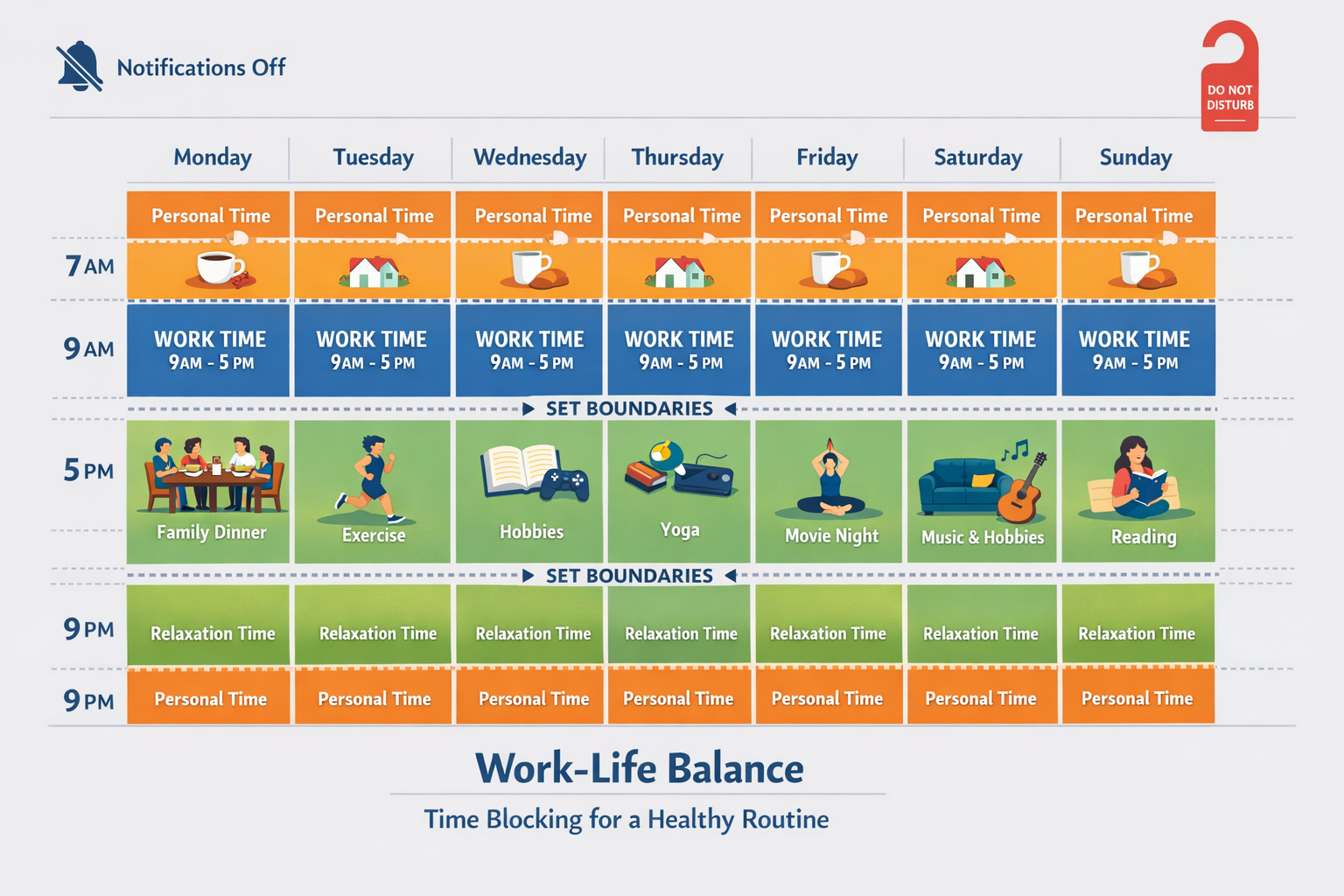
Start by defining your core work hours. Choose a start time and end time that align with your job requirements and personal preferences. Write these hours down. Share them with your team. Treat them as seriously as you would office hours in a traditional workplace.
Creating Your Work Schedule
A clear schedule prevents work from expanding to fill all available time:
Morning start ritual:
- Begin at the same time each day (within 30 minutes)
- Perform a specific action that signals work begins (make coffee, open your laptop, review your calendar)
- Avoid checking work email before your official start time
- Use the first 15 minutes to plan your day, not react to messages
End-of-day shutdown ritual:
- Set a firm end time and stick to it (5:30 PM, 6:00 PM, whatever works)
- Review what you accomplished
- Write tomorrow’s priority list
- Close all work applications and browser tabs
- Physically leave your workspace
- Perform a transition activity (change clothes, take a walk, play with pets)
Choose flexible hours if you need them, but choose them intentionally. Working 7 AM to 3 PM is fine. Working 10 AM to 6 PM is fine. Working whenever you feel like it until burnout hits is not fine.
Handling After-Hours Requests
Time boundaries only work if you enforce them when tested. Colleagues and clients will sometimes contact you outside work hours—your response sets the precedent.
Strategies that work:
- Set email auto-replies for evenings and weekends explaining when you’ll respond
- Turn off work notifications outside your set hours
- Use email scheduling to send messages during business hours even if you write them earlier
- Respond to after-hours messages during your next work session, not immediately
- Have a direct conversation with managers about availability expectations
Exception rule: Decide in advance what constitutes a true emergency worth breaking boundaries for. A server crash affecting customers might qualify. A non-urgent question about next week’s meeting doesn’t.
Building Mental and Emotional Boundaries Between Work and Life
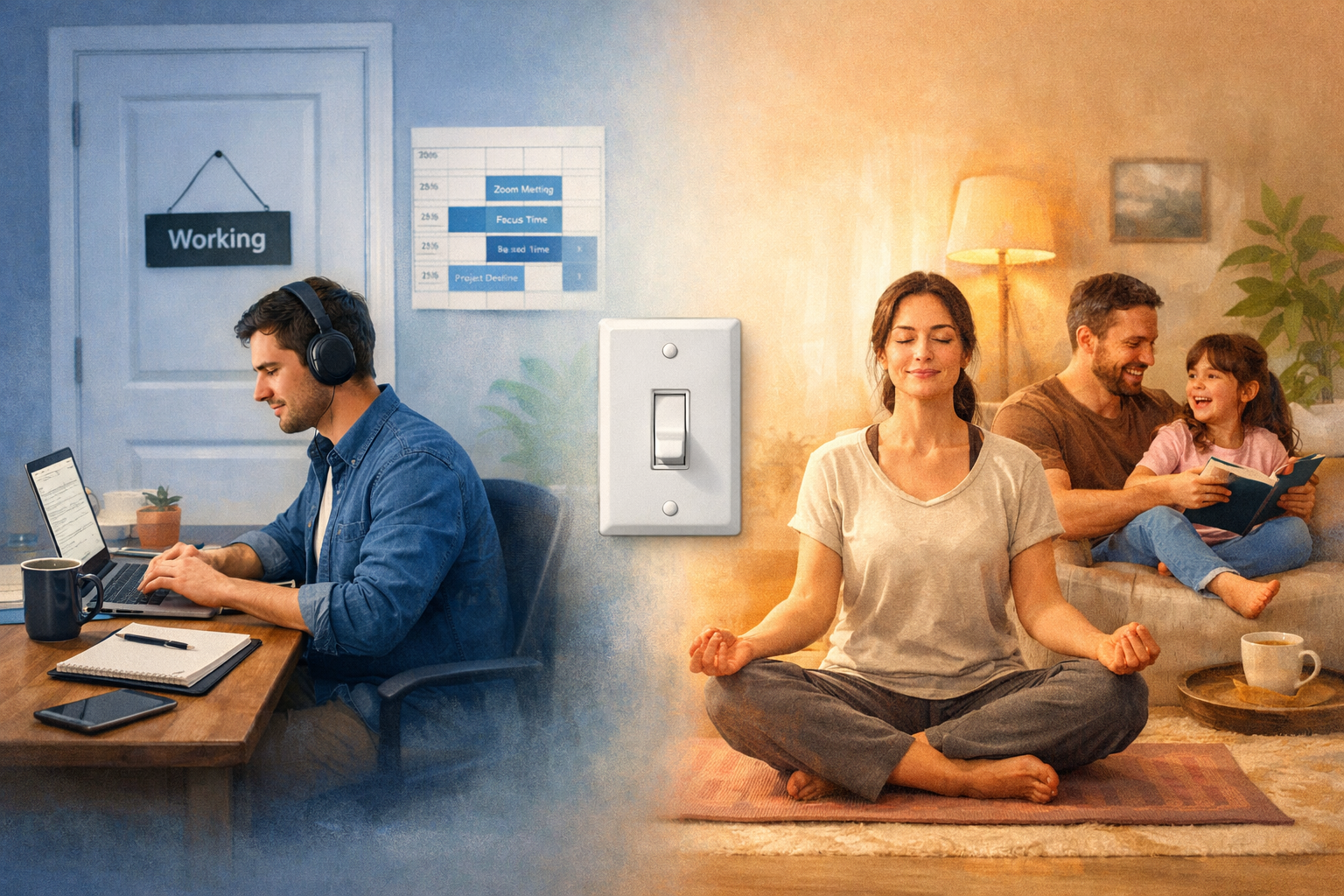
Mental boundaries are the hardest to establish because they happen inside your head. Even when you’ve left your physical workspace and your work hours have ended, work thoughts can follow you.
Creating mental separation requires deliberate transition rituals that help your brain shift from work mode to personal mode. Without a commute or office building exit to mark this transition, you need to create your own.
Transition Rituals That Signal Work Is Over
End-of-workday rituals create a psychological boundary. These don’t need to be elaborate—they just need to be consistent and meaningful to you.
Effective transition activities:
- Take a 10-15 minute walk around your neighborhood (mimics a commute)
- Change from work clothes into comfortable personal clothes
- Do a brief workout or stretching routine
- Play music that you associate with relaxation, not work
- Spend 10 minutes on a hobby (reading, gardening, cooking)
- Have a specific beverage that marks the work-life transition (tea, sparkling water, etc.)
The activity matters less than the consistency. Your brain learns that this ritual means work is done and it’s time to mentally shift gears.
Managing Work Anxiety During Personal Time
Even with good boundaries, work thoughts sometimes intrude on personal time. The difference is how you handle them.
When work thoughts appear during relaxation:
Don’t: Open your laptop “just to check one thing” or “quickly send that email”
Do: Write the thought in a notebook or phone app, then return to it during tomorrow’s work hours
Don’t: Spend your evening mentally rehearsing work conversations or solving work problems
Do: Acknowledge the thought, remind yourself you’ll address it during work hours, and redirect attention to what you’re doing now
Don’t: Feel guilty for not working when you’re off the clock
Do: Remember that rest makes you more effective during work hours
“The boundary isn’t about never thinking about work. It’s about not acting on work thoughts during personal time and not letting work anxiety dominate your mental space when you’re supposed to be recharging.”
Protecting Weekend and Vacation Time
Mental boundaries extend to days off. Remote workers often struggle to fully disconnect because work is always physically accessible.
Weekend boundaries:
- Close work applications on Friday and don’t reopen them until Monday
- Remove work email from your phone or use “focus modes” that hide it
- Plan weekend activities that fully engage your attention
- If you must check something urgent, set a specific 30-minute window rather than checking sporadically all weekend
Vacation boundaries:
- Set up proper out-of-office messages with backup contacts
- Delete work apps from your phone temporarily or use parental controls to block them
- Tell your team explicitly that you won’t be available
- Resist the urge to “just stay on top of things”—you’re defeating the purpose of vacation
Setting Communication Boundaries With Colleagues and Family
Communication boundaries define when and how others can reach you for work purposes, and they protect your personal time from constant interruptions.
With colleagues and managers:
Clear communication about your availability prevents assumptions that lead to boundary violations. Most people will respect boundaries once they know what they are.
Communicating Your Availability
Make your boundaries explicit:
- Add work hours to your email signature (“I work Monday-Friday, 9 AM – 5 PM EST”)
- Set your status in communication tools to reflect availability
- Use calendar blocking to show when you’re unavailable
- Discuss expectations with your manager directly
Sample boundary-setting conversation:
“I want to make sure I’m meeting team needs while maintaining good work-life balance. My core hours are 9 to 5, and I’m fully available then. For urgent issues outside those hours, call my phone. For non-urgent items, I’ll respond the next business day. Does this work with team expectations?”
Managing Different Time Zones
Remote teams often span multiple time zones, which can pressure you to be available at odd hours.
Strategies for time zone challenges:
- Identify a core overlap period when everyone’s available
- Rotate meeting times so the burden doesn’t always fall on one person
- Use asynchronous communication for non-urgent matters
- Record meetings for those who can’t attend live
- Be explicit about which time zone you’re referencing
Choose asynchronous over synchronous communication when possible. Not everything needs a real-time conversation. Detailed emails, recorded video messages, and shared documents let people work during their own hours.
Creating Boundaries With Family and Household Members
Family members need to understand your work boundaries as much as colleagues do. When you work from home, the people you live with might not realize you’re “really working” if they can see you.
Have a direct conversation about your work hours and what you need:
- Explain that you’re working even though you’re home
- Discuss when interruptions are okay and when they’re not
- Establish signals for “available” vs. “busy” (open door vs. closed door, headphones on, etc.)
- Set expectations about household responsibilities during work hours
For parents working from home:
Working from home with kids requires extra boundary creativity:
- Use visual timers so kids can see when you’ll be available
- Create a “work light” system (green = okay to interrupt, red = only emergencies)
- Set up independent activities for kids during important work blocks
- Communicate your meeting schedule so caregivers know when you absolutely can’t be interrupted
- Accept that boundaries will be imperfect and build in flexibility
For partners/roommates:
- Share your calendar so they know your schedule
- Discuss quiet hours for calls and meetings
- Divide household tasks with clear expectations about timing
- Respect each other’s work boundaries equally
Using Technology to Enforce Your Boundaries
Technology created many work-from-home boundary problems, but it can also help solve them. Strategic use of apps, settings, and tools reinforces the boundaries you’ve set.
Digital Boundary Tools
Notification management:
- Turn off work email and Slack notifications outside work hours
- Use “Do Not Disturb” modes on your phone and computer
- Set up separate browser profiles for work and personal use
- Use focus modes that limit which apps can send notifications
Scheduling tools:
- Use email scheduling to send messages during business hours
- Set up calendar blocking for personal time
- Use time-tracking apps to monitor when work hours creep too long
- Set phone alarms for start time, breaks, and end time
App and website blockers:
- Block work-related websites outside work hours
- Use apps like Freedom, Cold Turkey, or built-in screen time limits
- Remove work apps from your phone’s home screen
- Log out of work accounts at the end of the day
Creating Separate Digital Spaces
If possible, maintain separate devices or user accounts:
- Use a work computer and personal computer (or separate user accounts on one device)
- Keep work apps on a separate phone or use work profiles on Android
- Use different browsers for work and personal browsing
- Maintain separate email accounts that you check at different times
If you must use one device for everything:
- Create visual separation through wallpapers, themes, or desktop organization
- Use browser containers or profiles to keep work and personal tabs separate
- Establish a rule: close all work tabs/apps at end of day
- Use bookmarks folders or separate bookmark bars for work vs. personal sites
Common Mistakes When Creating Work-Life Boundaries
Even with good intentions, remote workers often make predictable mistakes that undermine their boundaries.
Mistake 1: Setting Boundaries But Not Enforcing Them
The problem: You establish work hours but regularly work late “just this once.” You create a dedicated workspace but answer emails from the couch. You tell colleagues you’re unavailable after 6 PM but respond to messages at 8 PM.
Why it fails: Boundaries only work when they’re consistent. Each violation teaches others (and yourself) that your boundaries are negotiable.
The fix: Decide which boundaries are non-negotiable and which have flexibility. Enforce the non-negotiables even when it’s uncomfortable. If you say you stop at 5 PM, stop at 5 PM.
Mistake 2: Making Boundaries Too Rigid
The problem: You refuse any flexibility, creating stress when legitimate exceptions arise. You won’t take a 4 PM doctor’s appointment because it’s “work hours,” then resent working from home.
Why it fails: The benefit of remote work is flexibility. Boundaries should protect your wellbeing, not create new sources of stress.
The fix: Build intentional flexibility into your boundaries. It’s fine to run an errand during the day if you make up the time. The key is making conscious choices rather than letting work expand randomly.
Mistake 3: Assuming Others Know Your Boundaries
The problem: You expect colleagues and family members to intuitively understand your work-from-home boundaries without explicitly communicating them.
Why it fails: People can’t respect boundaries they don’t know exist. Your manager might assume you’re available anytime. Your partner might not realize you’re in a focused work block.
The fix: Communicate your boundaries clearly and repeatedly. Put them in writing. Remind people when boundaries are crossed. Most violations come from ignorance, not malice.
Mistake 4: Creating Boundaries That Don’t Fit Your Life
The problem: You copy someone else’s boundary system without considering your own work style, job requirements, or personal circumstances.
Why it fails: A strict 9-to-5 schedule doesn’t work if you’re most productive at night. A dedicated office doesn’t work if you live in a studio apartment.
The fix: Design boundaries that match your reality. If you’re a night owl with flexible deadlines, working 11 AM to 7 PM might be perfect. If you have no spare room, a desk that folds away might be your physical boundary.
Mistake 5: Giving Up After Boundary Violations
The problem: Your boundary gets crossed once or twice, so you decide boundaries don’t work and stop trying.
Why it fails: Boundary-setting is a skill that improves with practice. Early violations are normal and don’t mean the system is broken.
The fix: Treat boundary violations as information. Why did it happen? Do you need to communicate more clearly? Adjust the boundary? Enforce it more consistently? Learn and adapt rather than abandoning the effort.
Adjusting Your Boundaries as Circumstances Change
Work-life boundaries aren’t set-it-and-forget-it. They need adjustment as your job, living situation, and personal life evolve.
When to reassess your boundaries:
- After a job change or role shift
- When household composition changes (new baby, roommate moves in/out, kids start school)
- During busy seasons at work
- When you notice signs of burnout or work-life imbalance
- After moving to a new home
- When your energy levels or health status changes
How to adjust boundaries effectively:
- Identify what’s not working: Are you consistently working too late? Is your workspace causing back pain? Are family interruptions disrupting focus?
- Experiment with one change at a time: Don’t overhaul everything at once. Adjust your end time by 30 minutes or try a new transition ritual.
- Give changes time to work: Test new boundaries for at least two weeks before deciding if they’re effective.
- Communicate changes: Tell colleagues and family when you’re adjusting boundaries so they can adapt too.
- Track what works: Keep notes about which boundaries improve your wellbeing and which don’t make a difference.
Seasonal boundaries:
Some remote workers benefit from different boundaries during different times of year:
- Summer boundaries might include more flexible hours to enjoy daylight
- Winter boundaries might emphasize earlier end times to combat seasonal mood changes
- Busy season boundaries might temporarily extend work hours with built-in recovery time afterward
- Holiday boundaries might include complete disconnection periods
The key is making these adjustments intentionally rather than letting boundaries erode by default.
Creating a Relaxing Home Environment Alongside Work Boundaries
Since your home serves dual purposes as workspace and living space, creating distinct zones for relaxation becomes essential for mental health.
Designate relaxation-only spaces that are completely separate from work:
Even in small homes, you can create psychological separation through intentional design choices.
Relaxation Zone Strategies
Visual separation:
- Use different color schemes in work vs. relaxation areas
- Add plants, art, or decorative items to personal spaces that don’t appear in work zones
- Use lighting that creates different moods (bright task lighting for work, warm ambient lighting for relaxation)
- Arrange furniture to face away from work areas
Sensory boundaries:
- Use specific scents in relaxation areas (candles, diffusers, incense)
- Play different music or sounds in personal spaces
- Keep textures soft and comfortable in relaxation zones (throws, pillows, rugs)
- Maintain cooler temperatures in work areas, warmer in relaxation spaces
Activity-based zones:
- Create a reading nook that’s exclusively for personal reading
- Designate your bedroom as a work-free zone
- Set up a hobby area for activities that have nothing to do with work
- Make your dining table a place for meals only, not work
Technology-free relaxation:
Consider making some relaxation spaces completely technology-free:
- No phones in the bedroom
- No laptops in the living room after work hours
- A specific chair or corner where you never use devices
- Designated times when all screens go off
These tech-free zones help your brain fully disengage from work mode and enter genuine relaxation.
Measuring Whether Your Boundaries Are Working
Good boundaries should improve your wellbeing, productivity, and satisfaction with remote work. Regular check-ins help you assess if your boundary system is effective.
Signs Your Boundaries Are Working
Positive indicators:
- You feel energized at the start of workdays rather than dreaded
- You can fully engage in personal activities without work anxiety
- Your sleep quality is good
- Relationships with family/friends are strong
- You’re productive during work hours
- You rarely think about work during time off
- You enjoy your home as a living space, not just a workplace
Signs Your Boundaries Need Adjustment
Warning signals:
- You regularly work beyond your set hours
- You feel guilty when not working
- You can’t remember the last time you fully disconnected
- Personal relationships are suffering
- You’re exhausted but can’t pinpoint why
- Your home feels like a prison or source of stress
- You fantasize about going back to an office just to escape
Simple boundary health check:
Ask yourself these questions weekly:
- Did I stick to my work hours this week?
- Did I take real breaks and lunch away from my desk?
- Did I fully disconnect during evenings and weekends?
- Do I feel rested or depleted?
- Did I engage in hobbies or activities I enjoy?
- Are my relationships healthy?
If you answer “no” to most questions consistently, your boundaries need strengthening.
Frequently Asked Questions
How do I set boundaries when my boss expects me to be available all the time?
Start with a conversation about expectations. Many managers don’t realize they’re creating unrealistic availability demands. Propose specific hours when you’ll be fully available and explain that focused work time improves your output. If your boss is genuinely unreasonable, this is a job culture problem that might require finding a new position with better work-life balance.
What if I live in a studio apartment and can’t create a separate workspace?
Use a foldable desk, laptop stand, or specific section of your dining table as your designated work spot. The boundary comes from consistency—always working in the same location—and from putting work items completely away when you’re done. Visual cues like a specific lamp or desk mat can signal work mode even in small spaces.
How do I stop feeling guilty when I enforce my boundaries?
Guilt often comes from believing that good employees are always available. Reframe boundaries as professional behavior that prevents burnout and maintains quality work. You’re protecting your long-term ability to contribute, not shirking responsibility. Remember that companies replace burned-out employees quickly, but you can’t replace your health and relationships.
Should I tell my team about my boundaries or just quietly enforce them?
Communicate them clearly. Explicit boundaries prevent misunderstandings and give others a chance to adjust their expectations. Most colleagues will respect boundaries once they know what they are. Quiet enforcement often leads to frustration on both sides.
How long does it take to establish work-from-home boundaries?
Expect 2-4 weeks for new boundaries to feel natural. The first week feels awkward and requires conscious effort. The second and third weeks involve adjusting and handling violations. By week four, boundaries start becoming automatic habits. Stick with them through the uncomfortable adjustment period.
What do I do when family members don’t respect my work boundaries?
Have another direct conversation. Explain specifically how interruptions affect your work and ask what they need to respect your boundaries. Sometimes visual signals help (closed door, headphones, a sign). For persistent issues, consider working from a library or coffee shop occasionally to demonstrate that you need uninterrupted time.
Can I have different boundaries on different days?
Yes, as long as they’re intentional and communicated. You might work 7 AM to 3 PM on Tuesdays and Thursdays for personal commitments, and 9 AM to 5 PM other days. The key is consistency within your stated schedule, not necessarily identical hours every day.
How do I handle urgent work situations that require breaking boundaries?
Define “urgent” in advance. A true emergency (system down, major client crisis, time-sensitive deadline) might warrant boundary flexibility. A colleague’s poor planning or a non-critical question doesn’t. When you do break a boundary for a genuine emergency, make it an exception, not a new pattern.
Should I check work email first thing in the morning?
Not before your official start time. Checking email before you’re “at work” starts your day in reactive mode and often leads to working earlier than intended. Use your morning for personal routines, then check email when your workday officially begins.
What if I actually like working flexible hours and don’t want strict boundaries?
Boundaries don’t have to be rigid to be effective. You can have flexible work hours while still maintaining boundaries around total hours worked, workspace location, and protected personal time. The goal is intentional choice, not strict scheduling. Just make sure your “flexibility” isn’t code for “always working.”
How do I transition back to relaxation mode if I have to work late occasionally?
Use an abbreviated version of your normal transition ritual even when you work late. If you usually take a walk, take a 5-minute walk. If you change clothes, change clothes. The ritual signals to your brain that work is over, even if the timing is different than usual.
What boundaries matter most for preventing burnout?
Time boundaries (especially a firm end time) and mental boundaries (truly disconnecting during off-hours) are most critical for preventing burnout. Physical boundaries help, but you can burn out even with a perfect home office if you never stop working mentally.
Key Takeaways
- Physical workspace boundaries create mental associations that help your brain switch between work and relaxation modes, even in small living spaces
- Consistent work hours with firm start and end times prevent work from expanding to fill all available time and protect personal life
- Transition rituals replace the commute and help your mind shift from professional to personal mode at the end of each workday
- Clear communication about your availability and boundaries prevents misunderstandings with colleagues, managers, and family members
- Technology management through notification controls, app blocking, and separate digital spaces reinforces boundaries when willpower alone isn’t enough
- Enforcement matters more than perfection – boundaries work when you consistently maintain them, not when they’re occasionally perfect
- Relaxation zones in your home that are completely separate from work help you genuinely rest and recharge
- Regular assessment of your boundary system ensures it evolves with changing circumstances and continues serving your wellbeing
- Flexibility within structure allows you to enjoy remote work benefits while maintaining healthy separation between professional and personal life
- Boundaries are professional behavior, not selfishness – they protect your long-term effectiveness and prevent burnout
Conclusion
Creating work-life boundaries when you work from home isn’t about building walls between yourself and your job. It’s about designing a sustainable way to work that protects the mental space, physical health, and personal relationships that make life meaningful.
The remote workers who thrive long-term are those who treat boundaries as essential infrastructure, not optional nice-to-haves. They understand that the laptop closing at 5 PM isn’t laziness—it’s the discipline that prevents burnout six months from now. The dedicated workspace isn’t about having a fancy home office—it’s about protecting their living room as a place for actual living.
Start with one boundary this week. Not five. Not a complete overhaul of your entire routine. Choose the boundary that will make the biggest difference in your daily life:
- Set a firm end time and stick to it for seven days straight
- Designate one room or area as completely work-free
- Turn off work notifications after 6 PM
- Create a 10-minute transition ritual that signals the end of your workday
- Have a direct conversation with your manager about availability expectations
Once that boundary feels natural, add another. Then another. Build your boundary system gradually, adjusting as you learn what works for your specific situation.
The goal isn’t achieving some perfect work-life balance that looks good in Instagram posts. The goal is creating enough separation that you can be fully present in both work and life—focused and productive during work hours, genuinely relaxed and recharged during personal time.
Your home should feel like a sanctuary that happens to contain a workspace, not a workplace that you also happen to live in. Creating work-life boundaries when you work from home makes that possible.