

Last updated: February 21, 2026
Key Takeaways
- Home environments often trigger stress instead of relaxation because they’re filled with work reminders, digital devices, and poor lighting that keeps the brain in alert mode
- The average person checks their phone 96 times per day, making it nearly impossible to mentally disconnect even in personal spaces
- Creating physical boundaries between work and relaxation zones, controlling lighting, and establishing device-free periods can restore home as a sanctuary
- Simple environmental changes like adjusting color temperature, adding texture, and designating specific relaxation areas produce measurable stress reduction
- A structured wind-down routine starting 2-3 hours before bed helps the nervous system shift from active to rest mode
Quick Answer
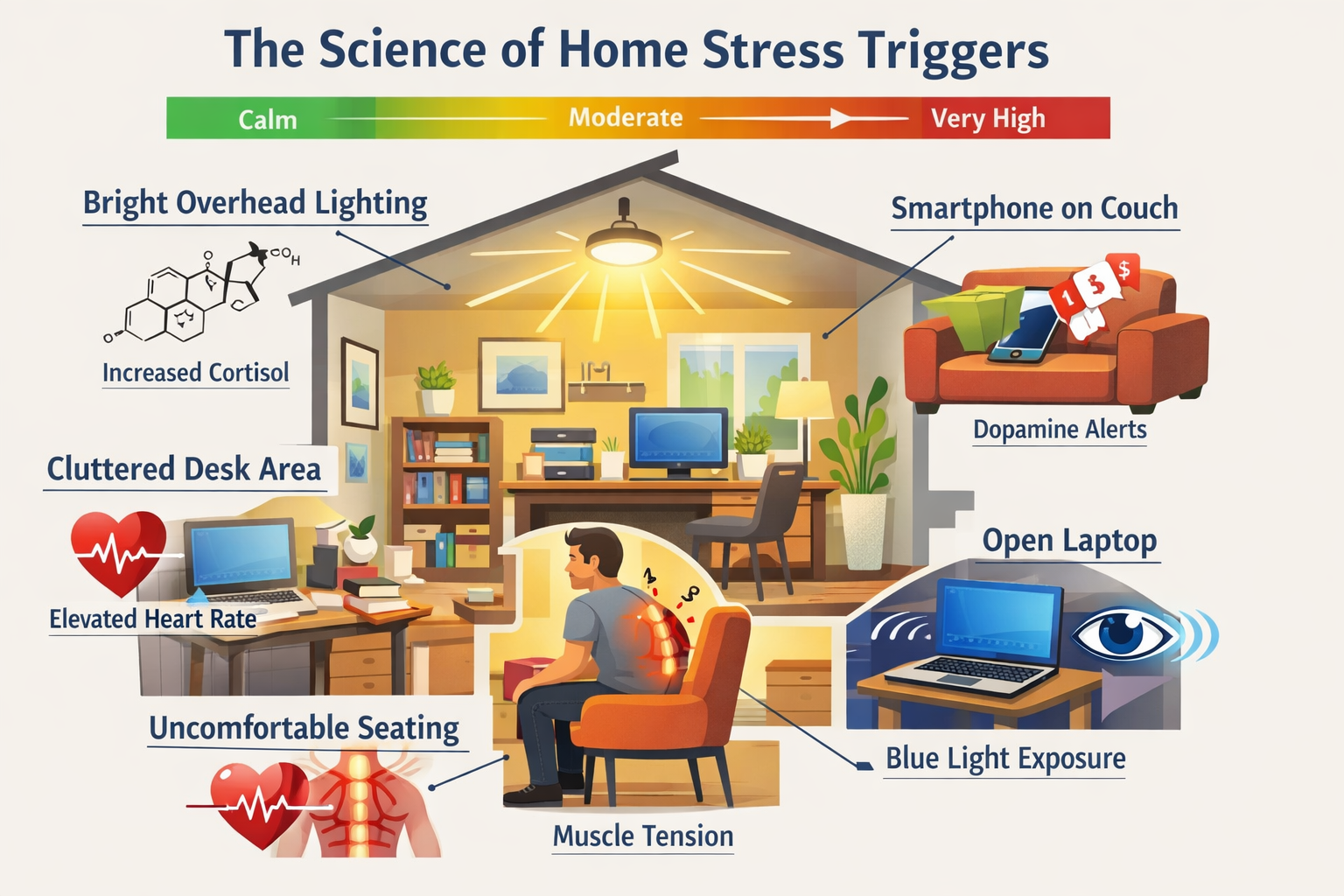
Relaxing at home has become harder because modern homes blur the boundaries between work, entertainment, and rest, keeping the brain in a constant state of low-level alertness. Digital devices, poor lighting, environmental clutter, and the absence of clear physical or temporal boundaries between “on” and “off” modes prevent the nervous system from downshifting into genuine relaxation. The solution involves redesigning both the physical environment and daily routines to create clear signals that tell the brain it’s safe to rest.
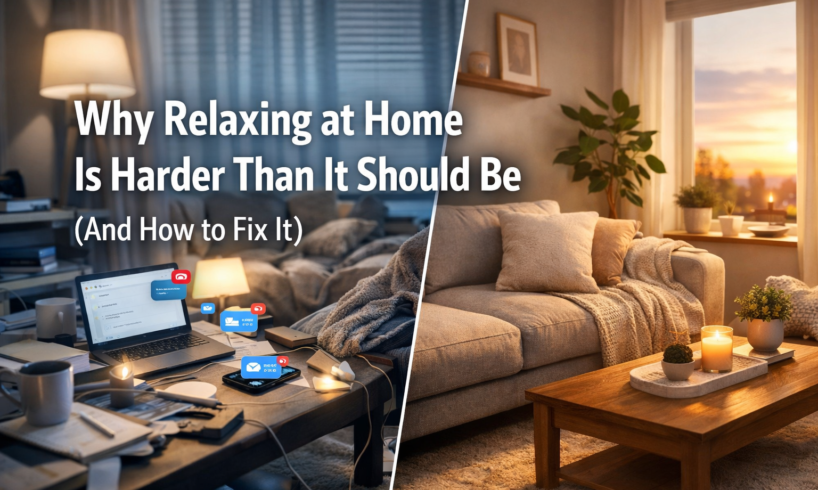
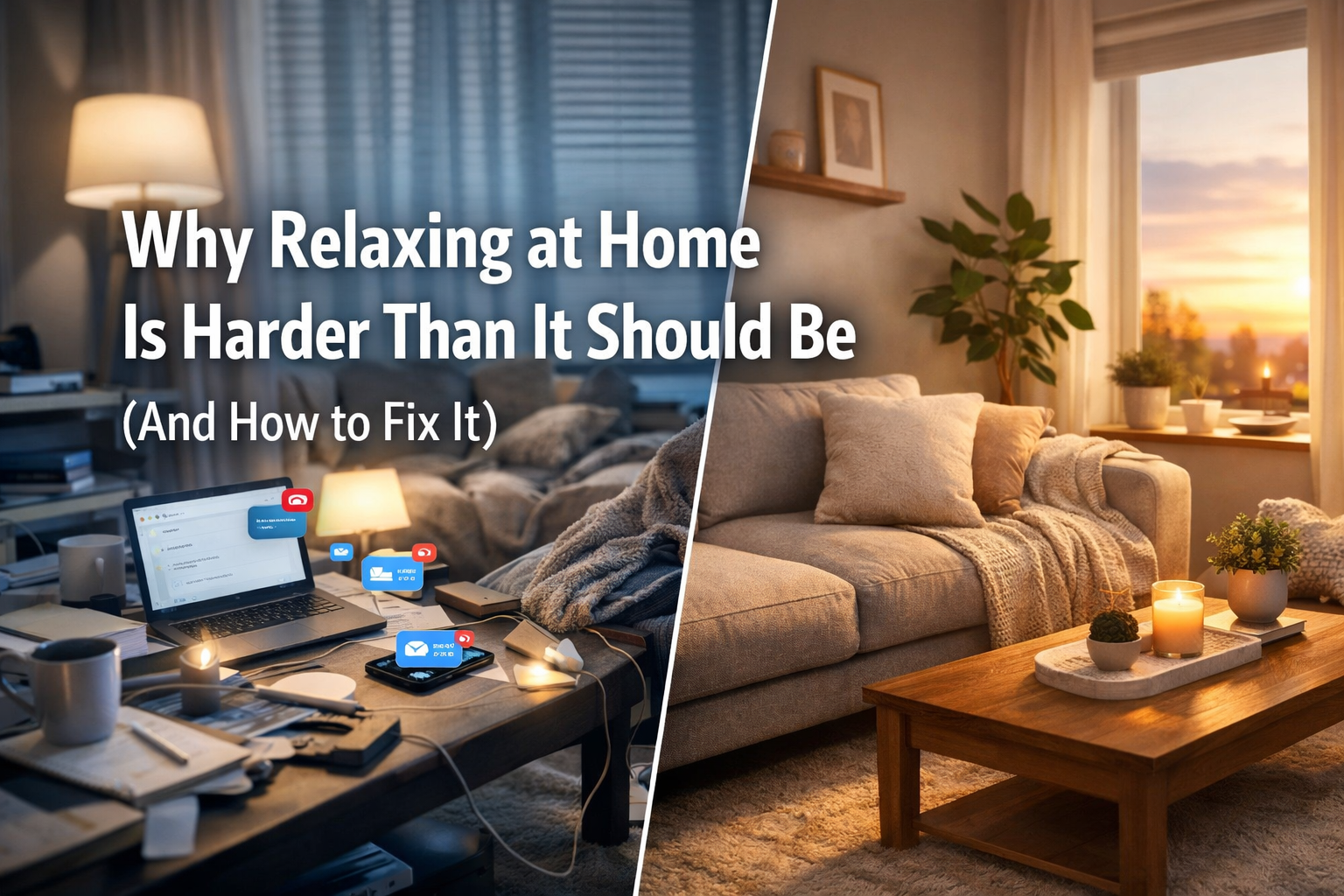
Picture this: after a long day, you finally collapse onto your couch, ready to unwind. But instead of feeling peaceful, your mind races. The pile of laundry stares at you from the corner. Your phone buzzes with notifications. The laptop sits open on the coffee table, silently reminding you of unfinished tasks. Thirty minutes later, you’re still tense, scrolling mindlessly, wondering why relaxing at home feels like another item on your to-do list.
Understanding why relaxing at home is harder than it should be (and how to fix it) starts with recognizing that our living spaces have fundamentally changed. Homes are no longer just places to rest—they’re offices, gyms, entertainment centers, and social hubs all rolled into one. This transformation has created an environment where true relaxation requires intentional design and deliberate boundaries.
What Makes Home Relaxation So Difficult in 2026?
Home relaxation has become challenging because modern living spaces lack the environmental and psychological boundaries that signal to the brain when it’s time to rest. When work emails arrive on the same couch where you watch TV, and your bedroom doubles as a home office, the brain never receives clear “off duty” signals.
The human nervous system relies on environmental cues to regulate stress responses. Historically, leaving the workplace meant physically separating from work stressors. In 2026, that separation has collapsed for millions of people. Remote and hybrid work arrangements mean professional responsibilities invade personal spaces, creating what researchers call “spatial role blurring.”
Key factors disrupting home relaxation:
- Digital intrusion: Constant connectivity means work, news, and social obligations follow you into every room
- Multi-purpose spaces: The same table serves breakfast, work meetings, and dinner, preventing mental compartmentalization
- Environmental design: Most homes prioritize function and aesthetics over neurological calm
- Absence of transition rituals: Without a commute or physical boundary, there’s no buffer between work mode and rest mode
- Overstimulation: Bright lighting, background noise, and visual clutter keep the brain in processing mode
The physical environment directly impacts the autonomic nervous system. Harsh overhead lighting mimics midday sun, suppressing melatonin and maintaining alertness. Cool color temperatures (blue-tinted light) signal daytime to the brain. Cluttered visual fields require constant low-level cognitive processing, preventing deep relaxation.
Choose environmental changes if: you notice physical tension that doesn’t ease even when sitting still, have trouble “switching off” mentally at home, or find yourself constantly aware of tasks and obligations in your peripheral vision.
Why Your Brain Won’t Shut Off When You Get Home
The brain refuses to shut off at home because it’s receiving conflicting signals about safety, time, and appropriate behavior for the environment. When the same space hosts multiple incompatible activities, the brain maintains a state of preparedness rather than allowing full relaxation.
The prefrontal cortex—responsible for executive function and decision-making—stays partially activated when surrounded by task reminders. Seeing a laptop triggers work-related neural pathways. Noticing dishes in the sink activates planning circuits. The brain interprets these cues as unfinished business requiring attention.
This constant low-grade activation prevents the parasympathetic nervous system from fully engaging. The parasympathetic system controls “rest and digest” functions, but it only activates when the brain perceives safety and absence of demands. Modern homes rarely provide these conditions.
Common mental barriers to home relaxation:
- Decision fatigue: Every visible object represents a potential decision or task
- Incomplete task loops: The brain tracks unfinished projects, creating background cognitive load
- Temporal confusion: Without clear start and end times, work bleeds into all hours
- Hypervigilance: Constant notifications train the brain to expect interruptions
- Guilt and productivity anxiety: Relaxing feels like wasting time when work is always accessible
The phenomenon intensifies because relaxation itself has become another performance metric. People track sleep scores, meditation minutes, and stress levels, turning rest into yet another task to optimize. This metacognitive awareness prevents the unselfconscious ease that characterizes genuine relaxation.
Common mistake: Trying to relax while remaining digitally connected. The brain cannot fully disengage while monitoring for notifications, even unconsciously. True rest requires periods of complete disconnection.
How Physical Space Design Affects Your Ability to Relax
Physical space design directly influences relaxation capacity by controlling sensory input, spatial psychology, and environmental cues that regulate nervous system states. Homes designed without consideration for neurological needs actively work against relaxation, regardless of conscious effort.
Critical design elements for relaxation:
Lighting
Lighting is the most powerful environmental regulator of circadian rhythms and alertness. Bright, cool-toned overhead lighting signals daytime and maintains cortisol production. For relaxation, spaces need layered, warm-toned lighting that can be dimmed progressively throughout the evening.
- Use multiple light sources at different heights instead of single overhead fixtures
- Install dimmer switches or use smart bulbs that adjust color temperature
- Aim for 2700K-3000K (warm white) in relaxation areas after sunset
- Position lights to avoid direct eye contact with bulbs
Color and Texture
Visual processing consumes significant cognitive resources. Spaces with high contrast, bright colors, or busy patterns require more neural processing than muted, cohesive environments. Soft textures signal comfort and safety to the tactile system.
- Choose muted, analogous color schemes in relaxation zones
- Incorporate varied textures: soft fabrics, natural wood, smooth ceramics
- Limit high-contrast elements that draw constant visual attention
- Use texture to create psychological warmth without visual complexity
Spatial Boundaries
The brain uses spatial context to determine appropriate behavior. Creating physical boundaries between activity zones helps establish mental boundaries between different modes of being.
- Use furniture placement to define distinct areas for different activities
- Create a designated relaxation zone that has no association with work or tasks
- If space is limited, use screens, curtains, or even different rugs to mark boundaries
- Position relaxation areas away from visual sightlines to task-related objects
Sensory Control
Relaxation requires reducing unnecessary sensory input. Homes with poor acoustic control, temperature fluctuations, or intrusive odors prevent the sensory system from settling.
- Address noise with soft furnishings, rugs, and curtains that absorb sound
- Maintain consistent, slightly cool temperatures (65-68°F is optimal for most people)
- Control air quality with plants or purifiers to reduce cognitive load from poor air
- Minimize strong or artificial scents that require constant olfactory processing
Decision rule: If you can see work materials, task reminders, or digital devices from your primary relaxation spot, your space design is working against you. Reorganize to create visual separation.
The Digital Device Problem and Why It Sabotages Relaxation
Digital devices sabotage relaxation by maintaining the brain in a state of anticipatory alertness, fragmenting attention, and providing supernormal stimuli that dysregulate dopamine systems. Even when not actively used, the mere presence of smartphones reduces cognitive capacity and prevents deep rest.
Research consistently shows that smartphone proximity—even when powered off—reduces available working memory and fluid intelligence. The brain allocates resources to the task of NOT checking the device, creating cognitive drain. This effect intensifies for people who feel dependent on their devices.
How devices disrupt relaxation:
| Device Behavior | Neurological Impact | Relaxation Consequence |
|---|---|---|
| Notifications | Unpredictable reward triggers dopamine spikes | Brain maintains vigilant state anticipating next alert |
| Blue light emission | Suppresses melatonin production | Circadian disruption prevents natural wind-down |
| Infinite scroll design | Exploits novelty-seeking circuits | Time distortion and difficulty disengaging |
| Work email access | Blurs work-life boundaries | Inability to psychologically “clock out” |
| Social comparison | Activates social evaluation systems | Increased cortisol and reduced contentment |
The problem extends beyond direct use. Devices create what psychologists call “continuous partial attention”—a state of constant monitoring that prevents the deep focus or deep rest required for restoration. The brain never fully commits to the present activity because part of its attention remains allocated to potential digital interruptions.
Practical device management strategies:
- Create physical distance: Place devices in another room during designated relaxation periods
- Use analog alternatives: Replace phone-based activities with physical versions (paper books, wall clocks, separate alarm clocks)
- Establish device-free zones: Make bedrooms and primary relaxation areas permanently device-free
- Set temporal boundaries: Implement specific times when devices are completely off-limits (e.g., after 8 PM)
- Disable non-essential notifications: Reduce anticipatory alertness by eliminating most alerts
- Use grayscale mode: Removing color makes devices less stimulating and easier to disengage from
Edge case: Some people need devices accessible for legitimate emergencies (on-call medical professionals, parents of young children). In these situations, use a separate, dedicated device for emergency contact only, and keep personal devices in a different location.
Creating Environmental Cues That Signal “It’s Time to Relax”
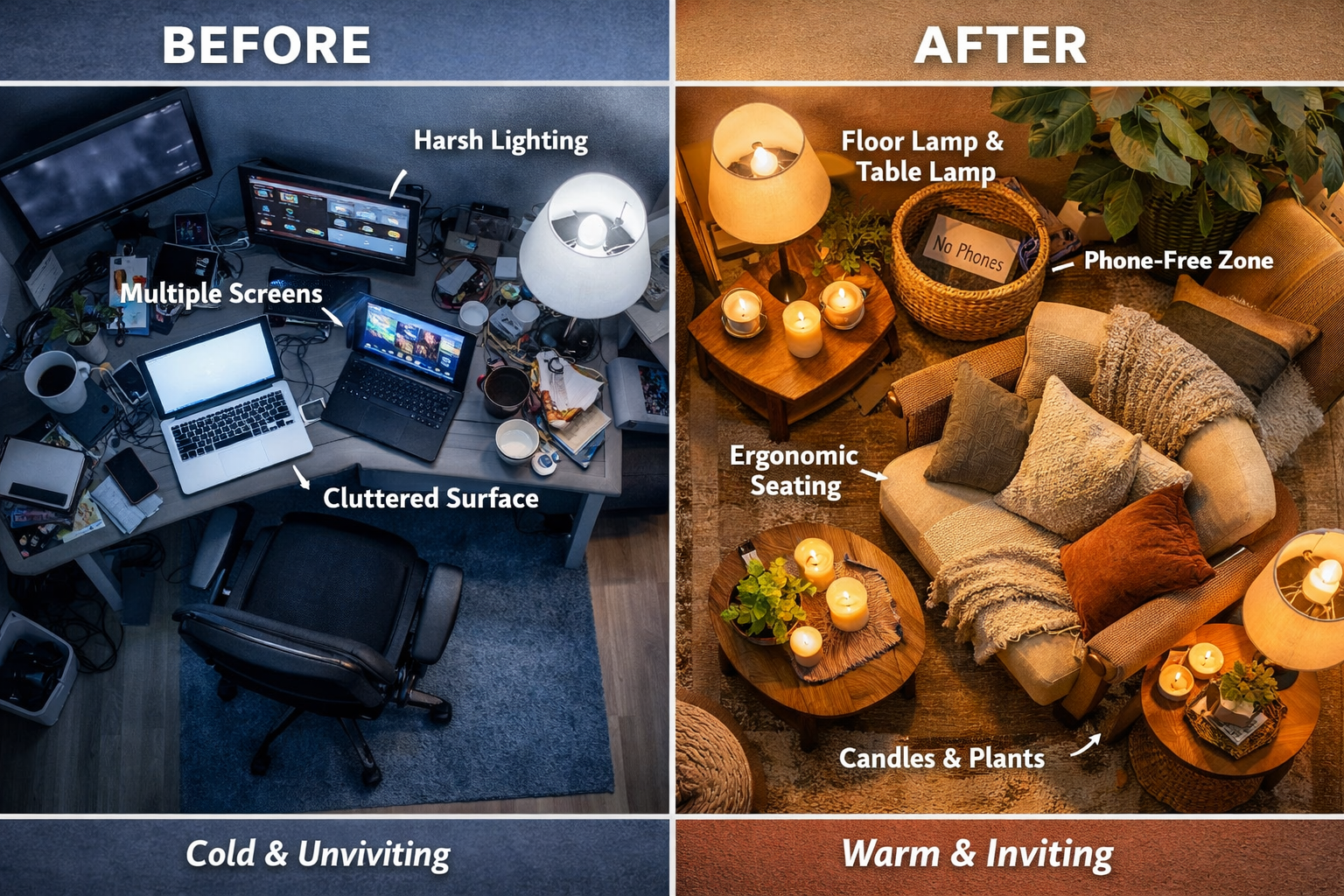
Environmental cues that signal relaxation time work by establishing consistent associations between specific sensory experiences and rest states, allowing the nervous system to begin downregulating automatically when it encounters those cues. This classical conditioning approach leverages the brain’s pattern-recognition systems to facilitate easier transitions into relaxation.
The key is consistency and specificity. Random or inconsistent cues don’t create strong associations. The brain needs repeated pairing of specific environmental changes with actual relaxation experiences to build reliable neural pathways.
Effective environmental cue strategies:
Lighting Transitions
Progressively dimming lights in the evening mimics natural sunset and triggers melatonin production. Create a consistent lighting routine that the body learns to associate with winding down.
- 6:00 PM: Turn off overhead lights, switch to lamps only
- 7:00 PM: Dim lamps to 50% brightness
- 8:00 PM: Further reduce to 25% or use only candlelight in relaxation areas
- 9:00 PM: Transition to minimal lighting in preparation for sleep
Scent Anchoring
Olfactory memories are particularly powerful because scent processing connects directly to the limbic system. Using specific scents exclusively during relaxation creates strong associations.
- Choose one signature scent for relaxation only (lavender, chamomile, sandalwood)
- Use it consistently during designated wind-down time
- Never use this scent during work or high-stress activities
- The brain will begin relaxing automatically when it detects the scent
Sound Environments
Consistent audio environments signal different modes. Using specific sounds only during relaxation builds associations that trigger automatic responses.
- Create a relaxation playlist used only during wind-down time
- Use white noise, nature sounds, or specific music genres exclusively for rest
- Maintain consistent volume levels that become familiar
- Avoid using relaxation sounds during work or active periods
Temperature Changes
The body naturally cools slightly before sleep. Deliberately lowering room temperature signals the approaching rest period.
- Drop temperature 2-3 degrees during evening hours
- Take a warm bath or shower (the post-bath cooling triggers sleepiness)
- Use temperature as a consistent environmental marker of transition time
Clothing Rituals
Changing into specific relaxation clothing creates a physical and psychological boundary between active and rest modes.
- Designate specific comfortable clothing worn only during relaxation time
- Make the clothing change a deliberate ritual, not a rushed transition
- Choose fabrics and fits that feel distinctly different from work attire
- The act of changing becomes a cue that work mode is ending
Implementation tip: Introduce cues gradually, one at a time, to avoid overwhelming yourself with too many changes. Start with lighting transitions, then add scent or sound after two weeks, and layer additional cues over time.
Why Relaxing at Home Is Harder Than It Should Be: The Role of Mental Boundaries
Mental boundaries are harder to maintain than physical ones because they require consistent cognitive effort to enforce, yet modern home environments provide no external support for maintaining these distinctions. Without deliberate mental boundary-setting, the brain defaults to treating all time and space as potentially productive, preventing genuine rest.
The collapse of mental boundaries stems from several converging factors. Work-from-home arrangements eliminate the physical commute that once served as a psychological buffer. Digital connectivity means professional obligations can intrude at any moment. The cultural valorization of productivity creates guilt around unstructured time.
Strategies for establishing mental boundaries:
Time Blocking
Assign specific time blocks to different modes of being, and treat those boundaries as non-negotiable. The brain learns to shift states when it knows the schedule is reliable.
- Work hours: Clearly defined start and end times, even when working from home
- Transition period: 30-60 minutes of neutral activity between work and relaxation
- Relaxation window: Protected time with no work-related activities permitted
- Preparation time: Evening routine that signals approaching sleep
Cognitive Closure Rituals
Create end-of-work rituals that provide psychological closure, signaling to the brain that the work day has ended.
- Write tomorrow’s task list (externalizes mental tracking)
- Physically close laptop and put it away in a designated location
- Change out of work clothes, even if they’re casual
- Take a short walk or do light exercise to mark the transition
- Verbally declare “work is done for today” to reinforce the boundary
Attention Training
Practice directing attention deliberately rather than letting it scatter across multiple concerns. This builds the mental muscle needed to maintain boundaries.
- When relaxing, notice when work thoughts intrude
- Acknowledge them without engaging: “That’s a work thought for work time”
- Redirect attention to present sensory experience
- Use brief mindfulness practices to strengthen attention control
Permission Structures
Many people struggle with relaxation because they haven’t given themselves explicit permission to rest without productivity. Creating clear permission structures reduces guilt and resistance.
- Define what “enough” work looks like for the day
- Establish criteria for when you’ve earned rest (not based on exhaustion)
- Recognize rest as essential maintenance, not optional luxury
- Challenge beliefs that equate constant productivity with worth
Common mistake: Treating mental boundaries as optional or flexible. The brain requires consistency to build reliable associations. Frequent boundary violations train the brain that the boundaries don’t actually exist, making them progressively harder to maintain.
Practical Steps to Fix Your Home Relaxation Problem
Fixing home relaxation requires systematic changes to both environment and routine, implemented gradually to allow new patterns to establish without overwhelming existing systems. Start with high-impact changes that address the most significant barriers in your specific situation.
Step 1: Conduct a Relaxation Audit
Identify what specifically prevents relaxation in your current environment.
- Spend one evening noting every time you feel tension or can’t settle
- Record what triggered the feeling (visual cue, sound, thought, device)
- Identify patterns in what disrupts your relaxation attempts
- Prioritize the top three most frequent or intense barriers
Step 2: Create a Designated Relaxation Zone
Establish one area exclusively associated with rest, with no competing associations.
- Choose a specific chair, corner, or room for relaxation only
- Remove all work materials, devices, and task reminders from this zone
- Add elements that support relaxation: soft lighting, comfortable seating, pleasant textures
- Use this space consistently for relaxation activities only
Step 3: Implement Device Boundaries
Establish clear rules about device presence and use during relaxation time.
- Set a specific time when devices go into a charging station in another room
- Remove TVs, computers, and tablets from the bedroom
- Use analog alternatives for functions currently handled by phones
- Create a device-free period of at least 90 minutes before intended sleep time
Step 4: Design a Wind-Down Routine
Build a consistent sequence of activities that signals the transition from active to rest mode.
Sample wind-down routine (customize to personal preferences):
- 7:00 PM: Finish dinner, begin dimming lights
- 7:30 PM: Put devices in charging station, change into relaxation clothes
- 8:00 PM: Engage in low-stimulation activity (reading, gentle stretching, journaling)
- 8:30 PM: Prepare space for next day (set out clothes, prep coffee maker)
- 9:00 PM: Personal care routine, further dim lights
- 9:30 PM: Quiet activity in designated relaxation zone
- 10:00 PM: Begin sleep preparation
Step 5: Optimize Environmental Factors
Make physical changes that support nervous system downregulation.
Lighting modifications:
- Replace bright overhead bulbs with lower-wattage warm bulbs
- Add table and floor lamps for layered lighting
- Install dimmer switches or use smart bulbs with scheduling features
- Use blackout curtains in bedrooms
Sensory adjustments:
- Add soft textiles: throw blankets, cushions, rugs
- Introduce plants for air quality and visual calm
- Use white noise machines or fans to mask disruptive sounds
- Maintain consistent, cool temperature in relaxation areas
Spatial organization:
- Create physical barriers between work and relaxation zones
- Store task-related items out of sight during relaxation time
- Arrange furniture to face away from work areas
- Designate specific drawers or closets for work materials that can be closed
Step 6: Establish Mental Boundary Practices
Implement cognitive strategies that support psychological separation.
- Practice a 5-minute transition meditation when shifting from work to relaxation
- Use journaling to externalize concerns and prevent mental rumination
- Create a “worry time” earlier in the day so evening concerns can be deferred
- Develop a mantra or phrase that signals boundary enforcement (“Not now, that’s for tomorrow”)
Step 7: Build in Progressive Muscle Relaxation
Physical tension prevents mental relaxation. Active relaxation techniques help release accumulated stress.
- Systematically tense and release muscle groups from toes to head
- Practice for 10-15 minutes during the wind-down routine
- Pair with deep breathing (4 count inhale, 7 count hold, 8 count exhale)
- Use guided recordings until the sequence becomes automatic
Decision rule: If implementing all steps feels overwhelming, start with device boundaries and environmental lighting. These two changes produce the most immediate and noticeable impact on relaxation capacity.
Common Mistakes That Keep You From Relaxing at Home
Understanding common relaxation mistakes helps avoid wasting effort on approaches that appear helpful but actually maintain the problem. Many popular relaxation strategies contain hidden elements that work against their stated purpose.
Mistake 1: Trying to Relax While Remaining Connected
Attempting to relax with devices nearby or notifications enabled creates divided attention that prevents genuine rest. The brain maintains background monitoring systems that consume cognitive resources.
Fix: Implement complete device separation during designated relaxation periods. Physical distance is essential because proximity alone triggers monitoring behaviors.
Mistake 2: Using Stimulating Activities as Relaxation
Many activities marketed as relaxing—scrolling social media, watching intense shows, playing competitive games—actually increase arousal rather than promoting rest.
Fix: Choose genuinely low-stimulation activities: reading physical books, gentle stretching, listening to calm music, taking baths, doing simple crafts, or sitting quietly.
Mistake 3: Inconsistent Timing
Relaxing at random times prevents the body from developing anticipatory responses. The nervous system can’t prepare for rest if rest periods are unpredictable.
Fix: Establish consistent relaxation windows at the same time daily. The body will begin downregulating automatically as the scheduled time approaches.
Mistake 4: Multitasking During Relaxation
Combining relaxation with other activities (planning tomorrow while bathing, listening to podcasts while stretching) keeps the cognitive system engaged and prevents deep rest.
Fix: Practice single-tasking during relaxation time. Focus fully on the sensory experience of whatever you’re doing.
Mistake 5: Skipping the Transition Period
Attempting to jump directly from high-intensity work to deep relaxation rarely works. The nervous system needs time to downshift through intermediate states.
Fix: Build in a 30-60 minute transition period with moderate-stimulation activities that bridge between work and rest modes.
Mistake 6: Optimizing and Tracking Relaxation
Monitoring relaxation quality, tracking meditation minutes, or measuring stress reduction turns rest into another performance metric, creating pressure that prevents relaxation.
Fix: Allow relaxation to be unmeasured and unoptimized. Focus on subjective experience rather than quantified outcomes.
Mistake 7: Ignoring Physical Discomfort
Attempting to relax in physically uncomfortable positions or environments creates competing sensory signals that prevent rest.
Fix: Prioritize physical comfort. Invest in supportive seating, adjust temperature, address pain or tension before attempting to relax mentally.
Mistake 8: Expecting Immediate Results
Relaxation capacity builds over time through consistent practice. Expecting instant deep relaxation after years of chronic tension leads to frustration and abandonment of helpful practices.
Fix: Commit to consistent practice for at least three weeks before evaluating effectiveness. The nervous system needs time to learn new patterns.
How Long Does It Take to Make Home Feel Relaxing Again?
Restoring home as a genuinely relaxing environment typically requires 3-6 weeks of consistent environmental and behavioral changes before the brain establishes new associations and the nervous system develops reliable downregulation patterns. Individual timelines vary based on stress levels, consistency of implementation, and severity of existing dysregulation.
The timeline breaks down into distinct phases:
Week 1-2: Adjustment and Resistance
The brain resists new patterns, and relaxation may feel forced or artificial. Discomfort with stillness or unstructured time is common. Physical changes to environment feel unfamiliar.
Week 3-4: Pattern Recognition
The nervous system begins recognizing environmental cues and responding with anticipatory relaxation. Transitions become slightly easier. Resistance to relaxation practices decreases.
Week 5-6: Automaticity
Relaxation responses become more automatic. Environmental cues trigger physiological changes without conscious effort. Home begins feeling genuinely restful rather than requiring constant effort to relax.
Factors that accelerate progress:
- Consistency: Maintaining exact schedules and routines
- Complete device separation: Eliminating digital intrusion entirely during relaxation time
- Environmental optimization: Making comprehensive changes to lighting, sound, and spatial organization
- Stress management: Addressing external stressors that maintain nervous system activation
- Physical health: Adequate sleep, nutrition, and movement support nervous system regulation
Factors that slow progress:
- Inconsistent implementation of boundaries
- Frequent exceptions or boundary violations
- Ongoing high-stress situations without adequate coping strategies
- Poor sleep quality or sleep disorders
- Underlying anxiety or mood disorders requiring professional treatment
Edge case: People with chronic stress conditions, trauma histories, or clinical anxiety may need professional support alongside environmental changes. If relaxation remains difficult after 6-8 weeks of consistent practice, consider consulting a mental health professional.
Why Relaxing at Home Is Harder Than It Should Be: Addressing the Underlying Psychology
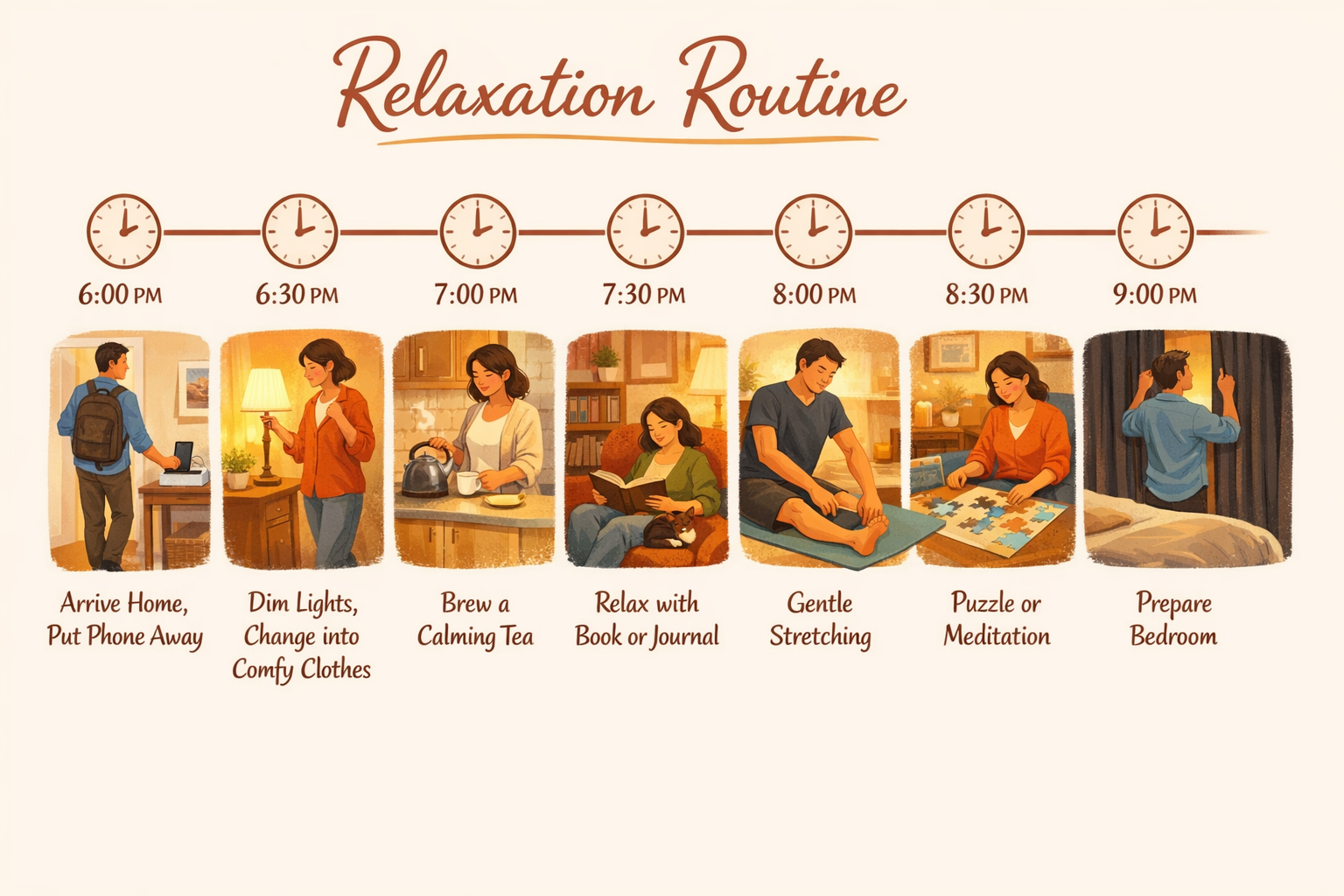
The underlying psychology of home relaxation difficulty involves learned associations, productivity conditioning, and nervous system dysregulation that develops over months or years of chronic stress exposure. Simply changing the environment addresses symptoms but not root causes for many people.
Modern culture creates psychological barriers to relaxation through several mechanisms:
Productivity as Identity
Many people have internalized the belief that their worth derives from constant productivity. Relaxation triggers guilt, shame, or anxiety about “wasting time.” This belief system actively resists rest, creating internal conflict when attempting to relax.
Addressing it: Consciously challenge productivity beliefs. Practice self-compassion. Recognize that rest enables productivity rather than opposing it. Reframe relaxation as essential maintenance rather than optional indulgence.
Hypervigilance Conditioning
Chronic stress and unpredictable demands train the nervous system to maintain constant alertness. Even in safe environments, the body remains in protective mode, scanning for threats or obligations.
Addressing it: Practice grounding techniques that signal safety to the nervous system. Use progressive muscle relaxation, deep breathing, and mindfulness to retrain automatic responses. Consider professional support for trauma-related hypervigilance.
Fear of Stillness
Many people avoid relaxation because stillness allows difficult emotions, thoughts, or physical sensations to surface. Constant activity serves as avoidance.
Addressing it: Start with gentle, structured relaxation that doesn’t require complete stillness. Gradually increase tolerance for quiet reflection. Consider journaling or therapy to process underlying concerns.
Learned Helplessness About Stress
Some people have internalized the belief that stress is inevitable and uncontrollable, leading to passive acceptance rather than active change.
Addressing it: Start with small, controllable changes that demonstrate agency. Build self-efficacy through successful environmental modifications. Recognize that stress responses are modifiable.
Comparison and Social Pressure
Social media and cultural messaging create pressure to maintain constant availability, achievement, and engagement. Relaxation feels like falling behind.
Addressing it: Limit social comparison triggers. Curate social media to reduce exposure to productivity culture. Build relationships that value rest and balance.
Perfectionism in Relaxation
Some people approach relaxation with the same perfectionistic standards they apply to work, creating pressure that prevents actual rest.
Addressing it: Practice “good enough” relaxation. Allow imperfect, messy, unoptimized rest. Focus on subjective experience rather than external standards.
“The inability to relax at home often reflects not a personal failing but a nervous system doing exactly what it was trained to do in an environment that no longer requires constant vigilance.”
Building a Sustainable Relaxation Practice for Long-Term Success
Sustainable relaxation practices balance structure with flexibility, creating reliable patterns while allowing adaptation to changing circumstances and needs. Long-term success requires building relaxation capacity as a skill rather than treating it as an occasional activity.
Core principles for sustainability:
Start Small and Build Gradually
Attempting comprehensive overnight changes typically leads to abandonment. Small, consistent practices build momentum and create foundation for expansion.
- Begin with one 15-minute relaxation period daily
- Add additional time or practices only after the initial habit feels automatic
- Celebrate small successes rather than focusing on ideal end states
- Allow 3-4 weeks for each new habit to establish before adding another
Create Accountability Structures
External accountability increases consistency, especially during initial habit formation when motivation fluctuates.
- Share relaxation goals with a friend or partner
- Use habit tracking apps (but avoid over-optimization)
- Join or create a relaxation accountability group
- Schedule relaxation time as non-negotiable calendar appointments
Build Flexibility Into Routines
Rigid routines break under real-world pressure. Build in acceptable variations that maintain core principles while accommodating life circumstances.
- Define “minimum viable relaxation” for high-stress days (10 minutes of deep breathing)
- Create 2-3 routine variations for different schedule demands
- Identify core non-negotiable elements vs. flexible components
- Plan for disruptions (travel, illness, schedule changes) with simplified alternatives
Regularly Reassess and Adjust
Needs change over time. Regular evaluation prevents continuing ineffective practices out of habit.
- Monthly check-ins: What’s working? What feels forced or unhelpful?
- Quarterly adjustments: Modify practices based on changing circumstances
- Annual review: Evaluate overall relaxation capacity and quality of life impact
- Stay curious rather than dogmatic about specific techniques
Address Obstacles Proactively
Anticipate common obstacles and develop strategies before they derail practice.
Common obstacles and solutions:
| Obstacle | Proactive Solution |
|---|---|
| Time pressure | Protect relaxation time first, schedule other activities around it |
| Family interruptions | Communicate boundaries, involve family in respecting relaxation time |
| Work emergencies | Define true emergencies vs. manufactured urgency, establish response protocols |
| Guilt about relaxing | Reframe rest as essential maintenance, track productivity improvements from adequate rest |
| Boredom with practices | Rotate between 3-4 different relaxation activities, allow natural variation |
Integrate Relaxation Into Identity
Long-term maintenance becomes easier when relaxation shifts from something you do to part of who you are.
- Identify as “someone who prioritizes rest and recovery”
- Make decisions aligned with relaxation values
- Build social connections that support rather than undermine relaxation practices
- Create environmental defaults that make relaxation the path of least resistance
Decision rule: If a relaxation practice feels like constant struggle after 4-6 weeks of consistent effort, it may not suit your temperament or circumstances. Try different approaches rather than forcing incompatible practices.
Frequently Asked Questions
Why can’t I relax at home even when I’m exhausted?
Exhaustion and relaxation use different nervous system states. Exhaustion often comes with elevated cortisol and sympathetic activation that prevents the parasympathetic system from engaging. The body is depleted but still in alert mode. True relaxation requires actively downregulating the stress response through environmental cues, breathing techniques, and removal of stimulating inputs, not just stopping activity.
How do I relax at home when I work from home?
Create strict spatial and temporal boundaries between work and relaxation. Designate specific work hours and a specific work location, then completely separate from both at the end of the workday. Put work materials out of sight, close the door to your office area if possible, and establish an end-of-work ritual that provides psychological closure. Treat the end of work time as seriously as you would leaving an office building.
What’s the fastest way to make my home feel more relaxing?
Change the lighting. Switch from bright overhead lights to warm-toned lamps at lower brightness levels. This single change has the most immediate impact on nervous system state because lighting directly regulates circadian rhythms and alertness. Pair this with removing visible devices from your primary relaxation area for compound effects.
Is it normal to feel anxious when trying to relax?
Yes, particularly for people who have been chronically stressed or who use activity to avoid difficult emotions. Stillness allows suppressed feelings and thoughts to surface, which can feel uncomfortable initially. This typically decreases with consistent practice as the nervous system learns that relaxation is safe. If anxiety during relaxation persists or intensifies after several weeks, consider professional support.
How much time should I spend relaxing each day?
Most people benefit from a 90-120 minute wind-down period in the evening, plus periodic brief relaxation breaks during the day. The key is consistency and quality rather than quantity. Fifteen minutes of genuine, undistracted relaxation provides more benefit than two hours of distracted, device-interrupted “rest.”
Can I relax while watching TV?
Television provides passive entertainment but rarely produces genuine relaxation because it maintains visual and cognitive engagement. Some slow-paced, familiar shows watched at low volume with dimmed screens can support relaxation, but most TV content keeps the brain in processing mode. For deeper relaxation, choose activities with lower stimulation levels.
Why do I feel guilty when I try to relax?
Guilt around relaxation typically stems from internalized productivity beliefs that equate worth with constant output. This conditioning is cultural and learned, not inherent. Address it by consciously challenging these beliefs, recognizing rest as essential for sustained performance, and practicing self-compassion. Guilt often decreases as you experience the benefits of adequate rest.
Do I need to meditate to relax at home?
No. Meditation is one relaxation tool among many. Some people find it helpful, others find it frustrating or incompatible with their temperament. Effective alternatives include gentle stretching, reading, taking baths, listening to music, doing simple crafts, or sitting quietly without formal meditation structure. Choose activities that genuinely feel restful to you.
How can I relax when I have young children?
Involve children in quiet evening routines that benefit everyone: dimmed lights, calm music, gentle activities like reading or coloring. Create brief relaxation opportunities during naps or after bedtime. Lower expectations for deep relaxation during intensive parenting phases, and prioritize sleep quality and brief restorative breaks over extended relaxation sessions.
What if my partner doesn’t respect my relaxation time?
Communicate clearly about your needs and the importance of designated relaxation time. Explain that protecting this time benefits the relationship by preventing burnout and resentment. Establish mutual respect for each person’s wind-down needs. If communication doesn’t resolve the issue, consider couples counseling to address boundary-setting challenges.
Is it better to relax alone or with others?
This depends on individual temperament and relationship dynamics. Introverts typically need solo time to fully relax, while extroverts may find social connection restorative. The key is that shared relaxation time should involve genuinely calming activities and compatible energy levels, not forced social performance or accommodation of others’ preferences at the expense of your own rest.
How do I know if my relaxation practice is working?
Notice subjective improvements in sleep quality, reduced physical tension, improved mood stability, decreased irritability, and enhanced ability to focus during work hours. These changes typically emerge gradually over 3-6 weeks. Avoid over-measuring with tracking devices, as this can undermine the relaxation you’re trying to create.
Conclusion: Reclaiming Your Home as a Sanctuary
Understanding why relaxing at home is harder than it should be (and how to fix it) comes down to recognizing that modern living environments and digital connectivity have fundamentally changed how homes function. Spaces that once provided natural boundaries between work and rest now blend everything together, keeping the nervous system in a constant state of low-level activation. The good news is that deliberate environmental design and consistent behavioral boundaries can restore home as a genuine sanctuary.
The solutions aren’t complicated, but they do require commitment. Physical changes to lighting, spatial organization, and sensory environments create the foundation. Device boundaries remove the most significant source of intrusion. Consistent routines and wind-down rituals train the nervous system to recognize when it’s safe to rest. Mental boundary practices protect against the cognitive intrusions that prevent relaxation even in optimized environments.
Action steps to implement immediately:
- Tonight: Put your phone in another room 90 minutes before bed
- This week: Replace overhead lighting with lamps in your primary relaxation area
- This month: Establish a consistent wind-down routine starting at the same time each evening
- Ongoing: Protect your relaxation time as non-negotiable, treating it with the same importance as work commitments
Remember that building relaxation capacity is a skill that develops over time. The first few weeks may feel awkward or forced. That’s normal. The nervous system needs consistent practice to establish new patterns. Stay patient with the process and focus on consistency rather than perfection.
The investment in creating a genuinely relaxing home environment pays dividends across every area of life. Better sleep improves cognitive function, emotional regulation, and physical health. Reduced chronic stress lowers risk of numerous health conditions. Enhanced recovery capacity increases sustainable productivity. The ability to truly rest at home transforms quality of life in ways that extend far beyond the relaxation periods themselves.
Your home should be the place where your nervous system gets to rest, where you can let down your guard, and where genuine restoration happens. With intentional changes to environment, boundaries, and routines, that’s entirely achievable. Start small, stay consistent, and watch as your home gradually transforms from another source of stress into the sanctuary it was meant to be.