


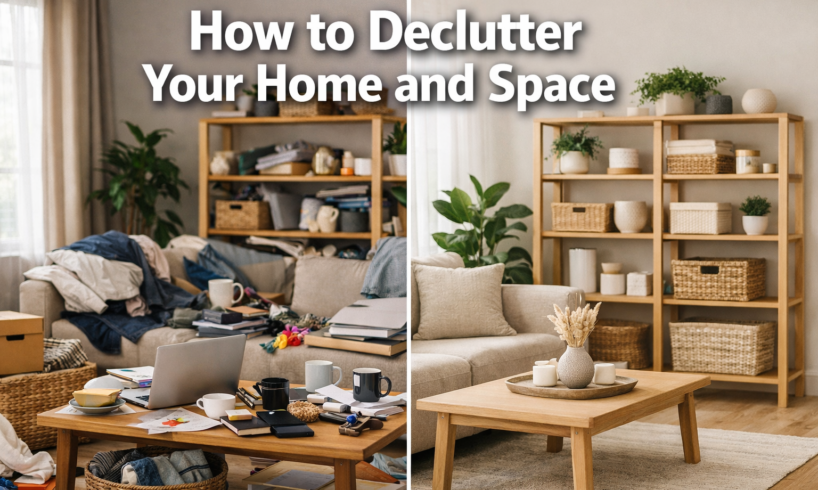
Last updated: February 21, 2026
Key Takeaways
- Decluttering creates physical and mental space by removing items that no longer serve a purpose in your home
- The four-box method (Keep, Donate, Trash, Relocate) simplifies decision-making during the sorting process
- Tackling one room or zone at a time prevents overwhelm and builds momentum
- Regular maintenance routines keep clutter from returning after the initial decluttering effort
- Different spaces require tailored strategies based on their function and the types of items they contain
Quick Answer
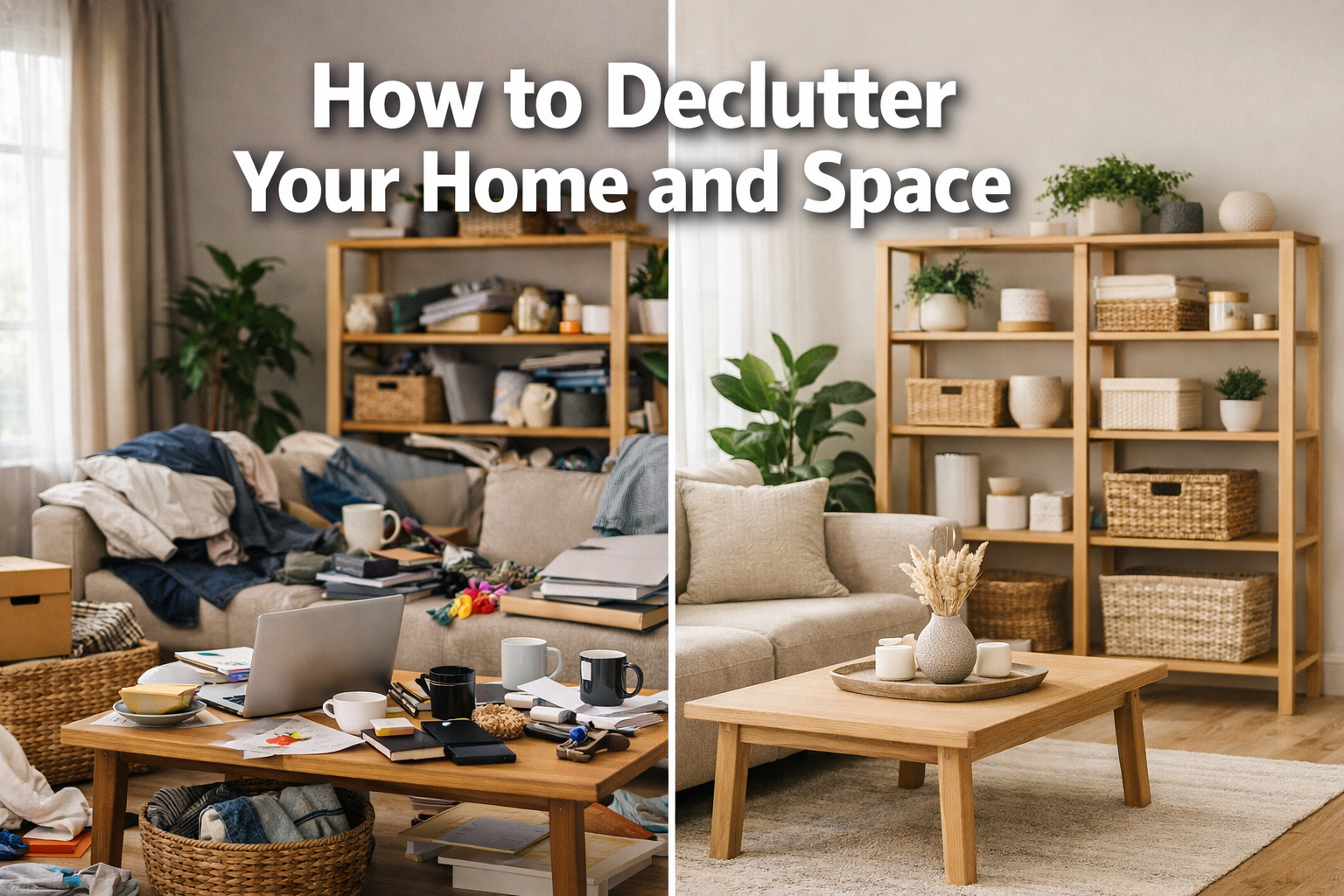
Learning how to declutter your home and space means systematically removing unnecessary items while organizing what remains to create a peaceful, functional environment. Start by choosing one small area, sort items using a simple decision framework, and establish habits that prevent clutter from accumulating again. Most people see noticeable results within 2-3 weeks when dedicating just 15-30 minutes daily to the process.
Imagine walking into your home and feeling instant calm instead of stress. No piles of mail on the counter, no overflowing closets, no mystery boxes shoved under the bed. That’s the power of a decluttered space, and it’s completely achievable without spending a fortune or dedicating entire weekends to the task.
Understanding how to declutter your home and space transforms more than just your physical environment. It creates breathing room in your daily routine, reduces the time spent searching for lost items, and gives you control over your surroundings instead of feeling controlled by them.
What Does It Mean to Declutter Your Home and Space?
Decluttering means intentionally removing items from your living areas that don’t add value, function, or joy to your life. This goes beyond basic tidying or cleaning; it’s about evaluating what you own and making conscious decisions about what stays and what goes.
The process involves three core actions:
- Sorting through belongings to identify what you actually use and need
- Removing items that are broken, duplicates, outdated, or no longer relevant to your current lifestyle
- Organizing what remains in ways that make sense for how you live
Decluttering differs from organizing because you can’t truly organize clutter. Buying more storage bins for things you don’t use just hides the problem. Real decluttering reduces the total volume of possessions so that what’s left has a clear purpose and designated place.
Who benefits most from decluttering? Anyone feeling overwhelmed by their belongings, spending excessive time cleaning or searching for items, or experiencing stress when looking at certain areas of their home. It’s particularly helpful for people downsizing, moving, or going through life transitions.
Why Should You Declutter Your Home and Space?
Decluttering creates tangible improvements in daily life beyond just having cleaner surfaces. A decluttered home reduces decision fatigue because you’re not constantly navigating around or through piles of stuff. It also cuts cleaning time significantly since there are fewer items to move, dust, and organize.
Mental and emotional benefits include:
- Reduced anxiety and stress from visual chaos
- Improved focus and productivity in work-from-home spaces
- Better sleep quality in decluttered bedrooms
- Increased sense of control and accomplishment
- More time for activities you actually enjoy
Practical advantages:
- Easier to find what you need when you need it
- Lower risk of pest problems in storage areas
- Improved air quality with fewer dust-collecting items
- More usable square footage in your home
- Potential financial return from selling unwanted items
Choose decluttering if you’re tired of maintaining possessions that don’t enhance your life. Skip it if you genuinely use and appreciate everything you own and your current system works without causing stress.
How to Declutter Your Home and Space: The Four-Box Method
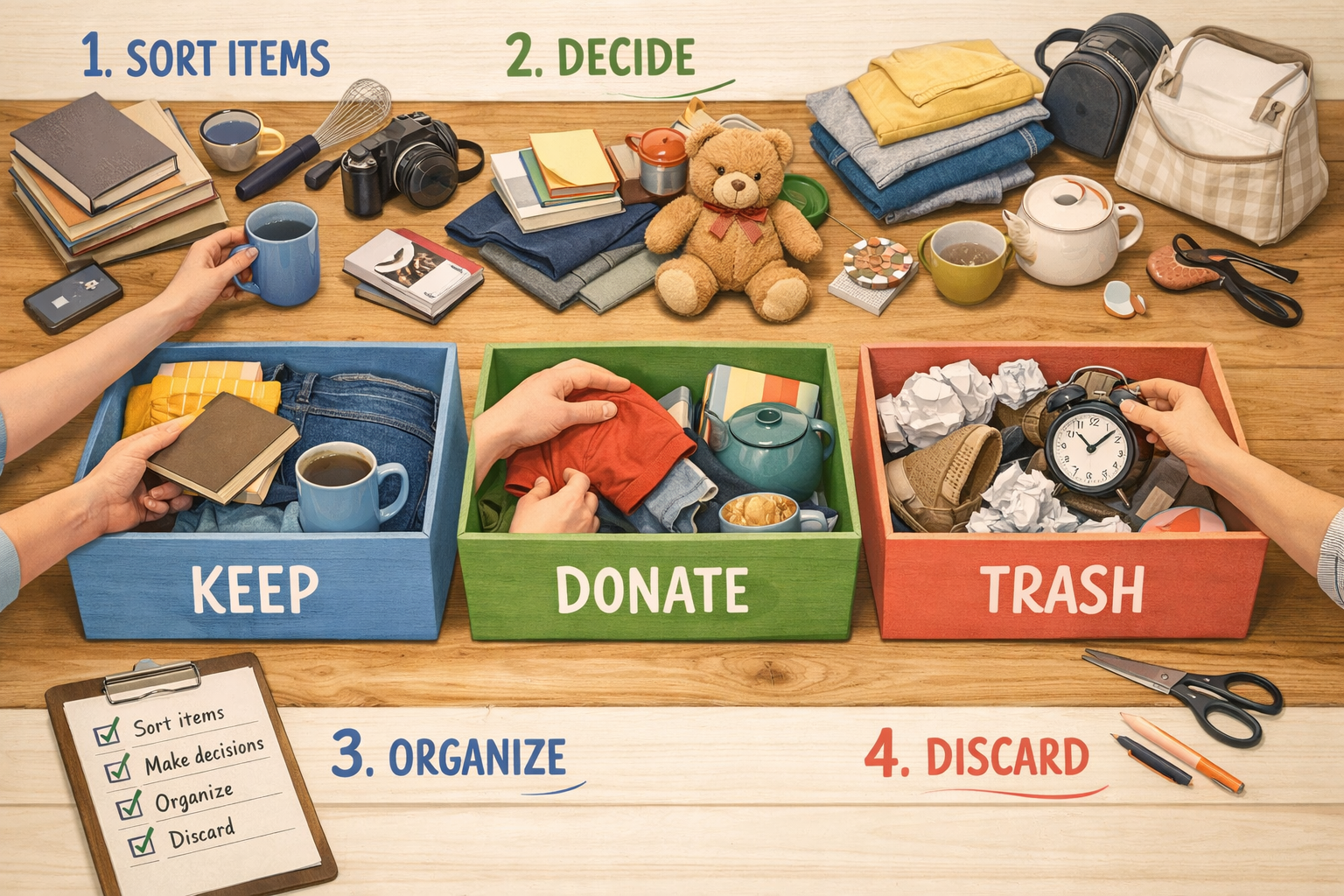
The four-box method provides a simple decision framework that eliminates the paralysis many people feel when decluttering. Prepare four containers or designated areas labeled Keep, Donate, Trash, and Relocate before you begin sorting any space.
Here’s how the system works:
- Keep box: Items you use regularly, need for practical reasons, or genuinely love
- Donate box: Usable items in good condition that someone else could benefit from
- Trash box: Broken, damaged, expired, or unsanitary items beyond repair
- Relocate box: Things that belong in a different room or area of your home
Step-by-step process:
- Set a timer for 15-30 minutes to maintain focus and prevent burnout
- Pick up each item in your chosen area one at a time
- Ask: “Do I use this? Does it work? Do I have multiples? Does it fit my current life?”
- Place the item in the appropriate box based on your honest answer
- When the timer ends, immediately handle the boxes (donate items to car, trash to bin, relocate items to proper rooms)
- Put Keep items back in organized fashion
Common mistake: Creating a “Maybe” box. This just delays decisions and clutters your space longer. If you’re uncertain, ask when you last used the item. If it’s been over a year and it’s not seasonal or sentimental, it probably belongs in Donate.
Decision rule: Choose Keep only if the item serves your life right now. Past cost, guilt about gifts, or “someday I might” scenarios don’t count as valid reasons to keep things.
Where to Start When You Declutter Your Home and Space
Start with the area causing you the most daily frustration or the smallest, easiest space to build confidence. For most people, this means a single drawer, one closet shelf, or a bathroom cabinet rather than an entire room.
Best starting points for beginners:
- Junk drawer: Small, contained, quick win that builds momentum
- Medicine cabinet: Easy decisions (expired = trash), visible results
- Coat closet: Seasonal items are simple to evaluate
- Nightstand: Personal space with immediate daily impact
- Car: Often overlooked but affects daily routine
Worst starting points:
- Sentimental items like photos or inherited belongings (save these for when you’ve built decluttering skills)
- Shared family spaces where you can’t make unilateral decisions
- Garage or attic with years of accumulated items
- Kitchen if you share cooking duties with others
The momentum approach: Complete one small area fully before moving to the next. Finishing a drawer completely feels better and builds more confidence than partially decluttering three rooms and seeing no finished results.
Time-based strategy: If you have 15 minutes, tackle a drawer. With 30 minutes, do a closet shelf or bathroom counter. An hour allows for a full closet or small room. Match your available time to an appropriately sized project.
Room-by-Room Guide to Declutter Your Home and Space
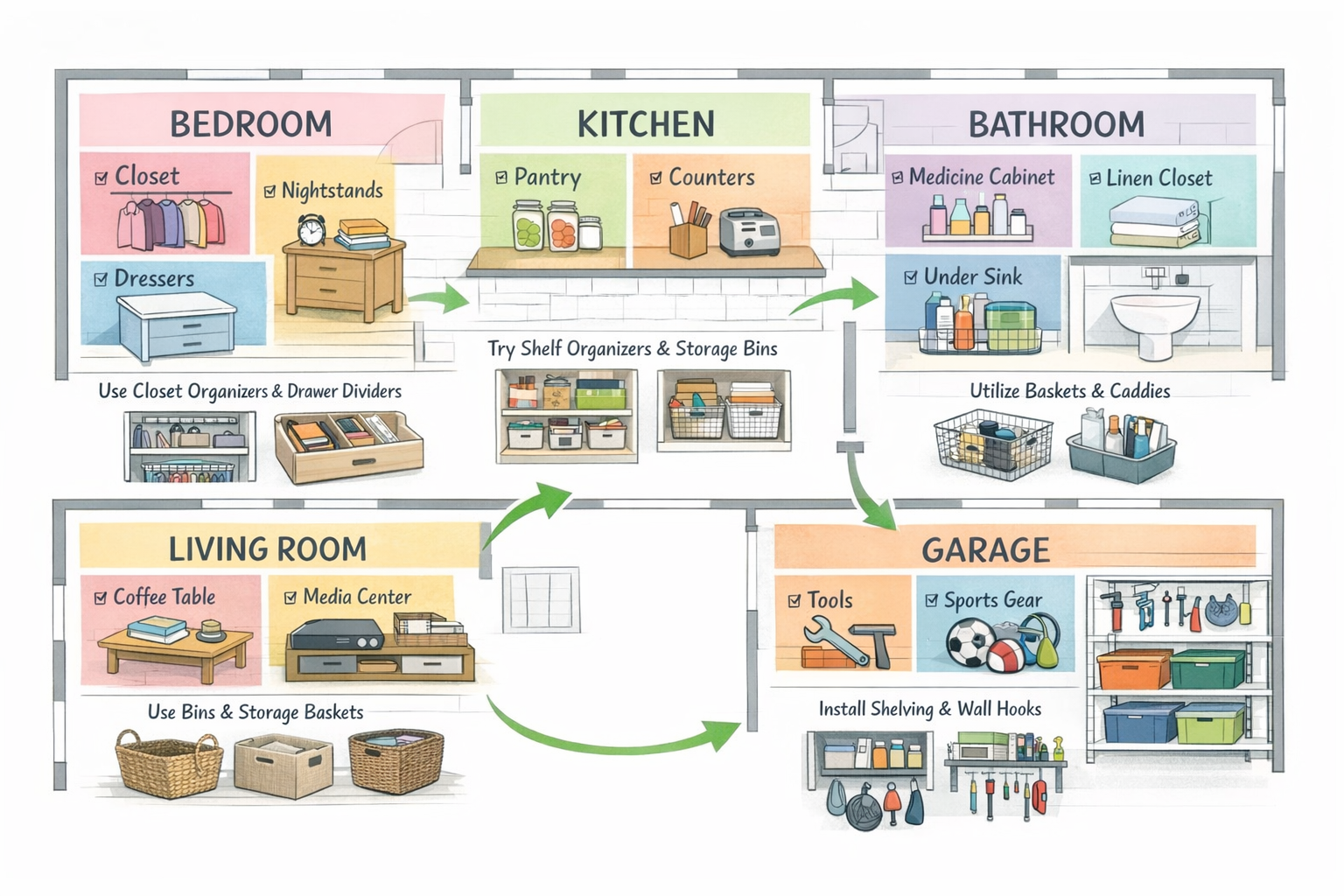
Different rooms accumulate different types of clutter and require tailored approaches based on their primary functions. Here’s how to tackle each major area of your home effectively.
Bedroom Decluttering
Bedrooms should promote rest and relaxation, which means removing work items, exercise equipment, and anything that creates visual stress.
Priority zones:
- Closet: Remove clothes that don’t fit, are damaged, or haven’t been worn in 12+ months
- Nightstand: Keep only current reading material, necessary medications, and one or two meaningful items
- Under the bed: Should be empty or contain only seasonal storage in labeled containers
- Dresser top: Clear completely except for daily essentials like a jewelry tray or lamp
Clothing decision framework: Try the hanger trick. Turn all hangers backward, then flip them forward only after wearing that item. After three months, donate everything still facing backward.
Kitchen and Pantry Decluttering
Kitchens accumulate duplicate tools, expired food, and single-use gadgets that waste valuable storage space.
What to remove:
- Expired food, spices older than 2 years, stale items
- Duplicate tools (you don’t need three can openers)
- Gadgets used less than twice yearly
- Chipped dishes, mismatched containers without lids
- Promotional cups, excess coffee mugs
Keep only: One set of daily dishes, essential cooking tools you actually use, food you’ll consume within reasonable timeframes, and appliances that earn their counter space.
Bathroom Decluttering
Bathrooms collect expired products, sample sizes, and half-empty bottles that create visual chaos in small spaces.
Declutter checklist:
- ✓ Expired medications and cosmetics (mascara after 3 months, sunscreen after expiration date)
- ✓ Dried-up nail polish, old razors, empty bottles
- ✓ Hotel samples you’ll never use
- ✓ Duplicate hair tools, unused beauty products
- ✓ Towels that are threadbare or mismatched
Organization tip: Use drawer dividers for small items and clear containers for visibility. If you can’t see it, you’ll forget you have it and buy duplicates.
Living Room and Common Areas
These spaces collect everyone’s belongings, making them clutter magnets that require regular maintenance.
Focus areas:
- Media centers: Remove old DVDs, tangled cables, broken remotes, outdated gaming equipment
- Bookshelves: Keep books you’ll reread or reference; donate the rest
- Coffee tables: Should be clear except for current reading or one decorative element
- Side tables: Limit to lamp, coaster, and one personal item
The one-in-one-out rule: When something new enters these shared spaces, something old must leave. This prevents accumulation over time.
Home Office and Paper Clutter
Paper clutter multiplies quickly and creates both physical and mental overwhelm in workspaces.
Paper sorting system:
- Shred: Financial documents older than 7 years (except tax returns), junk mail with personal info
- File: Current tax documents, insurance policies, warranties for owned items
- Action: Bills to pay, forms to complete, items requiring response
- Recycle: Everything else
Digital strategy: Scan important documents and store them in organized cloud folders with clear naming conventions. Physical copies of most papers aren’t necessary in 2026.
Office supplies: Keep one of each tool type. Donate excess pens, notepads, and supplies to schools or community centers.
Garage and Storage Areas
Garages become dumping grounds for items people don’t want to decide about, making them the most challenging spaces to declutter.
Systematic approach:
- Remove everything from one section (don’t try to do the entire garage at once)
- Sweep and clean the empty area
- Sort items using the four-box method
- Return only Keep items, grouped by category (tools together, sports equipment together, seasonal items together)
- Install appropriate storage (pegboards for tools, overhead racks for seasonal items)
Broken item rule: If you haven’t repaired it in 6 months, you won’t. Either fix it this week or dispose of it.
Seasonal evaluation: Review garage contents twice yearly when switching seasonal items. This prevents years of accumulation.
How to Maintain a Decluttered Space Long-Term
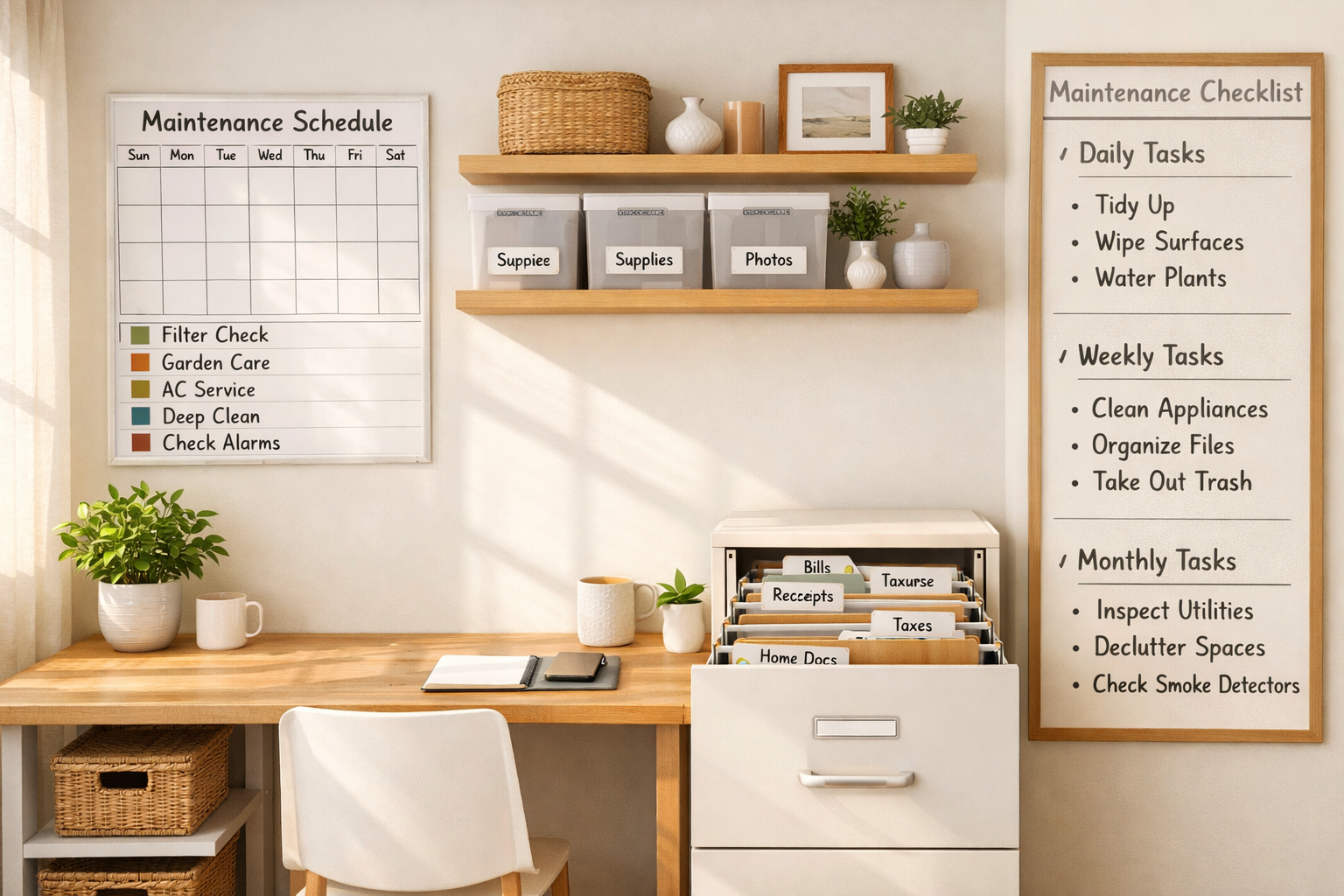
Decluttering once creates temporary relief, but maintenance habits prevent clutter from returning and undoing your hard work. The key is building small routines into existing habits rather than adding major new tasks to your schedule.
Daily maintenance habits (5-10 minutes):
- Put items back in their designated spots before bed
- Process mail immediately (shred, file, or recycle; don’t set it down)
- Do a quick visual scan of main living areas and return misplaced items
- Clear kitchen counters after meals
- Hang up clothes instead of draping them on furniture
Weekly maintenance (15-20 minutes):
- Review one drawer or small area for items that have migrated
- Donate or trash anything new that doesn’t fit your life
- Clear out car clutter and trash
- Process any paper accumulation
- Reassess one category of items (books, clothes, kitchen tools)
Monthly deep maintenance:
- Evaluate one room or major area
- Review purchases from the past month and ensure they’re being used
- Rotate seasonal items in and out of storage
- Donate items that haven’t been used since the last monthly check
The one-in-one-out rule: This is the single most effective maintenance strategy. When you buy a new shirt, donate an old one. New book? Remove one from your shelf. This keeps your total possessions stable instead of constantly growing.
Common maintenance mistakes:
- Buying storage solutions before decluttering (organize less, not more)
- Keeping items “just in case” (if you haven’t needed it in a year, you won’t)
- Accepting free items you don’t need (freebies still take up space)
- Delaying decisions about new items (decide immediately or they become clutter)
Choose maintenance if: You want lasting results and are willing to invest a few minutes daily. Skip it if you prefer periodic deep declutters, though this approach requires more time and energy in the long run.
Common Decluttering Challenges and Solutions
Even with the best strategies, certain obstacles trip up most people attempting to declutter their homes. Here’s how to handle the most common roadblocks.
Sentimental Items
Sentimental clutter is the hardest category because items carry emotional weight beyond their physical presence.
Solutions:
- Take photos of items before donating them (you keep the memory without the object)
- Keep one representative item from a collection rather than everything
- Display meaningful items properly instead of storing them in boxes where you never see them
- Set a specific limit (one memory box per person, one shelf for collections)
- Ask if the person who gave you the item would want you stressed by keeping it
Decision framework: If you can’t remember why an item is meaningful without a long pause, it’s not that important. True sentimental items trigger immediate emotional recognition.
You can’t declutter other people’s belongings without their consent, which complicates shared areas.
Strategies:
- Start with only your personal items in shared spaces
- Lead by example; visible results often inspire others
- Assign each family member a personal space they’re responsible for maintaining
- Set shared standards for common areas (clear counters, no floor clutter)
- Use the “if it’s on the floor, it goes in a donation box” rule for kids’ rooms (with warning)
Communication approach: Focus on benefits (“more space to play,” “easier to find things”) rather than criticism of current habits.
“I Might Need This Someday” Syndrome
This fear-based thinking keeps people surrounded by unused items indefinitely.
Reality check questions:
- When was the last time you used this?
- If you needed it, could you borrow or buy it for less than $20?
- Does keeping it cost more in space and stress than replacing it would?
- Are you keeping it for a realistic future scenario or an imaginary one?
The box test: Put questionable items in a sealed box with today’s date. If you haven’t opened it in 6 months, donate the entire box without looking inside.
Perfectionism and Overwhelm
Waiting for the “perfect” time or system prevents people from starting at all.
Anti-perfectionism strategies:
- Set a timer for just 10 minutes and start anywhere
- Accept that imperfect progress beats perfect inaction
- Focus on improvement, not magazine-worthy results
- Remember that decluttering is a skill that improves with practice
- Give yourself permission to make “wrong” decisions (you can always get another $5 item if needed)
Start messy: Pull everything out, make a bigger mess temporarily, and work through it. Waiting for a clean slate means never beginning.
Decluttering Tools and Resources That Actually Help
Most decluttering requires no special tools, but a few items genuinely make the process easier and more efficient.
Essential supplies:
| Item | Purpose | Cost Range |
|---|---|---|
| Heavy-duty trash bags | Removing trash and donations | $10-15 |
| Boxes or bins | Sorting during the process | $0-20 (use what you have) |
| Label maker or markers | Identifying sorted categories | $5-30 |
| Cleaning supplies | Cleaning empty spaces | $10-20 |
| Donation bags/boxes | Transporting items to charity | Free from donation centers |
Helpful but not required:
- Storage containers (only buy after decluttering to know what you actually need)
- Drawer dividers for organizing small items
- Shelf risers to maximize vertical space
- Vacuum storage bags for seasonal clothing (only for items you’ve decided to keep)
Apps and digital tools:
- Decluttr: Sells used electronics, books, and media
- Facebook Marketplace/Craigslist: Local selling for larger items
- Buy Nothing groups: Free community sharing and donations
- Donation tracking apps: Record charitable donations for tax purposes
What not to buy: Elaborate organizing systems, expensive storage furniture, or specialized containers before you’ve decluttered. These often enable keeping too much stuff rather than solving the underlying problem.
Free resources: Local libraries often host decluttering workshops, and community centers may offer free donation pickup for large items. Many charities provide free pickup services for furniture and large donations.
How Long Does It Take to Declutter Your Home and Space?
The timeline for decluttering depends on your home’s size, the amount of accumulated clutter, and how much time you can dedicate to the process. A single room might take 2-4 hours, while an entire house could require several weeks of consistent effort.
Realistic timeframes:
- Small apartment (500-800 sq ft): 10-15 hours total, spread over 2-3 weeks
- Medium home (1,200-1,800 sq ft): 20-30 hours total, spread over 4-6 weeks
- Large home (2,500+ sq ft): 40-60 hours total, spread over 2-3 months
- Severe hoarding situations: Requires professional help and months of work
Daily time investment options:
- 15 minutes daily: Sustainable long-term, shows results in 3-4 weeks
- 30 minutes daily: Noticeable progress weekly, complete home in 4-8 weeks
- 1 hour daily: Rapid transformation, entire home in 2-4 weeks
- Weekend intensive: 4-6 hours per weekend, complete home in 4-6 weekends
Factors that slow progress:
- Sentimental items requiring emotional processing
- Shared spaces needing family coordination
- Large amounts of paper requiring sorting and shredding
- Items requiring selling rather than simple donation
- Lack of nearby donation centers or pickup services
Factors that speed progress:
- Willingness to donate rather than sell most items
- Clear decision-making criteria established upfront
- Help from family members or friends
- Scheduled donation pickups creating deadlines
- Starting with easy categories to build momentum
Choose the marathon approach (15-30 minutes daily) if you want sustainable habits and have a busy schedule. Choose the sprint approach (weekend intensives) if you need quick results for an upcoming move or event and can handle the physical and emotional intensity.
Decluttering Mistakes to Avoid
Learning from common mistakes saves time and prevents frustration during the decluttering process.
Top mistakes people make:
- Starting with sentimental items: These require the most emotional energy and decision-making skill. Build your decluttering muscles on easier categories first.
- Buying organizing products first: You can’t know what storage you need until you know what you’re keeping. Declutter first, organize second, buy storage last.
- Creating a “maybe” pile: This just delays decisions. Force yourself to choose Keep, Donate, Trash, or Relocate for every item.
- Trying to sell everything: Selling takes significant time and energy. Unless an item is worth $50+, your time is better spent donating and moving on.
- Decluttering without a plan: Randomly pulling things out creates a bigger mess. Choose a specific area, set a time limit, and have your boxes ready.
- Keeping broken items to fix “someday”: If you haven’t fixed it in 6 months, you won’t. Either repair it this week or let it go.
- Organizing clutter instead of removing it: Neatly arranged items you don’t use are still clutter. Remove first, organize what remains second.
- Going it alone when you need help: Severe clutter or hoarding situations require professional organizers or therapists who specialize in these issues.
Edge case: If you’re decluttering due to grief, downsizing aging parents, or other emotionally charged situations, consider hiring a professional organizer who specializes in these transitions. The investment often pays for itself in reduced stress and better decisions.
The Psychology Behind Clutter and Letting Go
Understanding why we accumulate and keep unnecessary items helps address the root causes rather than just the symptoms of clutter.
Common psychological reasons for clutter:
- Sunk cost fallacy: Keeping items because of what you paid, even though the money is gone regardless
- Aspirational identity: Holding onto items for the person you wish you were rather than who you are
- Scarcity mindset: Fear that you won’t have enough if you let things go
- Guilt avoidance: Keeping gifts or inherited items out of obligation
- Decision fatigue: Finding it easier to keep everything than make individual choices
Mental shifts that help:
- Focus on present value: Does this item serve your life right now, today?
- Recognize opportunity cost: The space and mental energy clutter takes could be used for things you actually enjoy
- Reframe waste: The waste happened when you bought something you didn’t use, not when you donate it
- Honor gifts by using them: Keeping gifts in boxes doesn’t honor the giver; using them or passing them to someone who will does
- Accept identity changes: You’re not the same person you were 5 years ago, and your possessions should reflect who you are now
When clutter indicates deeper issues:
If you find yourself unable to discard obvious trash, feeling severe anxiety about letting go of clearly broken items, or if clutter is affecting your health and safety, you may be dealing with hoarding disorder. This requires professional help from a therapist specializing in hoarding, not just organizing advice.
Normal decluttering challenges involve difficulty with sentimental items or “maybe” categories. Clinical hoarding involves difficulty discarding any items, including trash, and causes significant distress or impairment in daily life.
Frequently Asked Questions
How often should you declutter your home?
Declutter major areas 1-2 times per year, with quick maintenance decluttering sessions monthly. High-traffic areas like entryways and kitchens benefit from weekly quick scans to prevent accumulation.
What should you not throw away when decluttering?
Keep important documents (birth certificates, passports, property deeds, tax records from the past 7 years), items with genuine sentimental value that you display or use, and anything you use regularly. Don’t discard other people’s belongings without permission.
How do you declutter when you’re emotionally attached to everything?
Start with easy categories like expired food or broken items where decisions are obvious. Build your decision-making skills before tackling sentimental items. Take photos of meaningful items before donating them, and remember that memories live in you, not in objects.
Should you declutter before or after cleaning?
Always declutter before deep cleaning. Cleaning around clutter wastes time and energy. Remove unnecessary items first, then clean the empty space, then organize what remains.
How do you declutter without being wasteful?
Donate usable items to charities, shelters, or community organizations. Sell valuable items. Recycle what you can. Compost appropriate materials. The waste happened when you bought something you didn’t need, not when you responsibly rehome it.
What’s the fastest way to declutter a room?
Set a 20-minute timer and use the four-box method. Focus only on obvious decisions (trash, clearly unused items). Save difficult decisions for later. Remove donation and trash boxes immediately when the timer ends.
How do you declutter when you live with a hoarder?
You can’t force someone to declutter, but you can set boundaries for shared spaces and take care of your personal areas. Hoarding disorder requires professional help. Focus on safety issues and encourage the person to seek therapy specializing in hoarding.
Where should you donate decluttered items?
Goodwill, Salvation Army, and local thrift stores accept most household items. Homeless shelters need toiletries and clothing. Libraries take books. Schools need office supplies. Animal shelters use towels and blankets. Check donation centers’ current needs before dropping off items.
How do you declutter papers and documents?
Sort into four categories: shred (old financial documents with personal info), file (current important documents), action (bills to pay, forms to complete), and recycle (everything else). Scan important documents and store them digitally with organized file names.
Can decluttering really reduce stress and anxiety?
Yes, for most people. Visual clutter competes for attention and creates low-level stress. Decluttered spaces reduce decision fatigue, make it easier to find needed items, and create a sense of control. However, if anxiety persists after decluttering, it may have other causes requiring professional support.
How do you maintain a decluttered home with kids?
Assign each child a personal space they’re responsible for. Use the one-in-one-out rule for toys. Do regular toy rotations to keep variety without volume. Make decluttering a game with timers and rewards. Model the behavior you want to see.
What if you regret getting rid of something?
This rarely happens, and when it does, most items can be replaced inexpensively if truly needed. Keep a “maybe” box for 30 days before final donation if you’re worried. After 30 days, donate without opening it. The anxiety about potential regret is usually worse than actual regret.
Key Takeaways
- Start small and build momentum by decluttering one drawer or shelf before tackling entire rooms, which prevents overwhelm and builds decision-making confidence
- Use the four-box method (Keep, Donate, Trash, Relocate) to simplify decisions and maintain forward progress without getting stuck in analysis paralysis
- Declutter before organizing or buying storage because you can’t effectively organize items you don’t need, and storage solutions should fit what you’re keeping, not enable keeping too much
- Focus on current use and value rather than past cost, future “maybes,” or guilt about gifts when deciding what stays and what goes
- Establish daily maintenance habits like the one-in-one-out rule and immediate mail processing to prevent clutter from accumulating again after your initial effort
- Different spaces require different strategies based on their function, with kitchens needing expiration checks, bedrooms needing clothing evaluations, and offices requiring paper management systems
- Donate rather than sell most items unless they’re worth $50+ because selling consumes significant time and energy that could be better spent on continued decluttering
- Address the psychology of clutter by recognizing patterns like sunk cost fallacy, aspirational identity, and scarcity mindset that keep you holding onto unused items
- Set realistic timeframes based on your home size and available time, expecting 2-3 weeks for small spaces and 2-3 months for large homes when working 15-30 minutes daily
- Seek professional help if you’re dealing with severe hoarding, emotionally charged situations like grief or downsizing elderly parents, or if clutter is affecting your health and safety
Conclusion
Learning how to declutter your home and space creates more than just clean surfaces and organized closets. It builds a living environment that supports relaxation instead of generating stress, saves time previously spent searching for lost items or navigating around piles, and gives you control over your surroundings.
The process doesn’t require perfection, expensive organizing systems, or entire weekends of intensive work. Small, consistent actions using simple strategies like the four-box method create lasting change. Start with one drawer today, spend 15 minutes making clear decisions, and immediately remove what you’re not keeping. That single completed space will motivate you to tackle the next area.
Your next steps:
- Choose one small area (a drawer, shelf, or cabinet) to declutter in the next 24 hours
- Gather four boxes or bags and label them Keep, Donate, Trash, and Relocate
- Set a timer for 15 minutes and sort every item in that space
- Immediately handle the boxes (trash to bin, donations to car, relocate items to proper rooms)
- Schedule your next 15-minute session for tomorrow
The decluttered, peaceful home you want is built one small decision at a time. Start today with just one drawer, and you’ll be surprised how quickly momentum builds toward the calm, organized space you deserve.