

Last updated: February 18, 2026
Key Takeaways
- Creating a home retreat that truly feels different requires intentional sensory design, not just aesthetic changes
- The most effective retreat spaces engage all five senses and establish clear psychological boundaries from everyday living areas
- Small spaces can become powerful retreats when you focus on atmosphere, lighting, and purpose-driven design
- Successful home retreats incorporate elements from hospitality design that signal “you’ve arrived somewhere special”
- The difference between a room and a retreat lies in deliberate transitions, rituals, and multisensory experiences
Quick Answer
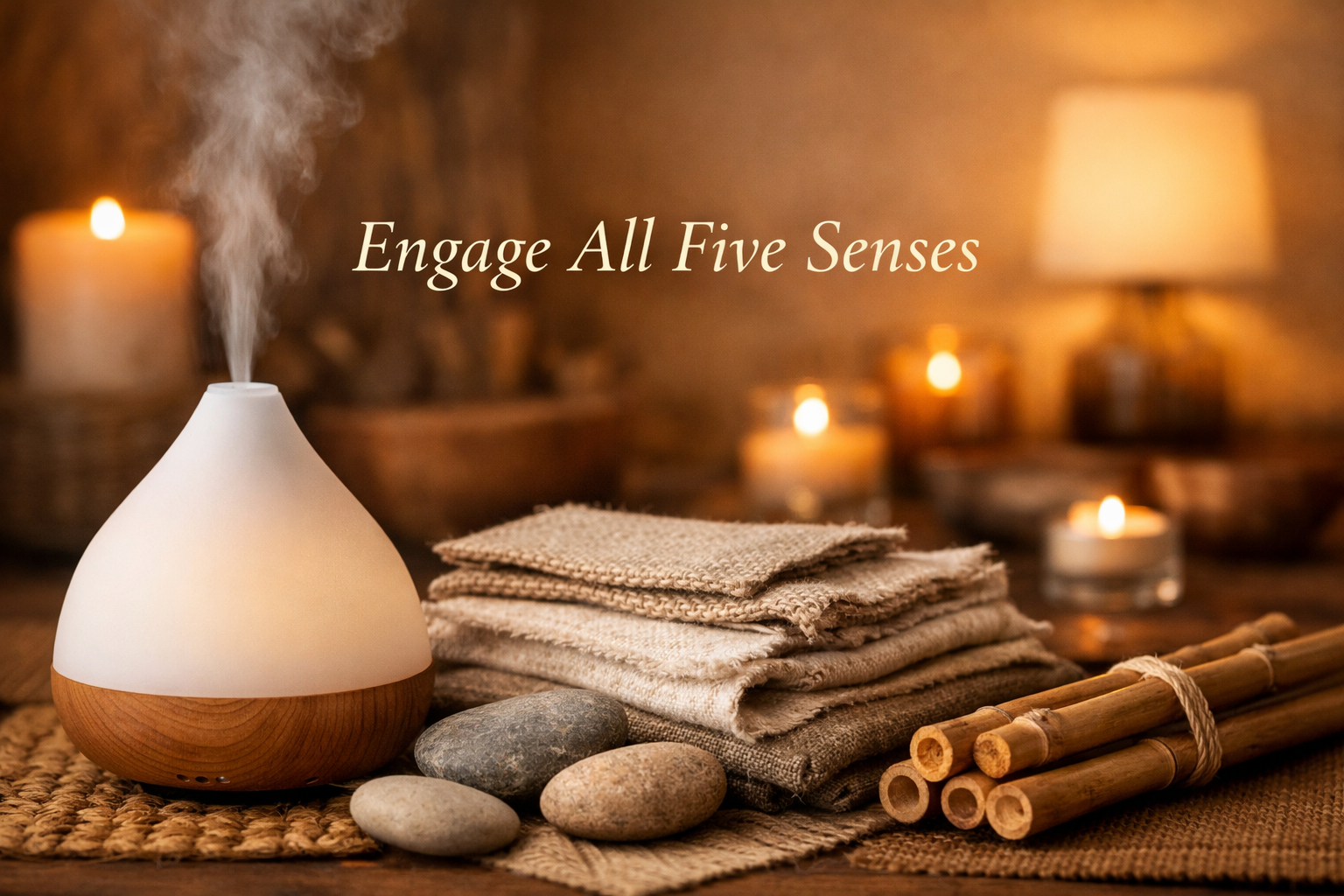
Designing a home retreat that actually feels different means creating a space that triggers a genuine psychological shift away from daily stress. The key is combining sensory design (scent, sound, texture, lighting, and visual cues), clear spatial boundaries that separate the retreat from everyday areas, and intentional rituals that signal you’re entering a different mode. Unlike simply redecorating a room, an effective home retreat uses hospitality design principles to make your brain believe you’ve traveled somewhere new, even when you’re still at home.
What Makes a Home Retreat Actually Feel Different From Regular Rooms?
A home retreat feels different because it creates a complete sensory departure from your everyday environment, not just a visual change. The difference lies in how the space engages your brain’s association patterns and triggers a relaxation response similar to arriving at a vacation destination.
Regular rooms serve functional purposes and blend into your daily routine. Your brain associates them with tasks, responsibilities, and habitual patterns. A true retreat space disrupts these associations through deliberate design choices that signal “this place is different.”
Essential elements that create the distinction:
- Sensory contrast – The space smells, sounds, and feels noticeably different from the rest of your home
- Threshold rituals – Physical or symbolic transitions that mark entry into the retreat (removing shoes, lighting a candle, changing music)
- Purpose clarity – The space serves one specific relaxation function rather than multiple competing uses
- Hospitality cues – Design elements borrowed from hotels and spas that your brain recognizes as “retreat” signals
- Visual separation – Clear boundaries that prevent everyday clutter and concerns from bleeding into the space
Common mistake: Many people redecorate a room with calming colors and comfortable furniture but continue using it for work emails, scrolling social media, or other daily activities. Without behavioral boundaries and sensory distinction, the space never becomes a true retreat.
Choose this approach if you find yourself unable to relax at home even in “nice” rooms, or if staycations feel disappointing because your environment doesn’t shift your mental state.
How Do You Create Sensory Boundaries When Designing a Home Retreat?
Creating sensory boundaries means establishing distinct smell, sound, texture, lighting, and visual experiences that exist only in your retreat space. These boundaries train your brain to recognize the space as fundamentally different from the rest of your home.
Start with scent, which is the most powerful memory and mood trigger. Choose a specific fragrance (essential oil blend, incense, or candle scent) that you use exclusively in your retreat space and nowhere else in your home. Your brain will begin associating that scent with relaxation within just a few uses.
Sensory boundary strategies:
- Scent layer – Use a signature fragrance only in the retreat (lavender-eucalyptus, sandalwood, or jasmine work well)
- Soundscape – Install a small speaker that plays nature sounds, ambient music, or white noise distinct from other rooms
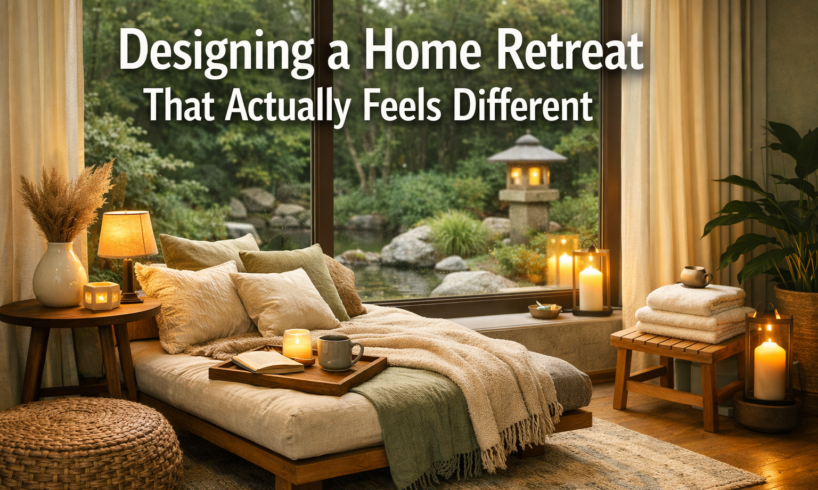
- Texture contrast – Introduce materials not found elsewhere: silk cushions, wool throws, linen curtains, or bamboo mats
- Lighting shift – Use warm-toned bulbs (2700K or lower), dimmers, or candles instead of overhead lighting
- Temperature control – Keep the retreat slightly warmer or cooler than the rest of your home
Practical example: A home retreat in a spare bedroom might use bergamot essential oil (never used elsewhere), play gentle rain sounds from a dedicated speaker, feature a thick wool rug not found in other rooms, use only table lamps with amber bulbs, and maintain a temperature two degrees warmer than the rest of the house.
Edge case: In studio apartments or very small homes, sensory boundaries become even more important because you can’t rely on physical separation. A corner retreat in a studio should have maximum sensory contrast to compensate for minimal spatial separation.
The goal is creating what hospitality designers call a “sensory signature” – a combination of cues that your brain recognizes as belonging exclusively to one place and purpose.
What Are the Key Design Elements for Designing a Home Retreat That Actually Feels Different?
The key design elements combine spatial planning, material selection, and atmospheric control to create an environment that feels transported from ordinary life. Focus on threshold design, layered lighting, natural materials, and intentional emptiness.
Threshold and entry design creates the psychological transition. Your retreat needs a clear “gateway” that marks crossing from everyday space into retreat mode. This might be a curtain, a doorway, a change in flooring material, or even a symbolic boundary like a beautiful rug edge.
Essential design components:
Spatial elements:
- Clear entry threshold (doorway, curtain, room divider, or visual boundary)
- Minimal furniture focused on comfort rather than function
- Dedicated storage that hides all non-retreat items
- Views of nature or calming imagery (real windows or quality nature photography)
- Ceiling height perception (use vertical elements or paint to make space feel taller)
Material palette:
- Natural fibers (linen, cotton, wool, silk)
- Wood elements (bamboo, teak, or light oak)
- Stone or ceramic accents
- Living plants (pothos, snake plants, or peace lilies)
- Avoid synthetic materials, plastic, and metal when possible
Atmospheric control:
- Layered lighting (ambient, task, and accent at different levels)
- Temperature regulation (space heater, fan, or thermostat control)
- Air quality (plants, air purifier, or open windows)
- Sound management (soft surfaces that absorb noise, sound machines)
Color psychology application:
- Soft neutrals (cream, beige, warm gray) as base
- One or two accent colors from nature (sage green, dusty blue, terracotta)
- Avoid high-contrast or energizing colors (bright red, electric blue, stark white)
Common mistake: Over-furnishing the space with too many “relaxing” items. Retreat spaces need breathing room and visual simplicity. Three well-chosen pieces beat ten mediocre ones.
Decision rule: Choose each element by asking “Does this help me forget I’m at home?” If an item reminds you of daily tasks or looks like it belongs in your regular living space, it doesn’t belong in your retreat.
How Can Small Spaces Become Effective Home Retreats?
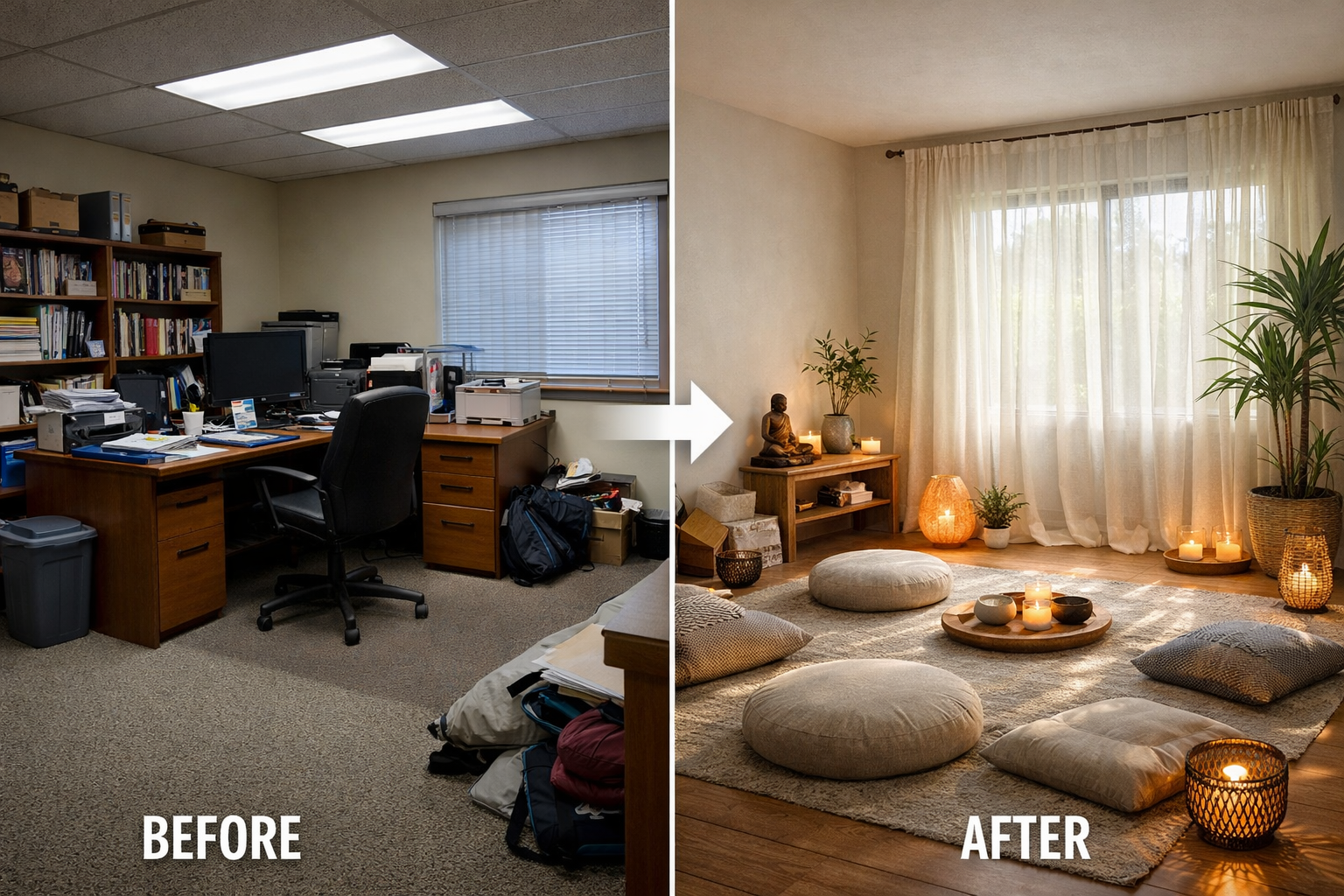
Small spaces can become powerful retreats by maximizing sensory impact and psychological boundaries rather than relying on square footage. A 4×6 foot corner can function as effectively as a full room when designed with intention.
The advantage of small retreat spaces is their ability to create cocoon-like environments that feel protective and separate. Focus on vertical design, multisensory layering, and clear purpose definition.
Small-space retreat strategies:
Maximize vertical space:
- Install floating shelves for plants and candles at eye level
- Use floor-to-ceiling curtains to create enclosure
- Hang fabric panels or tapestries to define boundaries
- Add wall-mounted lighting to save floor space
Create enclosure without walls:
- Position furniture to face away from the main room
- Use folding screens or room dividers
- Hang sheer curtains from ceiling tracks
- Place tall plants as natural barriers
Multi-sensory intensification:
- Layer three different light sources (candle, lamp, string lights)
- Combine two complementary scents (diffuser plus incense)
- Include varied textures within arm’s reach (cushions, throws, rug)
- Add a small water feature for sound
Furniture for small retreats:
- Floor cushions or meditation pillows (store easily)
- Folding chair with premium cushion
- Small side table for tea and books
- Wall-mounted fold-down desk for journaling
Quick example: A 5×5 foot bedroom corner becomes a retreat with: a floor cushion facing the corner, a small bookshelf with plants and candles, a curtain hung from a ceiling track creating a semi-circle enclosure, a small Bluetooth speaker playing nature sounds, and a essential oil diffuser. Total cost under $300, setup time under three hours.
Edge case: If you share your living space with others, use portable elements that can be set up and stored. A retreat “kit” in a decorative basket (cushion, candle, essential oil, small speaker, throw blanket) can transform any quiet corner temporarily.
The key is creating maximum sensory difference in minimum space, so your brain registers the shift even though you haven’t traveled far physically.
What Mistakes Do People Make When Designing a Home Retreat That Actually Feels Different?
The biggest mistake is treating retreat design as pure aesthetics rather than psychological architecture. People create beautiful spaces that fail to shift their mental state because they ignore behavioral patterns and sensory programming.
Critical design mistakes:
Mixing purposes in the space:
- Using the retreat for work calls, watching TV, or checking email
- Storing everyday items (work files, bills, laundry) in the retreat
- Allowing the space to become a dumping ground between uses
- Why it fails: Your brain can’t associate the space with relaxation if you also use it for stress-inducing activities
Insufficient sensory distinction:
- Using the same lighting, scents, and sounds as the rest of the home
- Choosing materials and textures already present in other rooms
- Maintaining the same temperature and air quality
- Why it fails: Without sensory contrast, your brain doesn’t register arriving somewhere different
Ignoring threshold rituals:
- Walking directly into the space without transition
- Skipping entry behaviors that signal mode-switching
- Treating the retreat like any other room
- Why it fails: Rituals train your nervous system to shift states; without them, the space feels ordinary
Over-stimulation through design:
- Too many colors, patterns, or decorative elements
- Multiple competing focal points
- Bright or harsh lighting
- Busy artwork or stimulating imagery
- Why it fails: Retreat spaces need visual calm to support mental calm
Neglecting maintenance and refresh:
- Letting dust, clutter, or disorder accumulate
- Never changing scents, sounds, or small details
- Using the space so rarely it feels unfamiliar
- Why it fails: Retreats need both consistency (same sensory cues) and freshness (periodic small updates)
Budget misallocation:
- Spending heavily on furniture while ignoring lighting and scent
- Buying expensive decor instead of investing in quality textiles
- Focusing on visual elements while neglecting sound and temperature
- Why it fails: Comfort and atmosphere matter more than aesthetics
Decision rule: Before adding anything to your retreat, ask “Will this help me relax, or does it just look nice?” If the answer is only aesthetic, reconsider.
Common edge case: People create retreats that work beautifully at first but stop feeling special after a few weeks. This happens when the space lacks ritual entry and exit behaviors. The solution is establishing a 2-3 minute transition routine (lighting candle, changing clothes, playing specific music) that you perform every time you enter.
How Do You Maintain the “Different” Feeling Over Time in Your Home Retreat?
Maintaining the retreat feeling requires balancing consistency in core elements with periodic refreshes in details. Your brain needs stable sensory cues to recognize the space while avoiding habituation that makes it feel ordinary.
Keep your signature scent, lighting approach, and spatial layout consistent – these are the anchors your brain uses to identify the retreat. Change smaller elements seasonally to maintain novelty and prevent the space from becoming invisible through familiarity.
Maintenance strategies for lasting impact:
Preserve core sensory anchors (never change):
- Primary scent signature
- Lighting temperature and approach
- Spatial layout and furniture placement
- Threshold ritual and entry sequence
Rotate supporting elements (change seasonally):
- Accent scents (add seasonal notes to your signature scent)
- Throw pillows and blankets (different textures each season)
- Artwork or nature photography
- Plants and fresh flowers
- Background sounds or music playlists
Weekly maintenance rituals:
- Deep clean to remove dust and maintain freshness
- Refresh scent diffusers or replace candles
- Launder textiles (cushion covers, throws)
- Tend to plants and remove dead leaves
- Test and adjust lighting
Monthly refresh practices:
- Rearrange small decorative elements
- Introduce one new texture or material
- Update reading materials or journals
- Change seasonal elements (flowers, natural objects)
- Assess what’s working and what feels stale
Quarterly deep refresh:
- Deep clean all textiles and surfaces
- Evaluate and update scent palette
- Consider one small furniture or layout adjustment
- Refresh plants or introduce new varieties
- Update sound library or ambient recordings
Prevent habituation:
- Use the retreat regularly (3-5 times per week minimum) but not constantly
- Maintain strict boundaries about retreat-only activities
- Never bring work, phones, or daily stress into the space
- Keep the space special by limiting access to yourself (or one other person)
Quick example: A home retreat maintains its power by keeping the same lavender-bergamot scent and warm lighting year-round, while rotating throw pillows from linen (spring) to cotton (summer) to velvet (fall) to wool (winter), changing artwork quarterly, and introducing seasonal flowers monthly.
Edge case: If your retreat starts feeling ordinary despite maintenance, you may have habituated to the sensory cues. The solution is a 2-3 week break from the space followed by changing 2-3 supporting elements (new scent layer, different textiles, rearranged furniture) before returning.
The goal is creating a space that feels both familiar (safe, recognizable) and special (distinct, intentional) every time you enter.
What Budget Ranges Work for Designing a Home Retreat That Actually Feels Different?
Effective home retreats can be created at any budget from $150 to $5,000+, with the key difference being material quality and space size rather than effectiveness. The psychological impact depends more on sensory design and intentionality than expensive furnishings.
Budget allocation should prioritize sensory elements (scent, lighting, sound) and comfort (textiles, seating) over decorative items or furniture. A $200 retreat with excellent lighting and premium textiles will outperform a $2,000 retreat with expensive furniture but poor atmospheric design.
Budget tiers and what they deliver:
| Budget Range | What You Can Create | Priority Investments |
|---|---|---|
| $150-$300 | Corner retreat in existing room | Essential oil diffuser, warm LED bulbs, floor cushion, throw blanket, small speaker |
| $300-$800 | Dedicated small space (closet, nook) | Above plus: quality meditation cushion, linen curtains, area rug, plants, better textiles |
| $800-$1,500 | Full room conversion (basic) | Above plus: comfortable chair, layered lighting, sound system, room divider, premium materials |
| $1,500-$3,000 | Full room conversion (elevated) | Above plus: quality furniture, multiple seating options, smart lighting, temperature control |
| $3,000-$5,000+ | Luxury home retreat | Above plus: custom built-ins, premium textiles, professional design, specialty features |
Essential budget allocation (any tier):
- 30% – Lighting (bulbs, lamps, dimmers, candles)
- 25% – Textiles (cushions, throws, curtains, rugs)
- 20% – Scent and sound (diffuser, oils, speaker, sound machine)
- 15% – Seating or floor comfort
- 10% – Plants, natural elements, storage
Money-saving strategies without sacrificing impact:
- Buy quality textiles secondhand (linen curtains, wool throws)
- Use paint to transform existing furniture instead of buying new
- Collect natural elements (stones, driftwood, branches) for free
- Invest in one excellent light fixture rather than multiple mediocre ones
- Choose multi-purpose items (ottoman that stores blankets)
- DIY simple elements (fabric wall hangings, painted screens)
Where to invest more:
- Seating comfort (your body will tell you if it’s worth it)
- Lighting quality (cheap bulbs and fixtures undermine atmosphere)
- Essential oils (synthetic fragrances can trigger headaches)
- Natural fiber textiles (they feel and perform better)
Where to save:
- Decorative objects (natural elements work as well as purchased decor)
- Furniture quantity (less is more in retreats)
- Trendy items (classic, simple designs last longer)
- Storage solutions (repurpose existing baskets and boxes)
Quick example: A $250 budget creates an effective retreat with: $60 for a quality floor cushion, $40 for warm LED bulbs and dimmer, $35 for essential oil diffuser and oils, $30 for a Bluetooth speaker, $45 for a soft throw blanket, $25 for sheer curtains, $15 for plants. The remaining budget covers candles and small decorative elements.
Decision rule: If you’re choosing between a more expensive decorative item and better lighting or textiles, always choose lighting or textiles. Atmosphere beats aesthetics in retreat design.
How Do Different Types of Travelers Approach Home Retreat Design?
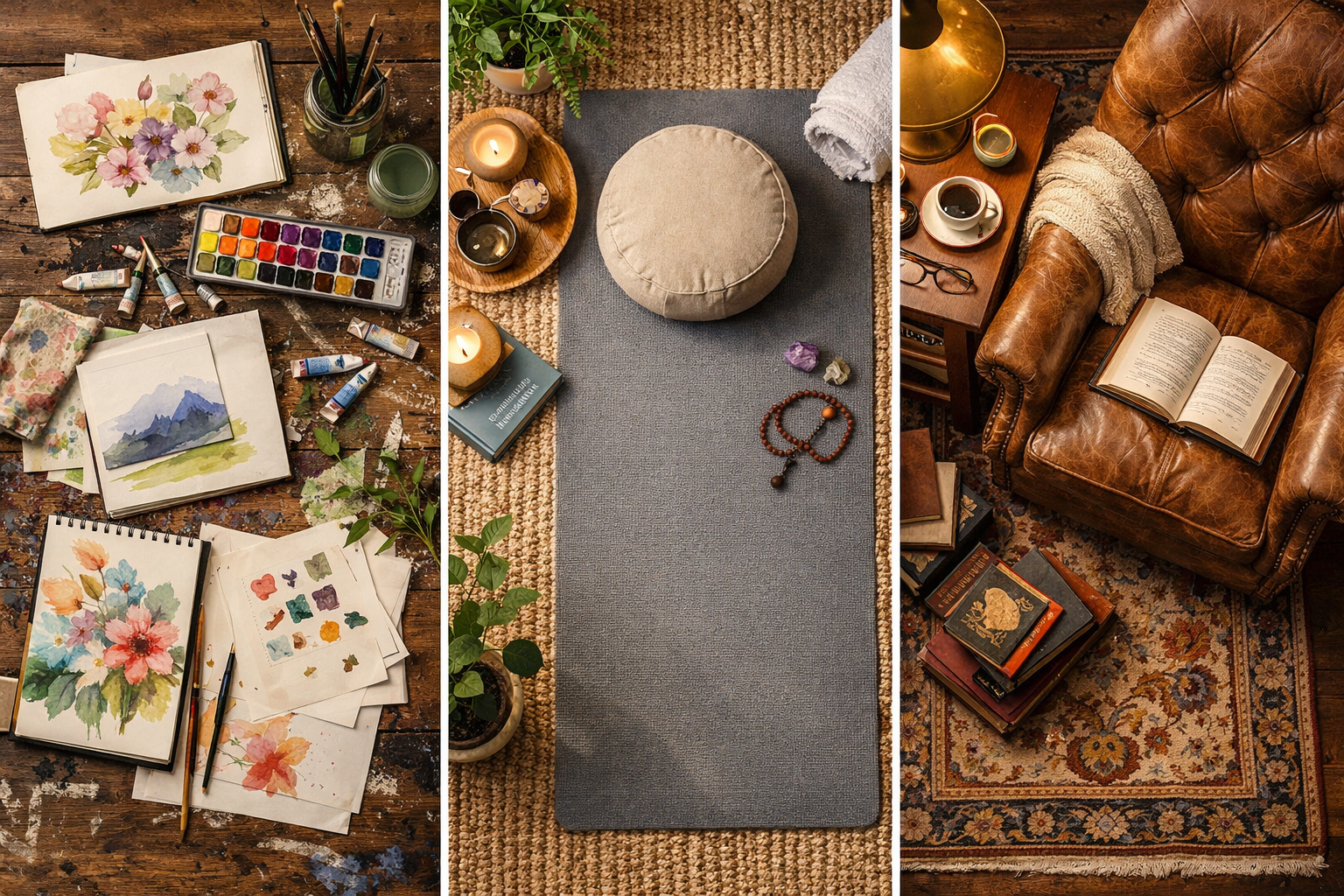
Different traveler personalities bring distinct priorities to home retreat design based on what they value most in travel experiences. Understanding your travel style helps you design a retreat that delivers the specific feelings you seek when you’re away.
Luxury resort travelers prioritize comfort, premium materials, and spa-like atmospheres. Their home retreats should emphasize high-quality textiles, sophisticated scent profiles, and hotel-inspired amenities.
Adventure travelers value unique experiences and connection to nature. Their retreats work best with natural materials, outdoor views or nature imagery, and elements that evoke specific destinations.
Cultural explorers seek authentic experiences and learning. Their retreat spaces benefit from global textiles, meaningful objects from travels, and dedicated areas for reading or creative pursuits.
Wellness retreat enthusiasts focus on restoration and mindfulness. Their home retreats should include meditation spaces, yoga areas, and elements supporting specific wellness practices.
Beach and tropical travelers crave relaxation and escape. Their retreats succeed with light colors, natural fibers, water features, and tropical plants.
Retreat design by traveler type:
For luxury resort lovers:
- Invest in hotel-quality linens and towels
- Use high-end scents (luxury candles, premium essential oils)
- Include a beverage station (tea setup, small fridge)
- Add plush robes and slippers
- Focus on temperature control and comfort
For adventure seekers:
- Incorporate natural materials (wood, stone, rope)
- Display maps or nature photography from favorite destinations
- Use earthy scents (pine, cedar, sage)
- Include a reading nook with travel books
- Add plants that remind you of specific locations
For cultural explorers:
- Feature textiles and objects from meaningful travels
- Create a gallery wall with destination photography
- Include a writing or journaling space
- Use incense or scents from favorite countries
- Display books about cultures and places
For wellness retreat fans:
- Dedicate space for yoga or meditation
- Include singing bowls, meditation cushions, or props
- Use calming scents (lavender, sandalwood, frankincense)
- Add elements for breathwork or mindfulness practice
- Keep the space minimal and distraction-free
For beach lovers:
- Use light, airy colors (white, sand, soft blue)
- Include natural textures (jute, linen, cotton)
- Add water sounds or ocean recordings
- Use coastal scents (coconut, sea salt, citrus)
- Incorporate shells, driftwood, or sea glass
Common mistake: Trying to recreate specific hotels or destinations exactly. Your home retreat should evoke the feelings of travel, not copy specific places. Focus on the emotional experience rather than literal recreation.
Decision rule: Choose your retreat design based on what you miss most when you haven’t traveled recently. If you crave luxury hotel comfort, prioritize textiles and amenities. If you miss adventure and nature, emphasize natural materials and outdoor connections.
What Role Does Lighting Play in Making a Home Retreat Feel Genuinely Different?
Lighting is the single most powerful tool for creating psychological separation between your retreat and the rest of your home. The right lighting triggers your brain’s circadian and emotional responses, signaling that you’ve entered a different environment with different rules.
Most homes use overhead lighting with cool color temperatures (3000K-5000K) that promote alertness and activity. Retreat spaces need warm, layered lighting (2200K-2700K) positioned at multiple levels to create depth, intimacy, and relaxation cues your brain recognizes from hospitality environments.
Lighting principles for retreat spaces:
Color temperature matters intensely:
- 2200K-2400K: Candlelight warmth (most relaxing, evening use)
- 2700K: Warm white (comfortable, versatile for retreats)
- 3000K: Soft white (too cool for most retreats)
- Avoid anything above 3000K in retreat spaces
Layer at three levels:
- Ambient lighting (overall room illumination): warm overhead with dimmer, or multiple table lamps
- Task lighting (reading, activities): adjustable reading lamp with warm bulb
- Accent lighting (atmosphere): candles, string lights, or small LED strips
Light source variety creates depth:
- Combine at least three different light sources
- Use different intensities (bright reading lamp, medium ambient, soft candles)
- Position lights at different heights (floor, table, wall, ceiling)
- Include at least one flame-based light (candle or fireplace)
Control and flexibility:
- Install dimmers on all electric lights
- Use smart bulbs that adjust color temperature
- Create multiple “scenes” (bright for yoga, dim for meditation, medium for reading)
- Always have manual override options
Natural light management:
- Use sheer curtains to diffuse harsh daylight
- Add blackout options for flexibility
- Position seating to benefit from natural light without glare
- Consider time of day when designing lighting schemes
Practical lighting setup for different budgets:
Basic ($40-$80):
- 2-3 warm LED bulbs (2700K) in existing fixtures
- Plug-in dimmer switch
- Quality candles in various sizes
- Optional: battery-operated string lights
Intermediate ($80-$200):
- Above plus: one quality table or floor lamp
- Smart bulbs with app control
- Himalayan salt lamp or similar ambient light
- Better quality candles and holders
Advanced ($200-$500+):
- Above plus: multiple quality light fixtures
- Professional dimmer switches installed
- Layered lighting at all three levels
- Specialty lighting (fiber optic stars, LED strips)
Common mistake: Using only one light source or relying on overhead lighting. Single-source lighting feels flat and institutional. Retreats need depth created by multiple light sources at different levels.
Quick example: A bedroom retreat uses three table lamps with 2700K bulbs on dimmers (ambient), one adjustable reading lamp with 2400K bulb (task), and three candles of varying heights (accent). Total cost: approximately $120. The variety creates a layered, hospitality-quality atmosphere that feels completely different from the overhead fixture used in daily life.
Edge case: If you use your retreat during daytime, you still need artificial lighting options. Natural light alone doesn’t create enough sensory distinction from the rest of your home. Add warm accent lighting even during the day to establish the retreat atmosphere.
Frequently Asked Questions
How much space do you actually need for a home retreat?
You need a minimum of about 4×4 feet (16 square feet) to create an effective home retreat. This allows space for floor seating, a small side table, and enough room to stretch or change positions. Larger is better, but psychological boundaries and sensory design matter more than square footage.
Can you create a retreat space if you live with other people?
Yes, but you need clear boundaries and communication. Designate specific times when the retreat is yours alone, use visual signals (closed door, curtain drawn) that others recognize, and consider portable elements you can set up and store. Shared retreats can work if all users maintain the same behavioral boundaries.
How long does it take to feel the difference in a home retreat?
Most people notice a psychological shift within 2-3 uses if the sensory boundaries are strong. Your brain needs a few experiences to associate the space with relaxation. After 5-7 consistent uses with the same entry ritual, the shift becomes nearly automatic.
Should a home retreat have technology or be completely unplugged?
Minimal, intentional technology works best. A speaker for ambient sound or meditation apps is fine. Avoid TVs, computers, or anything connected to work and daily stress. Keep phones out entirely, or use them only for music/sound apps in airplane mode.
What’s the best room to convert into a home retreat?
Spare bedrooms work well, but any room you can dedicate or partially dedicate works. Avoid converting your primary bedroom unless you can create very clear spatial boundaries. Guest rooms, finished basements, large closets, or even sectioned-off corners of living rooms can all become effective retreats.
How do you know if your home retreat is working?
You should feel a noticeable mental shift within 5-10 minutes of entering the space. Your breathing should slow, muscle tension should decrease, and you should find it easier to let go of daily concerns. If you don’t feel different after 15 minutes, your sensory boundaries or behavioral patterns need adjustment.
Can you use your home retreat every day without it losing effectiveness?
Yes, if you maintain strict behavioral boundaries and entry rituals. Daily use with consistent practices actually strengthens the psychological association. The retreat loses effectiveness when you start using it for non-retreat activities or skip the transition rituals.
What scents work best for home retreats?
Lavender, bergamot, sandalwood, eucalyptus, and frankincense are proven relaxation scents. Choose one or two that you genuinely enjoy and use exclusively in your retreat. Personal preference matters more than “best” scents – if you dislike lavender, it won’t relax you no matter how popular it is.
How often should you update or refresh your retreat space?
Keep core elements (scent, lighting, layout) consistent but refresh supporting details monthly. Change textiles seasonally, rotate small decorative elements every 4-6 weeks, and do a deep clean weekly. Major redesigns should happen no more than once or twice per year.
What if you can’t afford to create a dedicated retreat space?
Start with a retreat kit in a basket: a cushion, throw blanket, candle, essential oil, and small speaker. Set this up in any quiet corner when you need retreat time. Even temporary spaces work if you maintain consistent sensory cues and rituals. Budget: $80-$150 for a complete portable kit.
Should home retreats have windows and natural light?
Natural light is beneficial but not required. If you have windows, use sheer curtains to control harsh light. If your retreat is windowless, compensate with excellent artificial lighting and living plants. Some people prefer enclosed, cocoon-like retreats without windows.
How do you prevent a home retreat from becoming just another room?
Maintain strict behavioral boundaries (never use for work, TV, or daily tasks), perform a consistent entry ritual every time, keep the space impeccably clean, and use it regularly but not constantly. The space should feel special because you treat it differently, not just because it looks different.
Key Takeaways
- Designing a home retreat that actually feels different requires sensory boundaries (scent, sound, texture, lighting, temperature) that exist nowhere else in your home
- The most effective retreats combine threshold rituals, layered warm lighting, natural materials, and strict behavioral boundaries that prevent daily activities from entering the space
- Small spaces work as well as large rooms when you maximize sensory impact and create psychological separation through design
- Lighting is the single most powerful design element – use warm color temperatures (2200K-2700K), multiple sources, and layering at three levels
- Budget matters less than intentionality – a $200 retreat with excellent sensory design outperforms a $2,000 space with poor atmospheric planning
- Maintain effectiveness over time by keeping core sensory anchors consistent while refreshing supporting details monthly and seasonally
- Common mistakes include mixing purposes in the space, insufficient sensory distinction, ignoring entry rituals, and over-stimulating through too many decorative elements
- Your travel personality should guide design choices – luxury travelers need different elements than adventure seekers or wellness enthusiasts
- The space works when you feel a noticeable mental shift within 5-10 minutes of entering, with slowed breathing and reduced muscle tension
- Preserve the “different” feeling through regular use (3-5 times weekly), strict boundaries about retreat-only activities, and consistent entry/exit rituals
Conclusion
Designing a home retreat that actually feels different transforms how you experience relaxation without leaving your house. The difference between a nice room and a true retreat lies in intentional sensory design, psychological boundaries, and consistent rituals that signal to your brain you’ve arrived somewhere special.
Start small if needed. Even a corner with a floor cushion, warm lighting, and a signature scent can create the mental shift you’re seeking. Focus first on the sensory elements that trigger the strongest response for you – whether that’s scent, lighting, texture, or sound. Build from there, adding layers gradually while maintaining strict boundaries about how you use the space.
Your next steps:
- Identify your space – Choose a corner, closet, spare room, or area you can dedicate or partially dedicate to retreat use
- Define your sensory signature – Select a scent, lighting approach, and sound you’ll use exclusively in this space
- Establish your threshold – Create a clear entry point and design a simple ritual (lighting a candle, changing into specific clothes, playing specific music)
- Start with essentials – Invest in warm lighting, one comfortable seating option, and quality textiles before adding decorative elements
- Set behavioral boundaries – Decide what activities belong in your retreat and what stays out (no work, no phones, no daily tasks)
- Use it consistently – Visit your retreat 3-5 times per week with the same entry ritual to strengthen the psychological association
- Maintain and refresh – Clean weekly, update small details monthly, and assess what’s working quarterly
The goal isn’t perfection or expensive design. The goal is creating a space that helps your nervous system shift from daily stress to genuine relaxation. When you walk into your retreat and feel your shoulders drop, your breathing slow, and your mind quiet, you’ve succeeded in designing a home retreat that actually feels different.
Your home can hold space for both your daily life and your need for escape. With intentional design and consistent practice, you’ll have a retreat that delivers the psychological benefits of travel whenever you need them, right where you live.