




Last updated: February 21, 2026
Key Takeaways
- Parents need regular recovery time to maintain physical health, emotional balance, and effective caregiving capacity, not as a luxury but as a basic requirement for sustainable parenting
- Creating shame-free recovery time starts with reframing rest as essential maintenance rather than selfish indulgence, using the same logic applied to a child’s need for sleep or nutrition
- Practical strategies include scheduling non-negotiable recovery blocks, setting clear boundaries with family members, and choosing low-barrier rest activities that fit into existing routines
- Common obstacles like guilt, partner resistance, and lack of time can be addressed through communication scripts, incremental changes, and leveraging existing support systems
- Recovery time doesn’t require hours of spa treatments or expensive getaways—even 15-minute daily breaks provide measurable benefits when protected consistently
Quick Answer
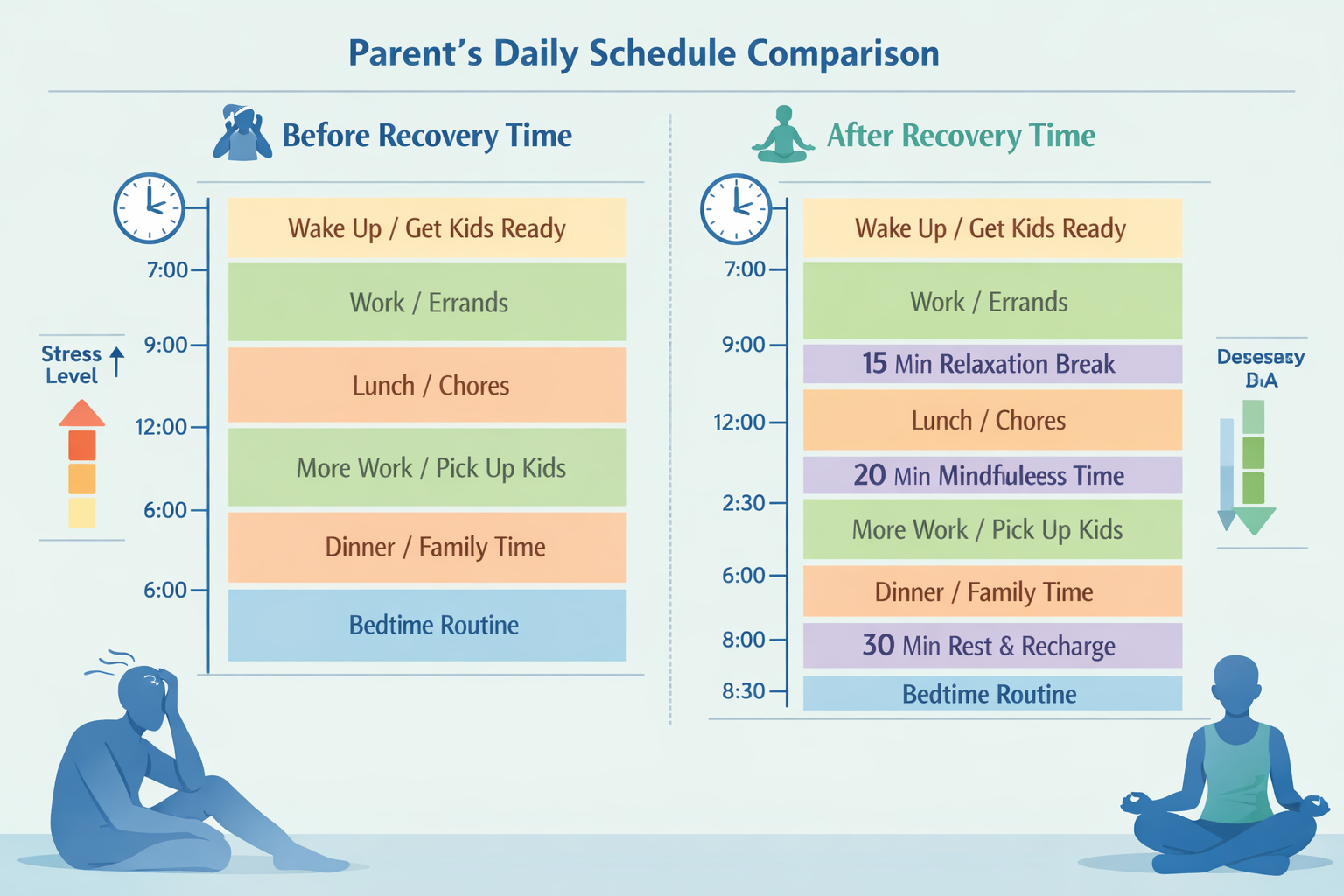
How parents can create recovery time without shame involves treating rest as non-negotiable maintenance rather than earned rewards, scheduling specific recovery blocks into daily routines, communicating boundaries clearly with family members, and choosing accessible rest activities that require minimal setup. The key is rejecting the cultural narrative that parental exhaustion equals dedication and instead recognizing that consistent recovery time improves both parent well-being and caregiving quality.
Parenting in 2026 comes with an unspoken rule: exhaustion is a badge of honor. Parents swap stories about sleepless nights, skipped meals, and postponed doctor appointments like battle scars proving their dedication. But here’s what nobody mentions in those conversations—running on empty doesn’t make anyone a better parent. It just makes them a depleted one.
Understanding how parents can create recovery time without shame starts with dismantling the myth that good parents sacrifice everything, including their own basic needs. Recovery time isn’t about bubble baths and face masks (though those count too). It’s about creating consistent, guilt-free spaces where parents can recharge physically, mentally, and emotionally so they can show up as the caregivers they want to be.
Why Do Parents Struggle to Take Recovery Time?
Parents struggle to take recovery time because cultural narratives equate parental self-care with selfishness, creating an environment where rest feels like abandoning responsibilities rather than maintaining capacity to meet them. This guilt operates on multiple levels—internalized beliefs about what “good parents” do, external judgment from family or social circles, and practical constraints that make rest seem impossible.
The shame around parental recovery time stems from several intersecting factors:
Cultural messaging about parental sacrifice
- Media portrayals consistently show devoted parents as perpetually available and self-sacrificing
- Social media amplifies comparison, where other parents appear to manage everything without needing breaks
- Older generations often share stories of “managing just fine” without recovery time, implying current parents are weak for needing it
Practical barriers that reinforce guilt
- Childcare responsibilities don’t pause, creating legitimate logistical challenges
- Financial constraints make paid help or activities feel inaccessible
- Work schedules already consume most available time, leaving recovery time competing with sleep or household tasks
Gender-specific pressures
- Mothers face particular scrutiny, with maternal self-care often labeled as neglectful despite fathers receiving praise for basic involvement
- Single parents carry compounded pressure without a co-parent to share responsibilities
- Primary caregivers of any gender internalize the belief that their needs come last
The result is parents who intellectually understand they need recovery time but emotionally cannot give themselves permission to take it. Breaking this cycle requires both practical strategies and mindset shifts that address the shame at its source.
What Counts as Recovery Time for Parents?
Recovery time for parents includes any activity that replenishes physical energy, mental clarity, or emotional reserves, ranging from 10-minute breathing exercises to multi-hour solo outings, as long as the activity feels restorative rather than depleting. The specific form matters less than the consistent protection of time dedicated to restoration.
Effective recovery activities share common characteristics rather than fitting one specific template:
Physical restoration activities
- Sleep or naps (the most fundamental recovery mechanism)
- Gentle movement like walking, stretching, or yoga
- Sitting down to eat a meal without interruption
- Taking a shower or bath without rushing
- Getting medical care or attending to health needs
Mental recovery activities
- Reading for pleasure without educational purpose
- Engaging in hobbies that require focus (crafts, puzzles, music)
- Watching shows or movies without multitasking
- Meditation or mindfulness practices
- Simply sitting in silence without stimulation
Emotional recovery activities
- Connecting with friends or partners about non-parenting topics
- Journaling or creative expression
- Therapy or counseling sessions
- Attending religious or spiritual services
- Engaging with nature or outdoor spaces
What doesn’t count as recovery time: Activities that feel obligatory (grocery shopping alone), require high mental load (organizing closets), or involve caring for others’ needs (attending children’s activities) don’t provide genuine recovery even if they occur without kids present.
Choose recovery activities based on what depletes you most. Parents experiencing physical exhaustion need rest and nutrition. Those facing mental fatigue benefit from activities requiring minimal decision-making. Emotional depletion responds to connection or solitude, depending on individual temperament.
How Can Parents Reframe Recovery Time to Reduce Shame?
Parents can reframe recovery time by shifting from “I’m taking time away from my kids” to “I’m maintaining my capacity to care for my kids,” using the same logic applied to other maintenance activities like sleeping, eating, or seeking medical care. This cognitive reframe treats recovery as preventive maintenance rather than selfish indulgence.
Effective reframing strategies:
The oxygen mask principle
Apply the airplane safety instruction to parenting: secure your own oxygen mask before helping others. Parents cannot pour from an empty cup—this isn’t a cliché but a practical reality. Depleted caregivers make more mistakes, have less patience, and experience higher rates of burnout and health problems.
The performance maintenance model
Athletes don’t train 24/7 without rest days. Musicians don’t practice until their hands cramp permanently. Parents shouldn’t expect to caregive continuously without recovery periods. Frame recovery time as essential maintenance that improves performance rather than time stolen from responsibilities.
The role modeling perspective
Children learn relationship patterns by watching their parents. Parents who never rest teach children that self-neglect is normal and expected. Taking recovery time models healthy boundaries, self-respect, and sustainable life management—lessons that serve children throughout their lives.
Language shifts that reduce shame:
| Instead of saying… | Try saying… |
|---|---|
| “I need a break from my kids” | “I need to recharge so I can be present” |
| “I’m being selfish” | “I’m taking care of my health” |
| “I should be able to handle this” | “All humans need recovery time” |
| “Other parents manage fine” | “I don’t know what happens behind closed doors” |
| “My kids need me more than I need rest” | “My kids need a healthy parent” |
Common mistake to avoid: Don’t wait until you’re completely depleted to take recovery time. Preventive rest requires less time than crisis recovery. A parent who takes 20 minutes daily needs fewer emergency mental health days than one who pushes through until breaking.
How Parents Can Create Recovery Time Without Shame: Practical Scheduling Strategies

Creating recovery time without shame requires treating rest as non-negotiable appointments rather than activities that happen “if there’s time,” using the same scheduling commitment applied to work meetings, doctor appointments, or children’s activities. Parents who successfully maintain recovery time schedule it first, then build other activities around it.
Step-by-step scheduling approach:
1. Identify your minimum viable recovery time
Start with what’s actually achievable rather than an ideal scenario. For some parents, this means 15 minutes daily. For others, it’s one hour weekly. The goal is consistency over duration—regular small breaks outperform occasional long ones.
2. Audit your current schedule
Track one week of activities in 30-minute blocks. Look for:
- Time currently spent on low-value activities (mindless scrolling, watching shows you don’t enjoy)
- Moments when someone else could handle tasks (partner, older children, hired help)
- Activities you do from obligation rather than necessity
- Pockets of time that exist but aren’t protected (early mornings, lunch breaks, after bedtime)
3. Schedule recovery time as recurring appointments
Enter recovery time into calendars with the same weight as doctor appointments. Use specific language: “Recovery time—not available” rather than vague blocking. Set reminders and treat these blocks as non-negotiable unless genuine emergencies arise.
4. Communicate the schedule to household members
Share recovery time schedules with partners, older children, and anyone else who might interrupt. Be specific: “Every Tuesday and Thursday from 7-7:30pm, I’ll be in the bedroom with the door closed. Please don’t interrupt unless someone is injured.”
Timing strategies for different family situations:
For parents with partners:
- Alternate recovery blocks (Partner A gets Tuesday/Thursday evenings, Partner B gets Wednesday/Friday evenings)
- Trade weekend mornings (one parent sleeps in Saturday, the other Sunday)
- Coordinate so both parents get simultaneous recovery when childcare is available
For single parents:
- Leverage school hours for recovery, not just errands
- Use children’s screen time strategically for parent rest time
- Trade childcare with other single parents (you watch kids Friday, they watch Saturday)
- Protect children’s bedtime as the start of recovery time, not the start of chores
For parents with inflexible work schedules:
- Claim lunch breaks for actual breaks rather than working through
- Use commute time for recovery (audiobooks, music, silence instead of calls)
- Wake up 20 minutes before household for quiet morning time
- Designate one weekend day as partial recovery day
For parents of young children who don’t nap:
- Implement “quiet time” where children play independently in safe spaces
- Use early bedtimes to create evening recovery windows
- Accept that recovery might happen in shorter, more frequent bursts
- Consider occasional childcare specifically for parent rest, not errands
What Boundaries Help Protect Recovery Time?
Boundaries that protect recovery time include clear communication about availability, physical separation from caregiving spaces, technology limits that prevent interruption, and predetermined criteria for what constitutes a genuine emergency versus a manageable situation. Effective boundaries specify both what parents will do and what they won’t do during recovery periods.
Communication boundaries:
Before recovery time starts:
- “I’ll be unavailable from 2-3pm today. Here’s where the snacks are and what to do if you need something.”
- “Dad is taking recovery time Saturday morning. I’m the parent on duty until noon.”
- “My phone will be on Do Not Disturb. Call this number only for emergencies.”
During recovery time:
- Use door hangers, closed doors, or headphones as visual signals
- Redirect non-emergency requests: “I’ll help you with that at 3pm when my recovery time ends”
- Ignore minor interruptions that others can handle (sibling disputes that aren’t dangerous, requests for non-urgent items)
Emergency criteria:
Define “emergency” clearly for household members. Emergencies include injuries, severe illness, safety threats, or situations beyond the on-duty caregiver’s capacity. Non-emergencies include boredom, minor conflicts, preference questions, or routine requests.
Physical boundaries:
- Dedicated recovery spaces: Claim a specific room or area as off-limits during recovery time (bedroom, bathroom, home office, backyard corner)
- Leave the house: Recovery time away from home eliminates interruption possibilities (coffee shop, library, park, friend’s house, car in parking lot)
- Visual signals: Use consistent markers like a specific blanket, closed door, or headphones that family members learn to recognize
Technology boundaries:
- Enable Do Not Disturb mode with exceptions only for genuine emergency contacts
- Delete social media apps temporarily if they create guilt or comparison
- Turn off notifications from school apps, parenting groups, or work communications
- Use timers to prevent recovery time from being consumed by scrolling
Task boundaries:
Recovery time is for recovery, not productivity. Set clear rules:
- No household chores during recovery time
- No work tasks or professional development
- No planning, organizing, or mental labor
- No guilt about “wasting” time on rest
Choose this approach if: You find yourself constantly interrupted during attempted rest periods, or family members don’t respect recovery time because boundaries aren’t clearly communicated.
How Can Parents Address Guilt During Recovery Time?
Parents can address guilt during recovery time by preparing cognitive responses to shame-inducing thoughts before they arise, using evidence-based self-talk that counters the narrative that rest equals neglect. The goal is not eliminating guilt entirely but preventing it from derailing recovery efforts.
Common guilt triggers and responses:
Guilt trigger: “My kids need me right now”
Response: “My kids need a rested parent more than they need me to respond to every non-urgent request. I’m modeling healthy boundaries.”
Guilt trigger: “Other parents don’t need this much recovery time”
Response: “I don’t know what other parents do in private. Comparison serves no useful purpose. I’m meeting my actual needs, not performing for others.”
Guilt trigger: “I should be able to handle everything”
Response: “No human can provide 24/7 care without breaks. This expectation is unrealistic and harmful. I’m doing what’s sustainable.”
Guilt trigger: “I’m being selfish”
Response: “Meeting basic needs isn’t selfish. I wouldn’t call my child selfish for needing sleep or food. I deserve the same consideration.”
Guilt trigger: “I haven’t earned this rest”
Response: “Rest isn’t a reward for productivity. It’s a requirement for functioning. I don’t need to earn the right to basic self-care.”
Practical guilt-reduction techniques:
The evidence journal
Keep a log of how you show up as a parent after recovery time versus when depleted. Note patience levels, energy for play, emotional regulation, and physical health. Review this evidence when guilt arises to reinforce that recovery time improves parenting quality.
The future-self perspective
Ask: “Will my children remember that I took 30 minutes to rest, or will they remember having a parent who was consistently present and patient because I took that time?” Long-term relationship quality matters more than constant availability.
The role-reversal test
If your child, partner, or friend needed recovery time, would you judge them as harshly as you judge yourself? Apply the same compassion to yourself that you’d extend to others.
The worst-case scenario check
What’s the actual worst outcome if you take recovery time? Usually, someone experiences minor inconvenience or temporary boredom—manageable situations that don’t constitute genuine harm.
Common mistake: Trying to eliminate guilt entirely before taking recovery time. Guilt may persist initially even when taking appropriate rest. The goal is taking recovery time despite guilt, not waiting until guilt disappears.
What Low-Barrier Recovery Activities Work for Busy Parents?
Low-barrier recovery activities for busy parents require minimal setup time, limited financial investment, and short duration options that fit into existing routines, making them accessible even during high-stress periods when elaborate self-care feels impossible. The most sustainable recovery activities can start within five minutes and provide benefits in sessions as short as 10-15 minutes.
Recovery activities requiring zero preparation:
- Breathing exercises: Box breathing (inhale 4 counts, hold 4, exhale 4, hold 4) for 5-10 minutes provides measurable stress reduction
- Sitting in silence: Simply sitting without stimulation, tasks, or conversation for 10 minutes
- Lying down: Horizontal rest with eyes closed, even without sleeping
- Stretching: Basic stretches that release physical tension without requiring yoga experience
- Listening to music: Putting on headphones and focusing only on music for one or two songs
Recovery activities requiring minimal setup (under 5 minutes):
- Short walks: 10-15 minute walks around the block or neighborhood
- Hot beverage ritual: Making and slowly drinking coffee or tea without multitasking
- Shower or bath: Extended time in water without rushing through
- Reading: Keeping a book or e-reader accessible for 15-minute reading sessions
- Journaling: Stream-of-consciousness writing for 10 minutes
Recovery activities using existing resources:
- Car sitting: Sitting in parked car with music or silence before entering the house
- Lunch break protection: Using work lunch breaks for actual rest instead of errands
- Early wake-up: Getting up 20-30 minutes before household for quiet time
- Post-bedtime buffer: Protecting 30 minutes after children’s bedtime before starting chores
- Waiting time conversion: Using time waiting for appointments, pickups, or activities for recovery instead of phone scrolling
Budget-friendly recovery options:
| Activity | Cost | Time needed | Setup required |
|---|---|---|---|
| Meditation apps (free versions) | $0 | 10-30 min | Download app |
| Library visits | $0 | 30-60 min | Library card |
| Nature walks | $0 | 15-45 min | None |
| YouTube yoga/stretching | $0 | 10-30 min | Internet access |
| Audiobooks (library apps) | $0 | Any duration | Library card, app |
| Journaling | $2-5 | 10-20 min | Notebook, pen |
| Bath with Epsom salts | $5-8 | 20-30 min | Bathtub, salts |
Choose this approach if: You’ve avoided recovery time because you think it requires money, time, or resources you don’t have. These activities prove recovery is accessible regardless of constraints.
Edge case: Some parents find traditional “relaxing” activities (meditation, baths) create more stress because they can’t quiet their minds. For these parents, gentle engaging activities (puzzles, coloring, simple crafts, casual games) provide better recovery than passive rest.
How Can Partners and Family Support Parental Recovery Time?
Partners and family can support parental recovery time by taking full responsibility for children and household during designated periods, respecting boundaries without requiring emotional labor from the recovering parent, and proactively offering specific recovery time rather than waiting to be asked. Effective support means the recovering parent can fully disengage without planning, supervising, or managing from a distance.
What effective support looks like:
Full responsibility handoff:
- The supporting partner handles all childcare decisions, meals, activities, and problem-solving during recovery time
- No texting questions, asking for item locations, or requesting guidance unless genuine emergency
- Managing children’s requests for the other parent: “Mom is resting. I can help you with that.”
Proactive scheduling:
- Offering specific recovery time: “I’ll handle everything Saturday morning 8-11am so you can rest” rather than vague “Let me know if you need a break”
- Putting recovery time in shared calendars and protecting it from scheduling conflicts
- Checking in weekly: “What recovery time do you need this week, and when should I plan to cover?”
Eliminating emotional labor:
- Not requiring praise or appreciation during basic support
- Handling tasks completely rather than partially (feeding kids but leaving dishes for later)
- Remembering routines, preferences, and schedules without being reminded
Communication scripts for requesting support:
For partners:
- “I need recovery time Tuesday and Thursday evenings from 7-8pm. Can you handle bedtime those nights?”
- “I’m scheduling a monthly Saturday morning from 9am-noon for recovery time. Let’s put it in the calendar now.”
- “When I’m in recovery time, please don’t interrupt me unless someone is injured. You’re fully capable of handling everything else.”
For extended family:
- “We’d appreciate if you could watch the kids one Sunday afternoon per month so we can both get recovery time.”
- “When you visit, the most helpful thing would be taking the kids to the park for an hour so I can rest.”
- “Please don’t drop by unannounced on weekday evenings—that’s my recovery time.”
For older children:
- “Quiet time is when everyone plays independently in their rooms. This helps Mom/Dad recharge.”
- “When the bedroom door is closed, only knock if it’s an emergency. Here’s what counts as an emergency…”
- “You can help by entertaining your younger sibling during my recovery time.”
What doesn’t count as support:
- Watching children while simultaneously expecting the other parent to plan activities, prepare meals, or answer questions
- Offering recovery time but creating guilt about taking it (“I guess I’ll handle everything while you relax”)
- Supporting recovery time inconsistently or canceling it for non-urgent reasons
- Requiring the recovering parent to be “productive” during recovery time
For single parents without co-parents:
Build a support network through:
- Childcare swaps with other parents (formal or informal)
- Asking extended family for specific, scheduled help
- Hiring occasional childcare specifically for recovery, not errands
- Joining single-parent support groups that organize mutual aid
What Should Parents Do When Recovery Time Feels Impossible?
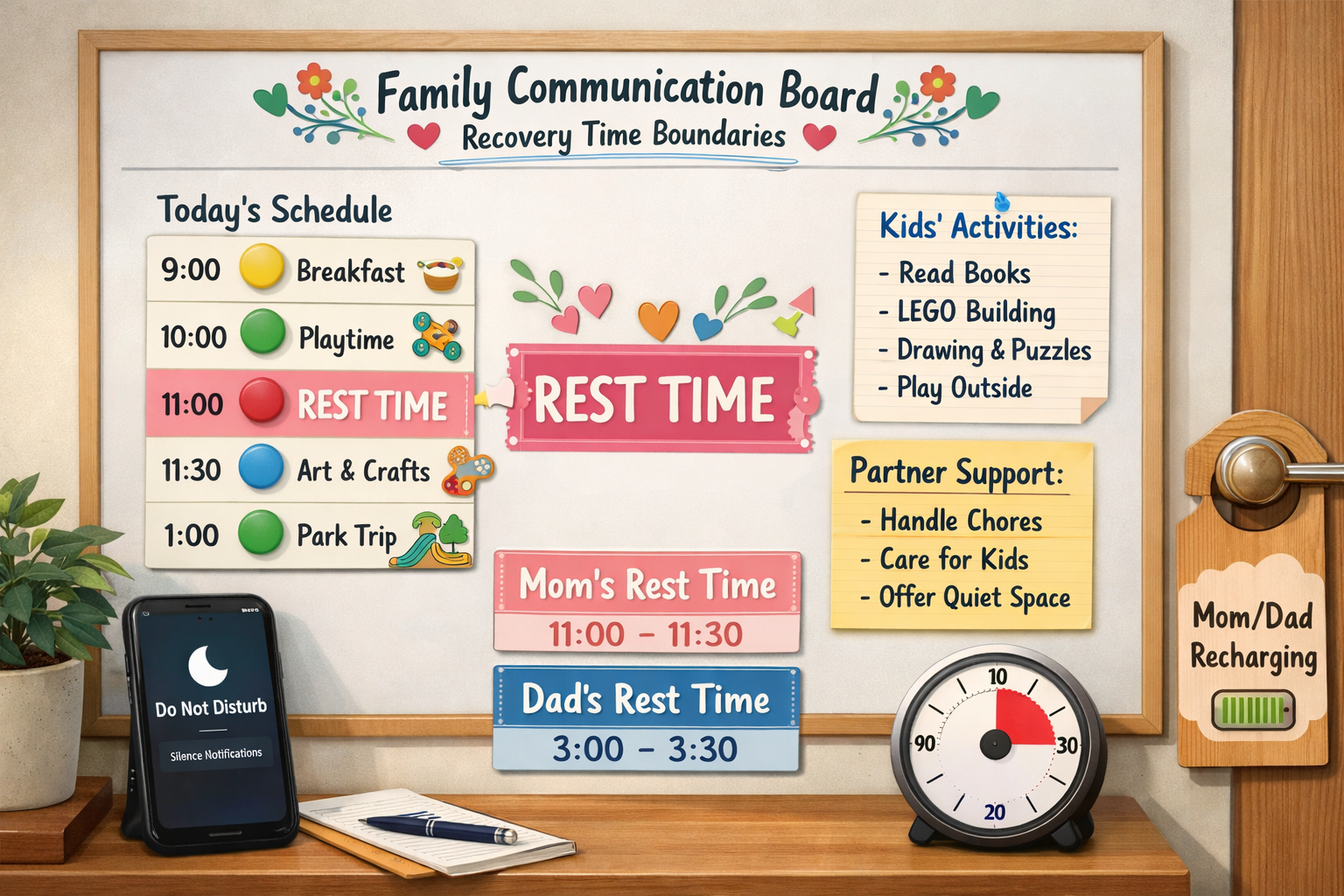
When recovery time feels impossible, parents should start with micro-recovery moments of 5-10 minutes rather than abandoning rest entirely, identify the specific barrier preventing recovery (time, money, childcare, guilt), and address that single obstacle with the smallest possible intervention. The goal is progress, not perfection—some recovery is infinitely better than none.
Troubleshooting common barriers:
Barrier: “I literally have no time”
Solution: Audit time for one week, tracking activities in 30-minute blocks. Most parents find 30-60 minutes of low-value activities (social media scrolling, watching shows they don’t enjoy, doing tasks that could be delegated or eliminated). Convert just 15 minutes of this time to recovery.
Micro-recovery option: Five minutes of breathing exercises before getting out of the car. Three minutes of stretching before bed. Two minutes of silence with morning coffee.
Barrier: “I can’t afford childcare”
Solution: Recovery time doesn’t require paid childcare. Options include:
- Using children’s existing screen time for parent recovery instead of chores
- Trading childcare with neighbors or friends (you watch their kids one afternoon, they watch yours another)
- Implementing independent play time where children entertain themselves in safe spaces
- Asking extended family for specific help: “Can you take the kids to the park Sunday 2-4pm?”
Barrier: “My partner doesn’t support it”
Solution: Have a direct conversation using specific language:
- “I need recovery time to maintain my health and patience. I’m scheduling Tuesday evenings 7-8pm. During that time, you’ll handle everything.”
- If partner resists, explain consequences: “Without recovery time, I’m experiencing [specific symptoms: anxiety, insomnia, short temper]. This affects everyone.”
- If partner still refuses, this indicates a relationship problem requiring couples counseling, not just a scheduling issue
Barrier: “I feel too guilty”
Solution: Start with recovery time framed as health maintenance. Tell yourself: “I’m taking 15 minutes to prevent a health crisis” rather than “I’m taking time for myself.” Use guilt-reduction techniques from earlier section. Take recovery time despite guilt—action often precedes feeling.
Barrier: “My children are too young/demanding”
Solution: Adjust expectations for recovery type, not whether it happens:
- Recovery might mean sitting while supervising play instead of lying down alone
- Use children’s naptime or quiet time for recovery, not chores
- Accept that recovery with young children happens in shorter, more frequent bursts
- Prioritize sleep above all other recovery forms during high-demand phases
Barrier: “Something always comes up”
Solution: Distinguish between genuine emergencies and situations others can handle. Create a decision tree:
- Is someone injured or in danger? → Interrupt recovery time
- Is someone upset but safe? → On-duty caregiver handles it
- Does someone want something? → It can wait until recovery time ends
- Did someone forget something? → Natural consequences teach responsibility
The minimum viable recovery plan:
When everything feels impossible, commit to this bare-minimum plan for two weeks:
- Five minutes daily of intentional rest (breathing, sitting in silence, lying down)
- One 30-minute block weekly of protected recovery time
- One boundary enforced consistently (door closed means don’t interrupt, bedtime means parent time starts, etc.)
After two weeks, assess whether even this minimal recovery improves functioning. Usually, small consistent recovery creates enough improvement to expand the practice.
How Can Parents Maintain Recovery Time Long-Term?
Parents can maintain recovery time long-term by treating it as non-negotiable infrastructure rather than a temporary intervention, regularly reassessing and adjusting recovery practices as children’s ages and family circumstances change, and building accountability systems that prevent recovery time from being the first thing sacrificed during busy periods. Sustainable recovery requires integration into family culture, not willpower.
Strategies for long-term sustainability:
Build recovery time into family culture
- Frame recovery time as normal and expected: “Everyone in this family gets time to recharge”
- Start recovery time practices early so children grow up seeing it as standard
- Celebrate and normalize recovery time rather than hiding it or apologizing for it
- Include recovery time in family schedules alongside other recurring activities
Create accountability systems
- Share recovery time commitments with friends who check in regularly
- Join parenting groups focused on sustainable self-care
- Track recovery time in calendars or apps to maintain visibility
- Partner with another parent for mutual accountability (weekly check-ins on whether you both took recovery time)
Adjust recovery practices as circumstances change
Recovery time needs and possibilities shift as children age, work situations change, and family dynamics evolve. Reassess quarterly:
- Is current recovery time still adequate, or do you need more/different types?
- Have new time pockets opened up (children started school, got more independent)?
- Are old recovery activities still restorative, or do you need new approaches?
- What barriers have emerged, and how can you address them?
Protect recovery time during high-stress periods
The busier and more stressed parents become, the more essential recovery time becomes—yet it’s usually the first thing sacrificed. Create rules:
- Recovery time is non-negotiable except for genuine emergencies
- During crisis periods, reduce recovery time duration but increase frequency
- When eliminating activities due to overload, cut optional commitments before recovery time
- Use recovery time to prevent burnout rather than waiting to recover from it
Common mistakes that derail long-term recovery:
Mistake 1: Treating recovery time as a reward for productivity
Recovery time is maintenance, not a prize. You don’t need to “earn” it by completing all tasks first. This mindset ensures recovery never happens because tasks are infinite.
Mistake 2: Abandoning recovery time during busy periods
High-stress times require more recovery, not less. Even five minutes daily during crises prevents complete depletion.
Mistake 3: Comparing your recovery needs to others
Some parents need more recovery time than others. This doesn’t indicate weakness—it reflects different temperaments, energy levels, and life circumstances. Honor your actual needs, not what you think you “should” need.
Mistake 4: Waiting for perfect conditions
Perfect recovery time (hours alone, complete silence, spa-like conditions) rarely exists for parents. Accept imperfect recovery—15 minutes with door closed while kids watch TV—over waiting for ideal scenarios that never materialize.
Signs recovery time is working long-term:
- Increased patience with children and partners
- Better physical health (fewer stress-related symptoms, better sleep)
- Improved emotional regulation (less yelling, quicker recovery from frustration)
- More energy for activities beyond basic survival
- Reduced resentment toward family members
- Ability to be present rather than just physically present
Frequently Asked Questions
How much recovery time do parents actually need?
Most parents need 30-60 minutes of dedicated recovery time daily, plus longer periods (2-4 hours) weekly for deeper restoration. However, individual needs vary based on temperament, stress levels, and life circumstances. Start with 15 minutes daily and adjust based on how you feel.
Is it normal to feel guilty about taking recovery time as a parent?
Yes, guilt about parental recovery time is extremely common due to cultural messaging that equates good parenting with constant availability and self-sacrifice. Feeling guilt doesn’t mean you’re doing something wrong—it means you’re challenging internalized beliefs. Take recovery time despite guilt, and the guilt typically decreases over time.
What if my partner refuses to support my recovery time?
Start with clear, direct communication about specific needs and consequences of not meeting them. If your partner continues refusing after understanding the health impact, this indicates a relationship problem requiring professional help through couples counseling, not just a scheduling disagreement.
Can recovery time happen while children are present?
Yes, though it’s less restorative than time completely alone. Options include having children play independently nearby, using quiet time where everyone rests separately, or engaging in low-demand parallel activities. However, aim for some completely child-free recovery time weekly if possible.
How do single parents create recovery time without a co-parent?
Single parents can create recovery time through childcare swaps with other parents, asking extended family for specific scheduled help, using children’s screen time or independent play for parent rest, and occasionally hiring childcare specifically for recovery rather than errands. Start with protecting time after children’s bedtime.
What if recovery time makes me feel more anxious instead of relaxed?
Some people find passive rest (meditation, sitting quietly) increases anxiety because it allows racing thoughts. Try active recovery instead—walking, light exercise, engaging hobbies, or activities requiring gentle focus. Recovery doesn’t have to look traditionally “relaxing” to be effective.
Should I feel bad about using screen time for kids so I can rest?
Moderate, strategic screen time that allows parents to recover is not harmful and may benefit children by providing them with a more patient, present parent afterward. The goal is balance—not zero screen time or constant screen time, but intentional use that serves family wellbeing.
How do I handle interruptions during recovery time?
Set clear expectations beforehand about what constitutes an emergency (injuries, safety issues) versus what can wait. Redirect non-emergency interruptions: “I’ll help you with that when my recovery time ends at 3pm.” Consistency teaches family members to respect boundaries.
What if I can only get 10 minutes of recovery time?
Ten minutes of genuine recovery is valuable and worth protecting. Short, consistent recovery periods provide more benefit than waiting for perfect conditions that never arrive. Use those 10 minutes for breathing exercises, sitting in silence, or simply resting without stimulation.
How can I tell if I’m getting enough recovery time?
Signs of adequate recovery include: consistent patience with family members, physical energy beyond survival mode, ability to regulate emotions effectively, enjoyment in parenting moments (not just endurance), stable physical health, and lack of resentment toward family. If these are missing, you likely need more recovery time.
Is it selfish to hire childcare just so I can rest?
No. Hiring childcare for recovery time is a health investment, not a selfish indulgence. Parents hire help for work, errands, and appointments—recovery is equally legitimate and arguably more important for long-term wellbeing and effective parenting.
What should I do during recovery time to make it most effective?
Choose activities that feel genuinely restorative to you rather than following prescriptive self-care advice. For some parents, this means complete rest; for others, it’s gentle movement or engaging hobbies. The key is that the activity replenishes rather than depletes you and doesn’t involve caring for others or completing tasks.
Conclusion
Learning how parents can create recovery time without shame fundamentally challenges the cultural narrative that equates parental exhaustion with devotion. The reality is simpler and more sustainable: parents who regularly rest, recharge, and maintain their own wellbeing show up as more patient, present, and effective caregivers than those who sacrifice themselves completely.
Creating shame-free recovery time doesn’t require perfect circumstances, unlimited resources, or hours of daily availability. It requires treating rest as non-negotiable maintenance, scheduling specific recovery blocks with the same commitment given to other appointments, communicating clear boundaries with family members, and choosing accessible activities that fit into existing routines. Even 15 minutes of protected daily recovery time provides measurable benefits when practiced consistently.
The barriers to parental recovery time—guilt, lack of support, time constraints, financial limitations—are real but not insurmountable. Each obstacle has practical solutions, from cognitive reframing techniques that address shame to childcare swaps that eliminate cost barriers. The key is starting where you are with what you have rather than waiting for ideal conditions.
Actionable next steps to implement today:
- Schedule your first recovery block: Put a specific 15-30 minute recovery time in your calendar for this week. Treat it as non-negotiable as a doctor’s appointment.
- Communicate one boundary: Tell your household members when you’ll be unavailable and what constitutes an emergency interruption. Be specific and clear.
- Identify your recovery activity: Choose one low-barrier activity from this article that feels restorative to you. Keep it simple and accessible.
- Prepare your guilt response: Write down the shame-inducing thought you anticipate and your evidence-based response. Review it before your first recovery time.
- Assess after two weeks: Track how you feel after maintaining recovery time for two weeks. Note changes in patience, energy, physical health, and emotional regulation.
Recovery time isn’t a luxury reserved for parents with exceptional resources or unusually easy children. It’s a basic requirement for sustainable parenting that every caregiver deserves and needs. The question isn’t whether parents should create recovery time without shame—it’s how quickly they can start.
Your children don’t need a perfect parent who never rests. They need a sustainable parent who models healthy boundaries, self-respect, and the understanding that all humans—including caregivers—have needs that matter. Recovery time isn’t taking time away from your children. It’s ensuring you have something to give them beyond depleted survival mode.
Start small. Start today. Start without shame.