



Last updated: February 21, 2026
Key Takeaways
- Create physical distance between yourself and your phone during rest periods to break automatic reaching habits
- Replace phone scrolling with specific alternative activities that genuinely relax your mind and body
- Design rest-friendly environments in your home that don’t accommodate or encourage phone use
- Build new neural pathways through consistent practice of phone-free rest routines over 3-4 weeks
- Address the root causes of phone dependency, including boredom tolerance and emotional avoidance
Quick Answer

Learning how to rest without reaching for your phone every time requires three core strategies: physically separating yourself from your device during rest periods, preparing alternative activities beforehand, and creating environmental cues that support phone-free relaxation. Most people need 21-30 days of consistent practice to rewire the automatic phone-reaching habit, and success depends on addressing both the physical accessibility of the phone and the psychological needs it currently fills during rest time.
Picture this: you finally sit down to relax after a long day, and before your body even settles into the couch, your hand is already reaching for your phone. Five minutes of “quick scrolling” turns into an hour, and somehow you feel more drained than before you sat down. Sound familiar?
The struggle to rest without immediately grabbing your phone isn’t a personal failing. It’s a deeply ingrained habit reinforced by thousands of repetitions and sophisticated app designs specifically created to capture your attention. But genuine rest—the kind that actually restores your energy and mental clarity—rarely happens while scrolling through an endless feed of content designed to keep you engaged.
Learning how to rest without reaching for your phone every time means retraining both your body and mind to find relaxation through methods that don’t involve screens. This guide walks through practical, tested strategies that work for people who want to reclaim their rest time and create spaces where true relaxation can happen.
Why Do We Automatically Reach for Our Phones When Resting?
The automatic phone-reaching habit during rest periods happens because our brains have created a strong association between downtime and phone use through repeated pairing over months or years. When you sit down to rest, your brain anticipates the dopamine hit from notifications, new content, or social validation, triggering the reaching behavior before you consciously decide to check your phone.
The habit loop works like this:
- Cue: Sitting down, feeling bored, or having unstructured time
- Routine: Reaching for and scrolling on phone
- Reward: Novelty, distraction, entertainment, or social connection
- Reinforcement: Immediate gratification strengthens the neural pathway
Several psychological factors make this habit particularly strong:
Boredom intolerance – Many people have lost the ability to sit with quiet, unstructured time without external stimulation. The phone provides instant relief from any moment of stillness or boredom.
Emotional avoidance – Phones offer an easy escape from uncomfortable feelings, stress, or thoughts that might surface during actual rest. Scrolling keeps the mind occupied and prevents deeper reflection.
FOMO and social pressure – The fear of missing important updates, messages, or social events creates anxiety around being disconnected, even briefly.
Variable reward schedules – Social media and apps use the same psychological principle as slot machines, delivering unpredictable rewards that keep you checking repeatedly.
Physical proximity – Simply having the phone within arm’s reach makes the behavior effortless and automatic, requiring no conscious decision.
The key insight: you’re not weak-willed or addicted in a clinical sense. You’ve simply trained your brain through repetition that rest time equals phone time. The good news is that habits can be retrained with the right approach.
What Does Real Rest Actually Look Like Without a Phone?
Real rest without a phone involves activities and states that allow your nervous system to downregulate, your mind to wander naturally, and your body to release accumulated tension without the stimulation of screens or digital content. This type of rest can be active (like gentle movement) or passive (like sitting quietly), but it always involves being present with your immediate environment rather than consuming external content.
Characteristics of genuine rest include:
- Mental spaciousness – Your thoughts can drift without being constantly interrupted by new information
- Physical relaxation – Muscle tension decreases, breathing deepens, heart rate slows
- Time distortion – You may lose track of time in a pleasant way, not through mindless scrolling
- Restored energy – You feel more refreshed afterward, not more drained or overstimulated
- Present awareness – You notice your surroundings, bodily sensations, or current activity
Examples of phone-free rest activities:
- Passive rest
- Sitting quietly with tea or coffee, looking out a window
- Lying down with eyes closed, listening to ambient sounds
- Taking a bath without entertainment
- Sitting in nature without agenda
- Gentle stretching or progressive muscle relaxation
- Active rest
- Reading physical books or magazines
- Journaling or sketching
- Doing puzzles or crosswords
- Light gardening or tending plants
- Crafts like knitting, drawing, or woodworking
- Playing a musical instrument for enjoyment
- Cooking or baking without following digital recipes
- Social rest
- Face-to-face conversation without phones present
- Playing board games or cards
- Shared meals with full attention
- Walking with a friend or partner
Common mistake: Assuming rest must be completely passive. Many people find that gentle, engaging activities (like reading or crafting) provide better rest than trying to “do nothing,” which can feel uncomfortable if you’re not used to it.
Choose passive rest if: you’re physically exhausted and need to literally lie down and close your eyes. Choose active rest if you have mental energy but need a break from demanding cognitive work or screen time.
How to Create Physical Distance From Your Phone During Rest Time
Creating physical distance means deliberately placing your phone in a location that requires effort to retrieve, breaking the automatic reach-and-check pattern that happens when the device sits within arm’s length during rest periods. For most people, a minimum distance of 10-15 feet or requiring movement to another room proves most effective.
Effective phone placement strategies:
The charging station method – Designate a specific spot in your home (not your bedroom or main relaxation area) as the only phone charging location. When you’re ready to rest, plug the phone in there and leave it.
- Best locations: kitchen counter, home office desk, entryway table, hallway shelf
- Worst locations: bedside table, coffee table, couch armrest, anywhere within sight
The drawer technique – Place your phone in a drawer, cabinet, or box during rest periods. The physical barrier of opening something creates enough friction to interrupt the automatic reaching habit.
The bag method – Put your phone in a bag, backpack, or purse and place it in another room. The extra step of unzipping or opening creates decision space.
The timer box – Use a timed lock box (available for $20-40) that won’t open for a set period. This removes the option entirely and can be helpful when building the initial habit.
Distance guidelines based on habit strength:
| Habit Strength | Recommended Distance | Additional Barriers |
|---|---|---|
| Mild (check 1-2 times during rest) | Same room, out of sight | Drawer or bag |
| Moderate (check 3-5 times) | Different room, must stand and walk | Charging in another room |
| Strong (constant checking) | Different floor or locked container | Timer box or car glovebox |
Implementation tips:
- Set up your phone-free rest space before you’re tired and your willpower is low
- Tell household members about your phone-free rest times so they don’t bring you the device
- If you use your phone for music, switch to a dedicated speaker with pre-loaded playlists
- Keep a simple alarm clock in rest areas if you’re worried about timing
Edge case: If you’re on-call for work or caregiving, use a separate device for essential calls only, or enable emergency bypass for specific contacts while silencing all other notifications.
The goal isn’t to never use your phone, but to create enough friction that you make a conscious choice rather than an automatic grab.
How to Prepare Your Rest Environment for Phone-Free Relaxation
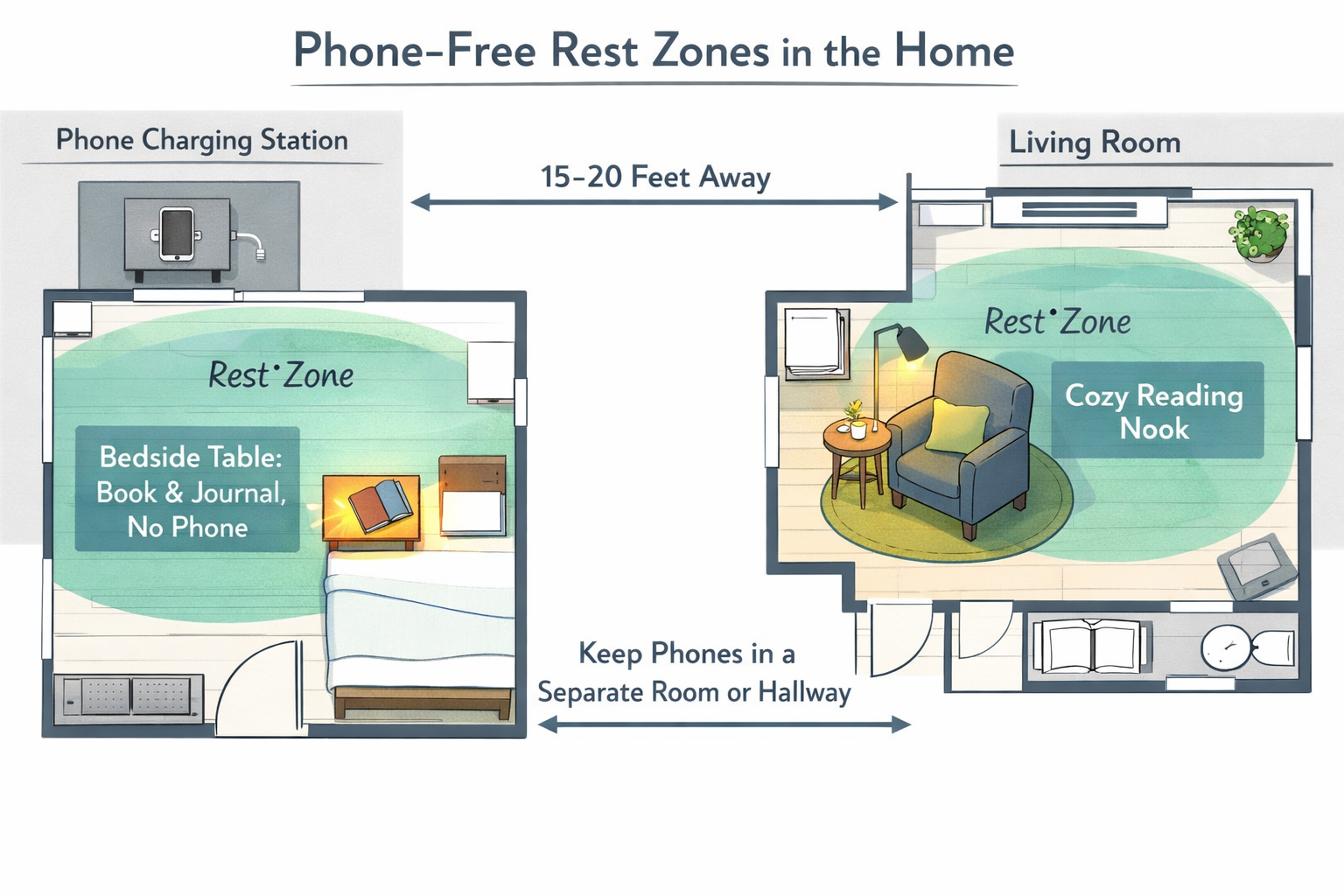
Preparing your rest environment means intentionally designing physical spaces in your home with cues, tools, and comfort elements that support phone-free relaxation while removing triggers that prompt phone use. A well-designed rest space makes the desired behavior (resting without phones) easier than the unwanted behavior (scrolling).
Essential elements of a phone-free rest space:
Comfort and appeal – Your rest area should be genuinely inviting and comfortable enough that you want to spend time there without needing phone-based entertainment.
- Quality seating: supportive chair or couch with good back support
- Appropriate lighting: warm, adjustable lighting (not harsh overhead)
- Temperature control: blankets, fans, or temperature settings for comfort
- Sensory elements: soft textures, pleasant scents (candles, essential oils)
- Visual calm: decluttered space without piles of mail, dishes, or work items
Alternative activities at hand – Stock your rest area with ready-to-use alternatives to phone scrolling.
Keep within arm’s reach:
- Reading materials: books, magazines, comics (whatever you actually enjoy)
- Tactile activities: knitting supplies, sketch pad and pencils, puzzle books
- Comfort items: tea setup, water bottle, healthy snacks
- Relaxation tools: journal and pen, meditation cushion, eye mask
Remove phone-related cues:
- Charging cables and docks
- Phone stands or holders
- Bluetooth speakers that remind you of phone-based music
- Smartwatches or tablets that serve similar functions
Create positive environmental cues:
- Place a book on your favorite chair before you sit down
- Set out your journal with a pen already uncapped
- Have a blanket draped invitingly over the armrest
- Position seating to face windows or pleasant views, not screens
Room-by-room rest zone setup:
Bedroom rest zone
- No phones after 9 PM (or your chosen time)
- Physical books on nightstand
- Dim, warm lighting
- White noise machine or fan (not phone-based)
Living room rest zone
- Basket of magazines and books beside couch
- Throw blankets within reach
- Tea station or beverage setup nearby
- Puzzle or craft project on coffee table
Outdoor rest zone
- Comfortable seating (porch chair, hammock, garden bench)
- Weather-appropriate setup (shade, cushions)
- Nature observation tools (binoculars, field guides)
- Outdoor-friendly reading materials
Common mistake: Creating a rest space but not maintaining it. If your “rest chair” becomes a laundry pile or your reading materials get buried, you’ll default back to the phone.
Quick setup routine: Spend 2 minutes each evening preparing your rest space for the next day—put out a book, clear the chair, set up tea supplies. This small investment makes phone-free rest much more likely.
What Alternative Activities Actually Work for Phone-Free Rest?
Alternative activities that successfully replace phone use during rest periods share three qualities: they’re immediately accessible without setup friction, they provide enough engagement to hold attention without being stressful, and they offer some form of sensory satisfaction or completion that phones typically provide. The best alternatives vary by person, but successful options tend to be tactile, creative, or gently absorbing.
High-success alternatives (reported by people who’ve successfully reduced phone dependency):
Reading physical books
- Why it works: provides narrative engagement and escape similar to scrolling, but with deeper satisfaction
- Best for: people who enjoyed reading before phones took over
- Setup: keep 2-3 books in progress in different genres; switch if one isn’t grabbing you
- Common barrier: “I can’t focus on reading anymore” – start with 10 minutes and build up
Journaling or free writing
- Why it works: processes thoughts and emotions that you might be avoiding through phone use
- Best for: people with active minds who use phones to quiet mental chatter
- Setup: dedicated notebook and pen that feel good to use (this matters)
- Formats: stream of consciousness, gratitude lists, daily highlights, creative writing
Hands-on crafts
- Why it works: provides tactile satisfaction and visible progress
- Options: knitting, crochet, embroidery, sketching, adult coloring books, origami, model building
- Best for: people who like to keep hands busy
- Tip: choose projects simple enough to do while listening to music or audiobooks
Puzzle activities
- Why it works: engages problem-solving brain without stress or time pressure
- Options: jigsaw puzzles, crosswords, sudoku, logic puzzles, word searches
- Best for: people who like the “just one more” feeling but want it offline
- Setup: keep puzzle books or a jigsaw puzzle in progress on a side table
Gentle movement
- Why it works: releases physical tension and restless energy that drives phone-checking
- Options: stretching, yoga, walking, gardening, simple strength exercises
- Best for: people who feel physically restless during rest time
- Duration: even 5-10 minutes can shift your state enough to rest without phones
Music listening (without phone)
- Why it works: provides auditory stimulation and mood regulation
- Setup: dedicated music player, CD player, vinyl record player, or pre-loaded speaker
- Best for: people who primarily use phones for background entertainment
- Tip: pair with another activity like stretching, journaling, or sitting quietly
Comparison: Phone scrolling vs. effective alternatives
| Aspect | Phone Scrolling | Reading | Crafts | Journaling |
|---|---|---|---|---|
| Setup time | Instant | 30 seconds | 1-2 minutes | 30 seconds |
| Engagement level | High but scattered | Deep and focused | Moderate, rhythmic | Variable |
| Energy after | Drained | Satisfied | Accomplished | Clearer |
| Completion feeling | Never ends | Chapter/book done | Visible progress | Thoughts processed |
| Boredom tolerance | Zero required | Builds over time | Moderate needed | Low needed |
Matching activities to your rest needs:
If you’re mentally exhausted: Choose passive activities like listening to music, gentle stretching, or looking at art books
If you’re physically tired but mentally wired: Try journaling, reading, or puzzles to occupy your mind while your body rests
If you’re both mentally and physically tired: Start with just sitting quietly with tea, or very light reading (magazines, comics)
If you’re restless and bored: Choose tactile activities like crafts, puzzles, or walking
Building your personal rest menu:
Create a written list of 5-7 specific rest activities you can do without your phone, including exactly where the supplies are located. When you feel the urge to grab your phone, consult this menu and pick one. The decision-making is already done, reducing friction.
Example rest menu:
- Read current book (on nightstand)
- Work on jigsaw puzzle (coffee table)
- Write in journal (desk drawer)
- Do 10-minute stretch routine (yoga mat in closet)
- Knit 10 rows (basket beside chair)
- Sit on porch with tea (kettle in kitchen)
- Sketch in drawing pad (bookshelf)
Common mistake: Choosing alternatives that feel like obligations or self-improvement tasks. Rest activities should be genuinely enjoyable or soothing, not another item on your productivity list.
How to Handle the Discomfort and Boredom of Phone-Free Rest
Handling the discomfort and boredom that surfaces during phone-free rest requires recognizing that these feelings are temporary withdrawal symptoms from constant stimulation, not signs that something is wrong or that you need to grab your phone. Most people experience peak discomfort in the first 5-10 minutes of phone-free rest, which then naturally decreases if they don’t give in to the urge.
What you’ll likely experience (and why it’s normal):
Physical restlessness – Your body has learned to associate rest time with the micro-movements of scrolling. Without this, you may feel fidgety, like you don’t know what to do with your hands.
Mental discomfort – Thoughts you’ve been avoiding through constant distraction may surface. This can feel uncomfortable but is actually part of genuine rest and processing.
Boredom and time distortion – Five minutes without a phone can feel like twenty. Your brain has become accustomed to constant novelty and finds normal-paced activities too slow.
Anxiety or FOMO – Worries about missing messages, updates, or important information may create low-level anxiety.
Strategies for working through discomfort:
The 10-minute rule
- Commit to staying phone-free for just 10 minutes when discomfort hits
- Set a timer if needed (using a physical timer, not your phone)
- Notice that the urge typically peaks around 3-5 minutes then decreases
- After 10 minutes, reassess whether you actually need the phone
Active boredom tolerance building
- Start with short periods (5-10 minutes) of phone-free rest
- Gradually increase by 5-minute increments as tolerance builds
- Think of it like building physical endurance – you wouldn’t run a marathon on day one
The thought observation technique
When uncomfortable thoughts or feelings arise:
- Notice and name them: “I’m feeling bored” or “I’m anxious about missing something”
- Remind yourself: “This feeling is temporary and safe”
- Return attention to your breath or current activity
- Repeat as needed without judgment
Physical grounding for restlessness
- Hold a warm cup of tea or coffee
- Wrap yourself in a weighted blanket
- Do 5-10 slow, deep breaths
- Squeeze a stress ball or fidget toy
- Place your hand on your chest and feel your heartbeat
Reframe boredom as spaciousness
- Boredom isn’t emptiness; it’s your mind having room to wander
- This mental space is where creativity, problem-solving, and emotional processing happen
- What feels like “nothing happening” is actually your nervous system resetting
Timeline for adjustment:
- Days 1-3: Discomfort is highest; urges are frequent and strong
- Days 4-7: Urges remain but become slightly less intense
- Days 8-14: Noticeable improvement; some rest periods feel naturally phone-free
- Days 15-21: New habits start to feel more automatic
- Days 22-30: Phone-free rest feels increasingly normal and even preferable
Edge case: If anxiety or discomfort feels overwhelming or doesn’t improve after 2-3 weeks, you may be using your phone to manage deeper emotional issues. Consider speaking with a therapist about underlying anxiety or avoidance patterns.
Common mistake: Judging yourself for feeling uncomfortable or bored. These feelings don’t mean you’re doing it wrong; they mean you’re retraining your brain, which is inherently uncomfortable.
Quick comfort plan for intense urges:
- Stand up and move to a different location
- Drink a full glass of water
- Do 10 jumping jacks or stretch for 60 seconds
- Look out a window and name 5 things you see
- Return to your rest activity
The discomfort is real but temporary. Your brain is literally rewiring neural pathways, which takes time and repeated practice.
How to Build Sustainable Phone-Free Rest Habits That Actually Stick
Building sustainable phone-free rest habits requires focusing on consistency over perfection, starting with one specific rest period per day rather than trying to eliminate all phone use at once, and using environmental design to make the desired behavior easier than the old habit. Habits stick when they’re small enough to maintain during stressful periods and when they’re tied to existing routines.
The habit-building framework:
Start with one anchor rest period
Choose a single, specific time each day to practice phone-free rest:
- Morning coffee before work
- Lunch break
- Evening wind-down before bed
- Sunday afternoon relaxation time
Make this your only focus for the first 2-3 weeks. Don’t try to be phone-free during all rest periods at once.
Use habit stacking
Attach your phone-free rest to an existing habit:
- “After I pour my morning coffee, I will sit in my reading chair without my phone for 15 minutes”
- “After I finish dinner, I will put my phone in the kitchen drawer and read in the living room”
- “After I change into comfortable clothes, I will put my phone on the charger and do my evening rest routine”
Implementation intention formula:
“When [existing habit], I will [put phone in specific location] and [specific rest activity] for [specific duration].”
The two-minute setup rule
Make phone-free rest easier than phone-based rest by preparing in advance:
- Set out your book or craft project the night before
- Prepare your tea setup so it’s ready to go
- Clear your rest space of clutter daily
- Put your phone charger in the designated away-from-rest location
Tracking without pressure
Use a simple paper calendar to mark days you complete your anchor rest period phone-free:
- ✓ for successful phone-free rest
- ○ for attempted but grabbed phone
- X for didn’t attempt
Goal: See the pattern, not judge yourself. Even 4-5 check marks per week is progress.
Dealing with setbacks:
When you break the habit:
- Notice without judgment: “I grabbed my phone during rest time”
- Put it down immediately (even mid-scroll)
- Return to your rest activity
- Count it as practice, not failure
When you have a terrible day:
- One bad day doesn’t erase previous progress
- Return to the habit the next day
- Consider whether stress, poor sleep, or other factors made the habit harder
- Adjust difficulty if needed (shorter duration, easier activity)
Progression plan:
Weeks 1-2: Foundation
- One 10-15 minute phone-free rest period daily
- Same time and place each day
- Phone physically removed from rest space
- One prepared alternative activity
Weeks 3-4: Expansion
- Increase duration to 20-30 minutes
- Add a second daily phone-free rest period
- Experiment with different rest activities
- Notice improvements in rest quality
Weeks 5-6: Integration
- Phone-free rest starts feeling more natural
- Less intense urges to check phone
- Can handle occasional disruptions without losing the habit
- May naturally extend to additional rest periods
Weeks 7-8: Refinement
- Fine-tune your rest activities based on what actually works
- Adjust timing or location if needed
- Build in flexibility for different energy levels
- Habit feels sustainable long-term
Environmental reinforcement:
Create visual cues that remind you of your commitment:
- Place a small object (stone, card, bookmark) where your phone usually sits during rest
- Use this as a reminder: “Phone goes elsewhere, rest happens here”
- Post a simple note in your rest space: “Rest time = no phone time”
Social support strategies:
- Tell one person about your phone-free rest practice
- Invite family members to join you for phone-free rest periods
- Create phone-free rest zones that everyone in the household respects
- Share your progress (without pressure) to create gentle accountability
Reward system (optional):
After 7 consecutive days of successful phone-free rest:
- Buy yourself a new book, craft supply, or comfort item for your rest space
- Enjoy a special treat during your rest time
- Acknowledge the accomplishment in your journal
Common mistake: Making the habit too ambitious (2 hours phone-free immediately) or too vague (“rest without phone more”). Specific, small, and consistent beats ambitious and sporadic every time.
Choose this approach if: You want lasting change rather than a temporary challenge. Sustainable habits are built through repetition of small behaviors, not through willpower and dramatic overhauls.
What to Do When You Keep Reaching for Your Phone Despite Your Best Efforts
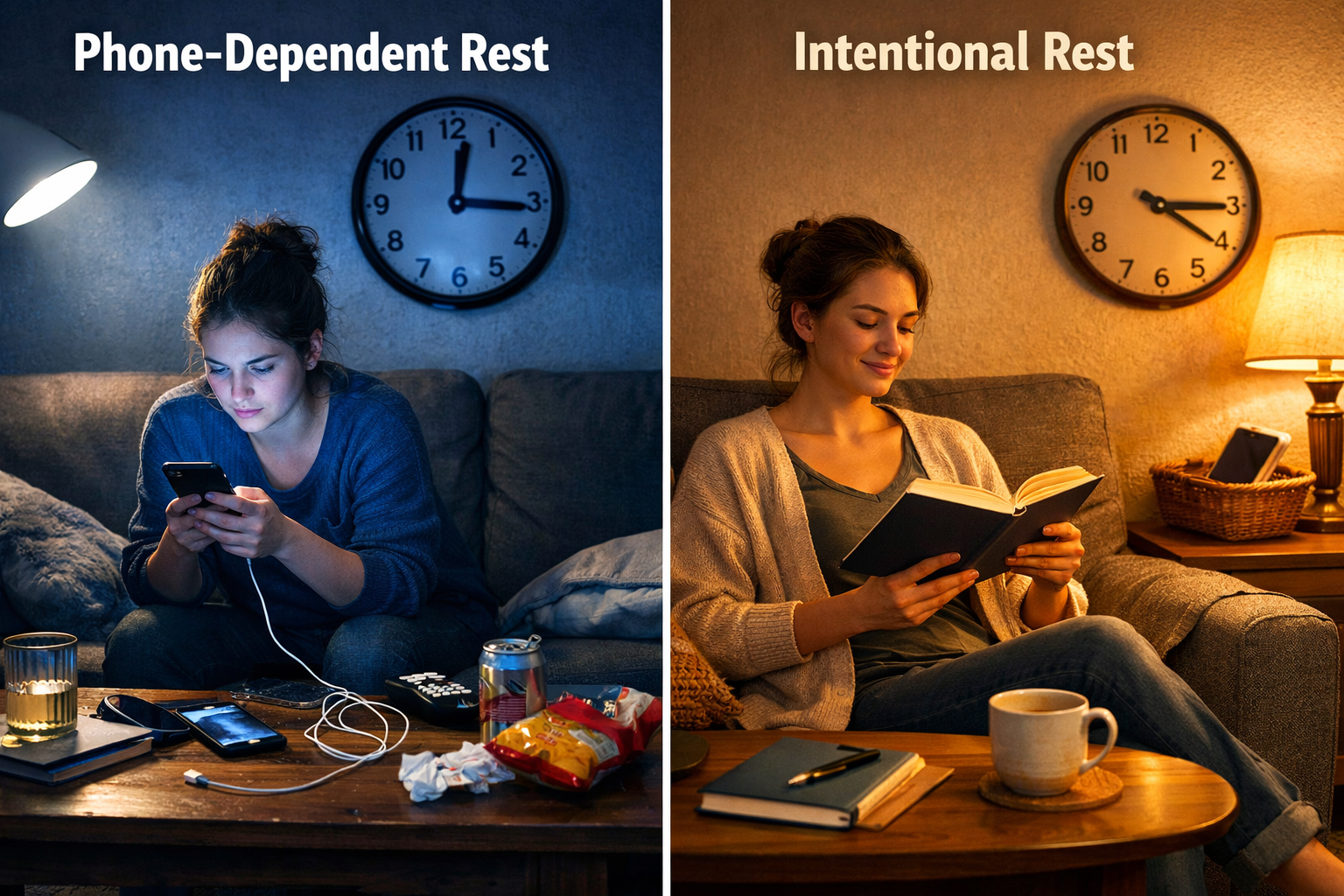
When you keep reaching for your phone despite implementing strategies, the issue is usually one of three things: the habit is too ambitious for your current capacity, you haven’t addressed the underlying emotional need the phone fills, or your environment still makes phone-grabbing easier than the alternative. Troubleshooting requires honest assessment of which barrier is actually blocking your progress.
Diagnostic questions:
Is the habit too hard?
- Are you trying to go phone-free for longer than 15-20 minutes initially?
- Are you attempting multiple rest periods per day right away?
- Is your alternative activity actually enjoyable, or does it feel like work?
If yes: Scale back to a smaller, easier version. Try 5-10 minutes. Choose one rest period. Pick the easiest, most appealing alternative activity.
Is your phone still too accessible?
- Can you see your phone from your rest space?
- Can you reach it without standing up and walking?
- Is it still in the same room?
If yes: Increase physical distance. Put it in another room, in a drawer, or in a timed lock box.
Are you trying to avoid something?
- Do you feel anxious or uncomfortable when you stop scrolling?
- Are there specific thoughts or feelings that surface during phone-free time?
- Do you use your phone to avoid difficult conversations, decisions, or emotions?
If yes: The phone isn’t the core issue; it’s a coping mechanism. Consider addressing the underlying anxiety, stress, or avoidance pattern (potentially with professional support).
Troubleshooting specific scenarios:
Scenario: “I put my phone away but get it within 5 minutes”
Solutions:
- Use a timed lock box that physically prevents access
- Set a timer for 10 minutes and commit to waiting until it rings
- Immediately stand up and leave the room when the urge hits
- Have someone else hold your phone during your rest period
- Increase the physical barrier (different floor, locked in car)
Scenario: “I feel too anxious without my phone nearby”
Solutions:
- Start with phone in same room but face-down and silent
- Gradually increase distance over 2-3 weeks
- Use “Do Not Disturb” with emergency contacts allowed through
- Practice 2-minute phone-free periods and build up slowly
- Address anxiety through breathing exercises, therapy, or anxiety management techniques
Scenario: “Alternative activities feel boring compared to my phone”
Solutions:
- Accept that boredom is part of the adjustment period (2-3 weeks)
- Choose more engaging alternatives (puzzles, crafting) rather than passive ones
- Combine activities (audiobook + stretching, music + journaling)
- Remember that phone content is engineered to be hyper-stimulating; normal activities will feel slow initially
- Give your dopamine receptors time to recalibrate
Scenario: “I’m fine during the day but can’t resist at night”
Solutions:
- Recognize that willpower is lowest when you’re tired
- Set up evening routine earlier, before exhaustion hits
- Use stronger barriers at night (phone in different room, timed lock box)
- Create an especially appealing evening rest space
- Consider whether you’re actually too tired and need to go to bed earlier rather than “rest” with phone
Scenario: “I do well for a few days then fall back into old patterns”
Solutions:
- Track the pattern: what happens right before you fall back?
- Identify triggers (stress, disrupted routine, poor sleep, social situations)
- Build in flexibility: one slip doesn’t mean complete reset
- Prepare for high-risk situations in advance
- Return to the habit immediately after a slip, not “tomorrow” or “Monday”
When to seek additional support:
Consider talking to a therapist or counselor if:
- Phone use is clearly connected to anxiety, depression, or trauma avoidance
- You experience panic or severe distress when separated from your phone
- Phone dependency is affecting relationships, work, or daily functioning
- You’ve tried multiple strategies consistently for 6-8 weeks with no improvement
- You recognize you’re using the phone to avoid dealing with serious life issues
Advanced strategy: The replacement ritual
Create a specific ritual that replaces the phone-reaching motion:
- When you feel the urge to reach for your phone, place your hand on your chest instead
- Take three slow, deep breaths
- Ask yourself: “What do I actually need right now?” (Rest? Connection? Distraction? Stimulation?)
- Choose an alternative that meets that specific need
Common mistake: Assuming that continued difficulty means you’re failing or that the strategies don’t work. Habit change is non-linear. Some days will be harder than others, and that’s completely normal.
Edge case: If you have ADHD or other executive function challenges, you may need additional environmental support, body-doubling (resting near someone else), or more frequent activity changes to maintain phone-free rest. The strategies still work but may need modification.
The goal isn’t perfection. The goal is progress and building capacity over time.
Frequently Asked Questions
How long does it take to stop automatically reaching for my phone during rest?
Most people need 21-30 days of consistent practice to significantly weaken the automatic phone-reaching habit during rest periods. The first 7-10 days are typically the hardest, with noticeable improvement by week 3. Complete habit replacement often takes 6-8 weeks of regular practice.
Can I rest with my phone nearby if I just don’t open it?
For most people, having the phone within sight or reach makes phone-free rest significantly harder because the visual cue triggers the automatic reaching response. Physical distance (different room or drawer) is more effective, especially when building the initial habit. Once the habit is strong (6-8 weeks), some people can have phones nearby without automatically reaching.
What if I need my phone for emergencies during rest time?
Use “Do Not Disturb” mode with emergency bypass enabled for specific contacts (family members, caregivers, essential work contacts). This allows critical calls through while blocking all other notifications. Alternatively, keep a separate basic phone for emergency calls only.
Is it okay to listen to music or audiobooks during phone-free rest, or does that count as phone use?
Listening to pre-loaded music or audiobooks on a dedicated device (not your phone) can support phone-free rest, especially when paired with other activities like stretching, crafting, or sitting quietly. The key difference is passive listening versus active scrolling and engagement with notifications and apps.
Why do I feel more anxious when I try to rest without my phone?
Anxiety during phone-free rest often indicates that you’ve been using your phone to avoid uncomfortable thoughts or feelings. When you stop scrolling, those thoughts surface. This is normal and typically decreases after 10-15 minutes if you stay with the discomfort. If anxiety remains intense after 2-3 weeks, consider whether underlying anxiety issues need professional support.
What’s the best alternative activity for someone who has trouble focusing on reading?
If reading feels too difficult initially, try tactile activities like puzzles, crafting, or coloring books that provide engagement without requiring sustained focus on text. You can also start with magazines, comics, or graphic novels that have shorter reading segments and more visual elements.
How do I handle phone-free rest when I live with people who are always on their phones?
Create a designated phone-free rest space in your home (even just a specific chair or corner) and communicate boundaries around that space. You can’t control others’ phone use, but you can control your own environment and potentially invite others to join you for phone-free time without pressure.
Should I go completely phone-free all day or just during rest periods?
Start with just designated rest periods (1-2 times per day for 15-30 minutes). Trying to go completely phone-free is usually unsustainable and sets you up for failure. Once phone-free rest periods feel natural, you can expand to other times if desired.
What if I work from home and my phone is also my work device?
Set clear boundaries between work and rest time by using different locations for each. When rest time begins, move to a different room and leave the phone in your work space. If you must keep it nearby for work emergencies, use a timed lock box during designated rest periods.
Is it normal to feel like time passes really slowly without my phone?
Yes, this is extremely common in the first 1-2 weeks. Your brain has become accustomed to the rapid stimulation and novelty of phone content, making normal-paced activities feel slow. This perception adjusts over time as your brain recalibrates to slower, more natural rhythms.
Can I use my tablet or e-reader instead of my phone during rest?
E-readers (like Kindle without internet) that only display books can support phone-free rest. Tablets with internet access, social media, and notifications typically create the same issues as phones. The key is whether the device provides constant stimulation and notifications or serves a single, focused purpose.
What do I do if my family or friends get upset that I’m not responding to messages during rest time?
Communicate your rest boundaries in advance: “I’m taking phone-free rest time from 8-9 PM each evening. I’ll respond to messages after that.” Most people will respect clearly communicated boundaries. If someone genuinely needs you, they can call (which you can allow through Do Not Disturb settings).
Key Takeaways
- Physical distance is essential – keeping your phone in another room or drawer breaks the automatic reaching habit more effectively than relying on willpower alone
- Prepare alternatives in advance – having books, crafts, or other rest activities immediately accessible makes phone-free rest significantly easier
- Start small and specific – one 10-15 minute phone-free rest period daily is more sustainable than trying to eliminate all phone use at once
- Expect discomfort for 7-10 days – restlessness, boredom, and anxiety are normal withdrawal symptoms from constant stimulation and typically decrease with practice
- Design your environment – create rest spaces that make phone-free relaxation easier than phone-based scrolling through comfort, lighting, and accessible alternatives
- Build tolerance gradually – your brain needs 21-30 days of consistent practice to rewire the phone-reaching habit and recalibrate to slower-paced activities
- Address underlying needs – if phone use is avoiding anxiety, difficult emotions, or uncomfortable thoughts, consider whether professional support would help
- Track without judgment – marking successful phone-free rest days helps you see progress without creating pressure or shame around setbacks
- One slip doesn’t erase progress – return to the habit immediately after breaking it rather than waiting for a “fresh start” on Monday or next month
- Genuine rest feels different – phone-free rest should leave you feeling refreshed and mentally clear rather than drained and overstimulated
Conclusion
Learning how to rest without reaching for your phone every time isn’t about willpower or discipline. It’s about understanding how habits work and using that knowledge to redesign your environment, prepare better alternatives, and give your brain time to adjust to a different way of resting.
The automatic phone-reaching habit developed through thousands of repetitions over months or years. Changing it requires patience, consistency, and the right strategies. Physical distance from your phone, prepared alternative activities, and a comfortable rest environment create the conditions where phone-free rest becomes easier than constant scrolling.
The first week will likely feel uncomfortable. Your brain will protest the loss of constant stimulation. You’ll feel bored, restless, maybe even anxious. This is normal and temporary. By week three, you’ll notice moments where phone-free rest feels natural, even preferable. By week six to eight, the new habit starts to feel automatic.
The payoff is worth the temporary discomfort: deeper relaxation, better sleep, improved focus, more genuine connection with yourself and others, and the satisfaction of being present in your own life rather than constantly consuming content designed to capture your attention.
Your next steps:
- Choose one specific rest period tomorrow to practice phone-free rest (morning coffee, lunch break, or evening wind-down)
- Set up your rest space tonight – clear the area, put out a book or alternative activity, remove your phone charger
- Commit to 10 minutes of phone-free rest during that period, with your phone in another room
- Mark your calendar when you complete it successfully
- Repeat daily for 21 days before evaluating progress or making changes
You don’t need to overhaul your entire life or throw your phone away. You just need to create one small pocket of time each day where rest happens without screens. Start there, and build from what works.
The ability to rest without immediately reaching for your phone is a skill, not a personality trait. Like any skill, it improves with practice. Your brain is capable of relearning how to be still, how to be bored, how to simply exist without constant digital stimulation. It just needs consistent practice and the right conditions.
Give yourself permission to rest—really rest—without the phone. Your mind and body will thank you.