

Last updated: February 18, 2026
Key Takeaways
- Travel anxiety stems from loss of control over your environment, schedule, and safety rather than fear of flying itself
- The unpredictability of travel triggers the same stress response as other situations where you can’t influence outcomes
- Recognizing that travel anxiety is about control helps you address the root cause instead of avoiding trips
- Practical preparation strategies and mindset shifts can restore a sense of agency during travel
- Understanding your specific control triggers allows you to create personalized coping mechanisms
Quick Answer
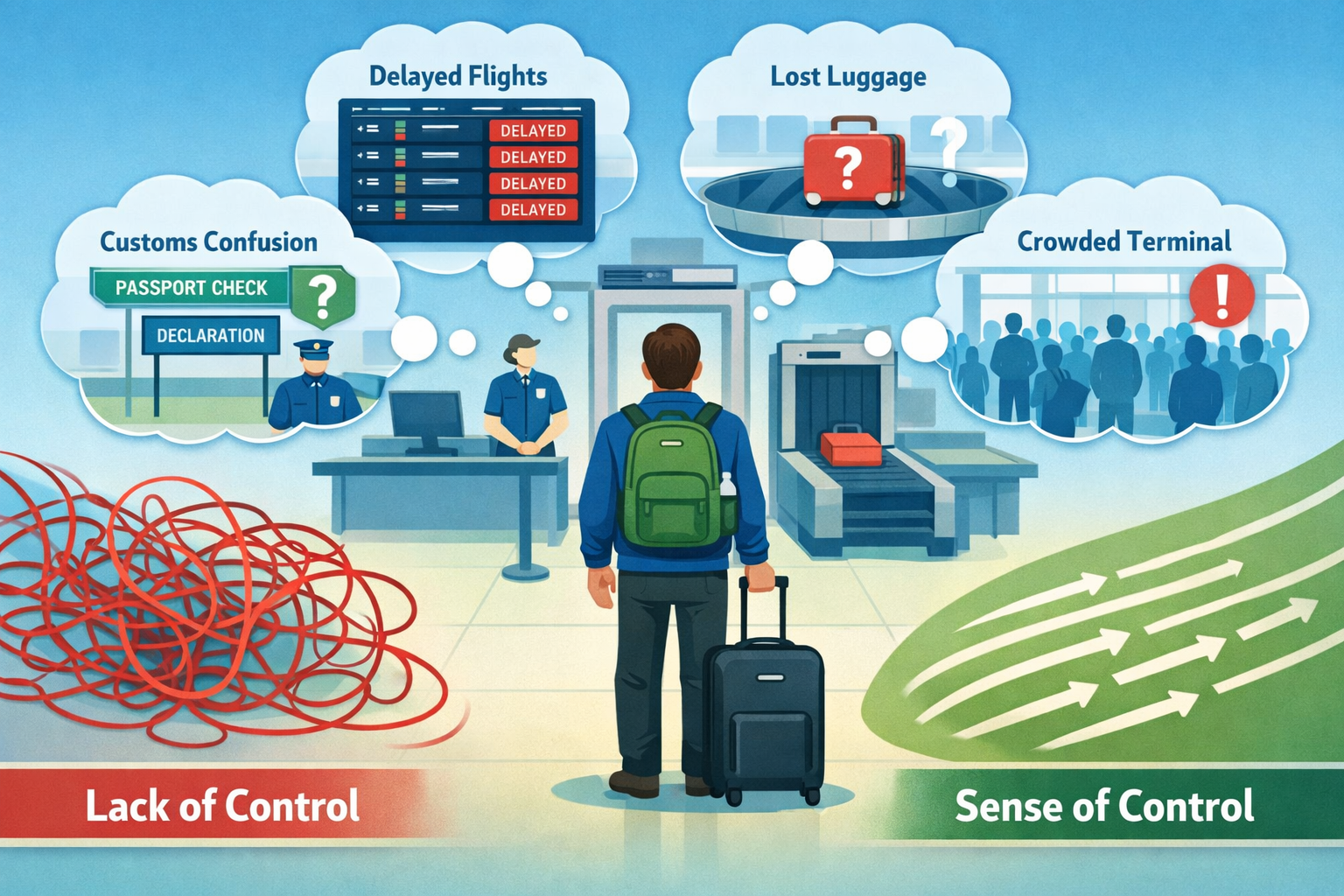
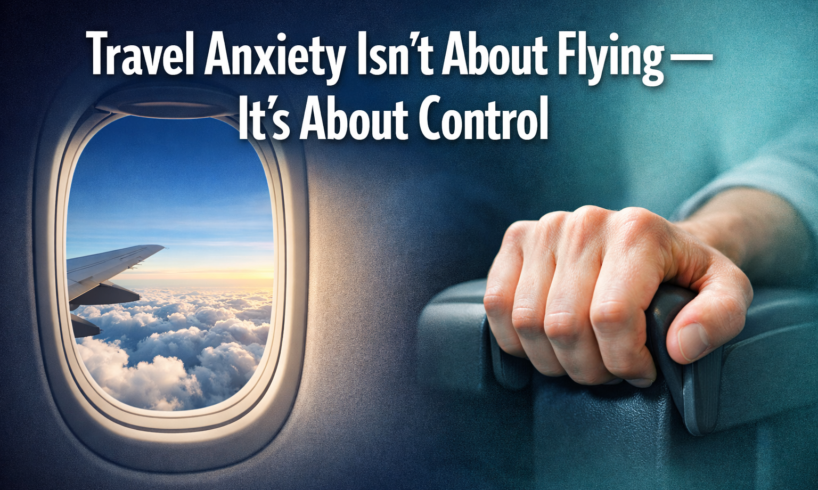
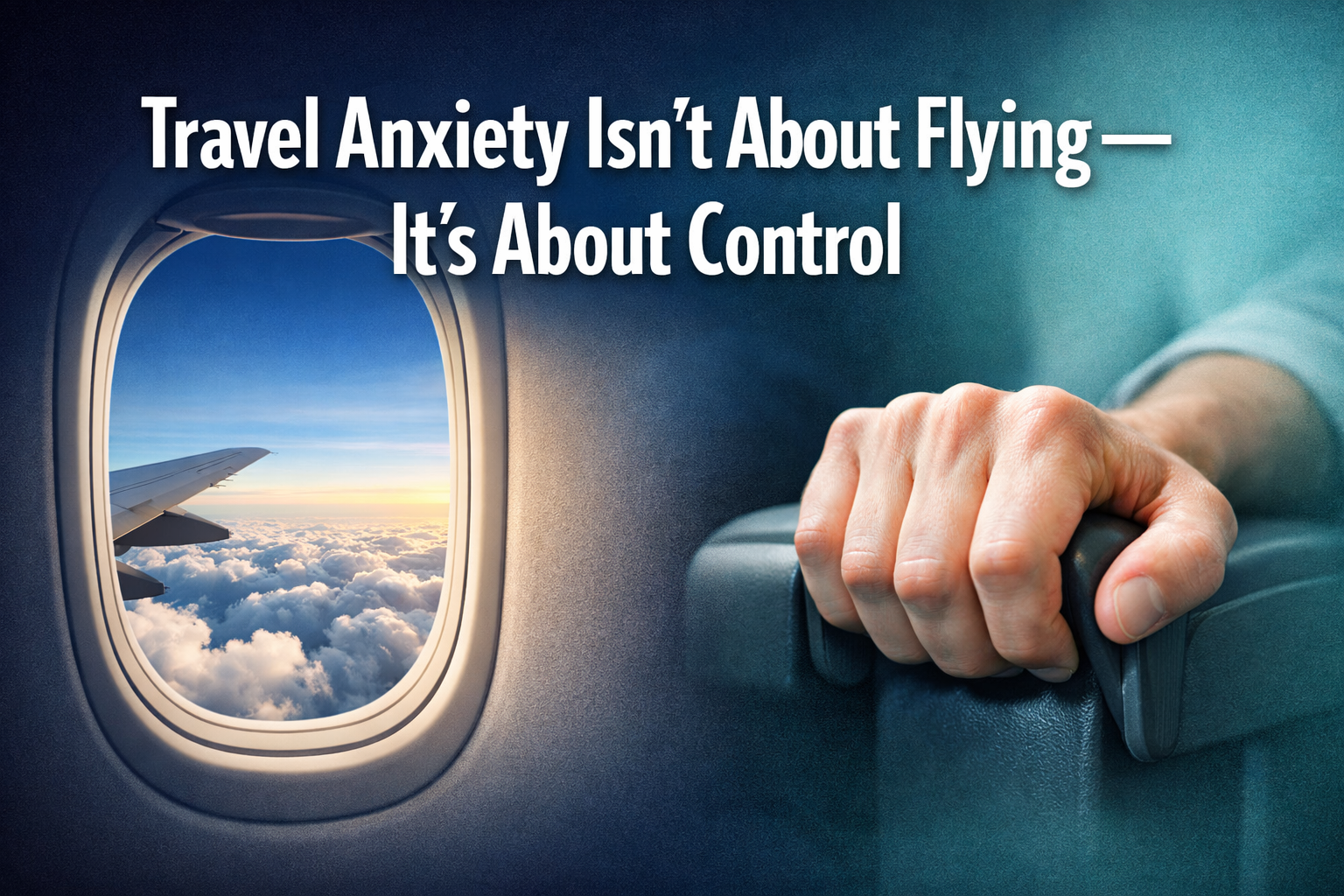
Travel anxiety isn’t about flying — it’s about control, and recognizing this distinction changes how you approach the problem. Most people who feel anxious about travel aren’t actually afraid of the airplane; they’re uncomfortable with surrendering control over their schedule, environment, safety, and personal space to airlines, TSA agents, and unpredictable circumstances. When you understand that your anxiety comes from feeling powerless rather than from the act of flying, you can develop targeted strategies that restore your sense of agency and make travel enjoyable again.
Picture yourself sitting in an airport terminal, watching your departure time get pushed back for the third time. Your stomach tightens. Your mind races through all the connections you might miss, the meetings you’ll be late for, the hotel reservations that won’t wait. This feeling? It’s not about the plane. It’s about the complete loss of control you’re experiencing right now.
Travel anxiety isn’t about flying — it’s about control, and this realization is the first step toward reclaiming your travel experiences. For years, countless travelers have blamed their stress on turbulence or takeoff when the real culprit is something much deeper: the fundamental human need to influence outcomes and predict what happens next.
What Does It Mean That Travel Anxiety Isn’t About Flying — It’s About Control?
Travel anxiety rooted in control means your stress comes from unpredictability and powerlessness, not from the physical act of being in an airplane. When you can’t control departure times, security wait times, seat assignments, or arrival schedules, your brain interprets this uncertainty as a threat. This triggers the same stress response you’d experience in any situation where you lack agency over important outcomes.
The control aspect of travel anxiety shows up in several ways:
- Schedule uncertainty: Flight delays, cancellations, and missed connections remove your ability to plan
- Environmental control: You can’t adjust temperature, noise levels, or personal space on planes
- Safety delegation: You must trust pilots, mechanics, and air traffic controllers with your life
- Process compliance: TSA procedures, boarding groups, and airline rules force you to follow systems you didn’t create
- Outcome unpredictability: Lost luggage, gate changes, and weather disruptions happen without your input
Many travelers report feeling perfectly calm during smooth flights but extremely anxious during ground delays. This pattern reveals the truth: the anxiety spikes when control disappears, not when the plane is actually in the air.
Common mistake: Assuming you need to “get over” your fear of flying when you actually need to develop strategies for managing uncertainty and limited control.
Why Do Humans Need Control During Travel?
Humans are wired to seek predictability and control because these traits helped our ancestors survive threats and secure resources. When you travel, especially by air, you enter an environment where almost nothing is within your control, which triggers ancient survival mechanisms even though modern air travel is statistically very safe.
The psychological need for control serves several functions:
Safety assessment: Your brain constantly evaluates whether you’re safe. When you can’t control or predict your environment, your brain assumes danger until proven otherwise. This explains why unfamiliar airports feel more stressful than your home airport, where you know the layout and procedures.
Resource management: Control allows you to conserve energy, time, and money. Travel strips away this ability because you can’t control costs (like overpriced airport food), time (delays happen), or energy (you might not sleep well on planes).
Identity and autonomy: Making your own choices reinforces your sense of self. Following TSA instructions, airline policies, and gate agent directions can feel like you’re losing your autonomy, which creates psychological discomfort.
Stress regulation: When you control your environment, you can manage stress by removing triggers. On a plane, you can’t escape crying babies, chatty neighbors, or turbulence, leaving you feeling trapped with your stressors.
Choose professional help if: Your need for control prevents you from traveling for important life events, career opportunities, or causes significant relationship strain.
How Does Loss of Control Trigger Travel Anxiety?
Loss of control activates your sympathetic nervous system, releasing stress hormones like cortisol and adrenaline that create the physical symptoms of anxiety. This biological response happens automatically when your brain detects that you cannot influence important outcomes, making your heart race, palms sweat, and thoughts spiral.
The control-anxiety connection follows a predictable pattern:
- Trigger identification: You encounter a situation you can’t control (flight delay announced)
- Threat assessment: Your brain evaluates whether this threatens your goals (missing important meeting)
- Response activation: Stress hormones flood your system to prepare for action
- Action impossibility: You realize you cannot take effective action to change the outcome
- Anxiety amplification: The combination of stress hormones plus helplessness intensifies anxiety
The Control-Anxiety Cycle in Travel
| Stage | What Happens | Physical Response | Mental Response |
|---|---|---|---|
| Normal control | You manage your daily routine | Baseline stress levels | Calm, confident thinking |
| Control threatened | Flight delay announced | Slight tension, alertness | Concern, planning mode |
| Control lost | No information, can’t fix it | Elevated heart rate, sweating | Catastrophic thinking, worry |
| Prolonged helplessness | Hours of uncertainty | Exhaustion, muscle tension | Overwhelm, resignation |
| Control restored | Problem resolved or accepted | Gradual calming | Relief, mental clarity |
Edge case: Some people experience anxiety even with perfect travel conditions because they’ve learned to associate travel with loss of control. This conditioned response requires different strategies than situational anxiety.
What Are the Specific Control Triggers in Travel?
The most common control triggers in travel include time management, personal space, safety delegation, financial unpredictability, and information access. Identifying which specific triggers affect you most allows you to create targeted coping strategies rather than generic anxiety management.
Time-Related Control Triggers
Time triggers are often the most frustrating because they cascade into other problems:
- Departure delays: You can’t make the plane leave on schedule
- Security line length: Wait times are unpredictable and unavoidable
- Boarding chaos: You must wait for your group regardless of urgency
- Connection anxiety: Tight layovers depend on factors outside your control
- Arrival uncertainty: Traffic, baggage claim, and customs timing vary wildly
Space and Comfort Triggers
Physical environment triggers create ongoing discomfort you cannot escape:
- Seat assignment: You might end up in a middle seat, near bathrooms, or by crying children
- Temperature control: Planes are often too cold or too hot with no personal adjustment
- Noise levels: Engine sounds, announcements, and other passengers create constant stimulation
- Movement restriction: Seatbelt signs and cramped spaces limit your ability to move freely
- Sensory overload: Smells, lights, and sounds combine without relief options
Safety and Trust Triggers
These triggers require you to trust systems and people you don’t know:
- Mechanical reliability: You must trust that maintenance was done properly
- Pilot competence: Your life depends on people you’ve never met
- Weather decisions: Pilots and dispatchers decide if conditions are safe enough
- Air traffic control: Unseen controllers manage spacing and routing
- Emergency preparedness: You hope the crew knows what to do if problems arise
Decision rule: If time triggers cause your most intense anxiety, focus on building schedule buffers. If safety triggers dominate, learning about aviation safety statistics and procedures helps more than general relaxation techniques.
How Can You Recognize When Control Issues Are Driving Your Travel Anxiety?
You can identify control-based travel anxiety by noticing whether your stress increases when uncertainty rises and decreases when you have information or options. This pattern differs from pure phobias, which remain intense regardless of how much control or information you have.
Signs Your Travel Anxiety Is About Control
Ask yourself these questions about your last anxious travel experience:
Before the trip:
- Did you feel more anxious about things that might go wrong than about the flight itself?
- Did making detailed plans and backup plans reduce your anxiety temporarily?
- Did you research extensively to feel more prepared?
- Did you feel stressed about aspects you couldn’t plan for (weather, delays)?
During the trip:
- Did your anxiety spike when you received unexpected information (gate changes, delays)?
- Did you feel better when staff provided clear information and timelines?
- Did you feel worse when stuck waiting with no updates?
- Did having options (different flights, rebooking possibilities) calm you down?
After the trip:
- Did you feel relief once you regained control of your schedule?
- Did the actual flight feel less stressful than the uncertainty before it?
- Did you spend more mental energy worrying about logistics than safety?
If you answered yes to most of these questions, your travel anxiety is primarily about control rather than flying itself.
Control Anxiety vs. Flight Phobia
| Control-Based Anxiety | Flight Phobia |
|---|---|
| Increases with uncertainty | Constant regardless of information |
| Reduces with detailed planning | Planning doesn’t significantly help |
| Worst during delays and changes | Worst during takeoff and turbulence |
| Improves with frequent travel | May worsen with exposure |
| Responds to information and options | Responds to exposure therapy and desensitization |
Common mistake: Treating control-based travel anxiety with exposure therapy alone, when you actually need uncertainty tolerance skills and planning strategies.
What Practical Strategies Help When Travel Anxiety Isn’t About Flying — It’s About Control?
The most effective strategies for control-based travel anxiety focus on preparation, creating backup plans, and developing tolerance for uncertainty rather than trying to eliminate anxiety entirely. These approaches work with your need for control instead of fighting against it.
Preparation Strategies That Restore Control
Thorough preparation gives you legitimate control over controllable factors:
Trip planning control:
- Book morning flights when delays are less common
- Choose nonstop flights to eliminate connection anxiety
- Select seats during booking rather than accepting random assignment
- Join airline loyalty programs for better rebooking options during disruptions
- Purchase travel insurance that covers delays and cancellations
Information control:
- Download airline apps for real-time updates
- Sign up for flight status notifications via text and email
- Research your airports ahead of time using terminal maps
- Check TSA wait times using apps like MyTSA
- Identify backup flights before you travel in case of cancellations
Physical comfort control:
- Pack comfort items in your carry-on (blanket, snacks, headphones)
- Bring medications, supplements, or calming aids
- Wear comfortable, layered clothing for temperature flexibility
- Download entertainment to your devices before leaving home
- Carry an empty water bottle to fill after security
Mindset Shifts for Uncertainty Tolerance
Since you cannot control everything, developing tolerance for uncertainty becomes essential:
Acceptance practice: Remind yourself that some uncertainty is normal and doesn’t equal danger. The statement “I don’t know exactly when I’ll arrive, and that’s okay” acknowledges reality without catastrophizing.
Reframe waiting time: Instead of viewing delays as wasted time, treat them as unexpected free time. Bring a book you’ve wanted to read, download a new podcast series, or use the time for meditation or journaling.
Distinguish between possible and probable: Your brain might imagine worst-case scenarios (missing a wedding, losing your job), but ask yourself: “What’s actually likely to happen?” Usually, the worst realistic outcome is inconvenience, not catastrophe.
Build in buffers: Arrive at airports earlier than required, schedule important meetings the day after you land, and book hotels with flexible cancellation. These buffers give you control over how you respond to delays.
Choose this approach if: You’re a planner by nature, you feel better with information, and your anxiety decreases when you have backup options.
How Do You Manage Anxiety When Control Is Impossible?
When you genuinely cannot control a travel situation, grounding techniques, breathing exercises, and cognitive reframing help you manage the anxiety response itself. These tools don’t change the situation, but they prevent your nervous system from escalating into panic.
Immediate Anxiety Reduction Techniques
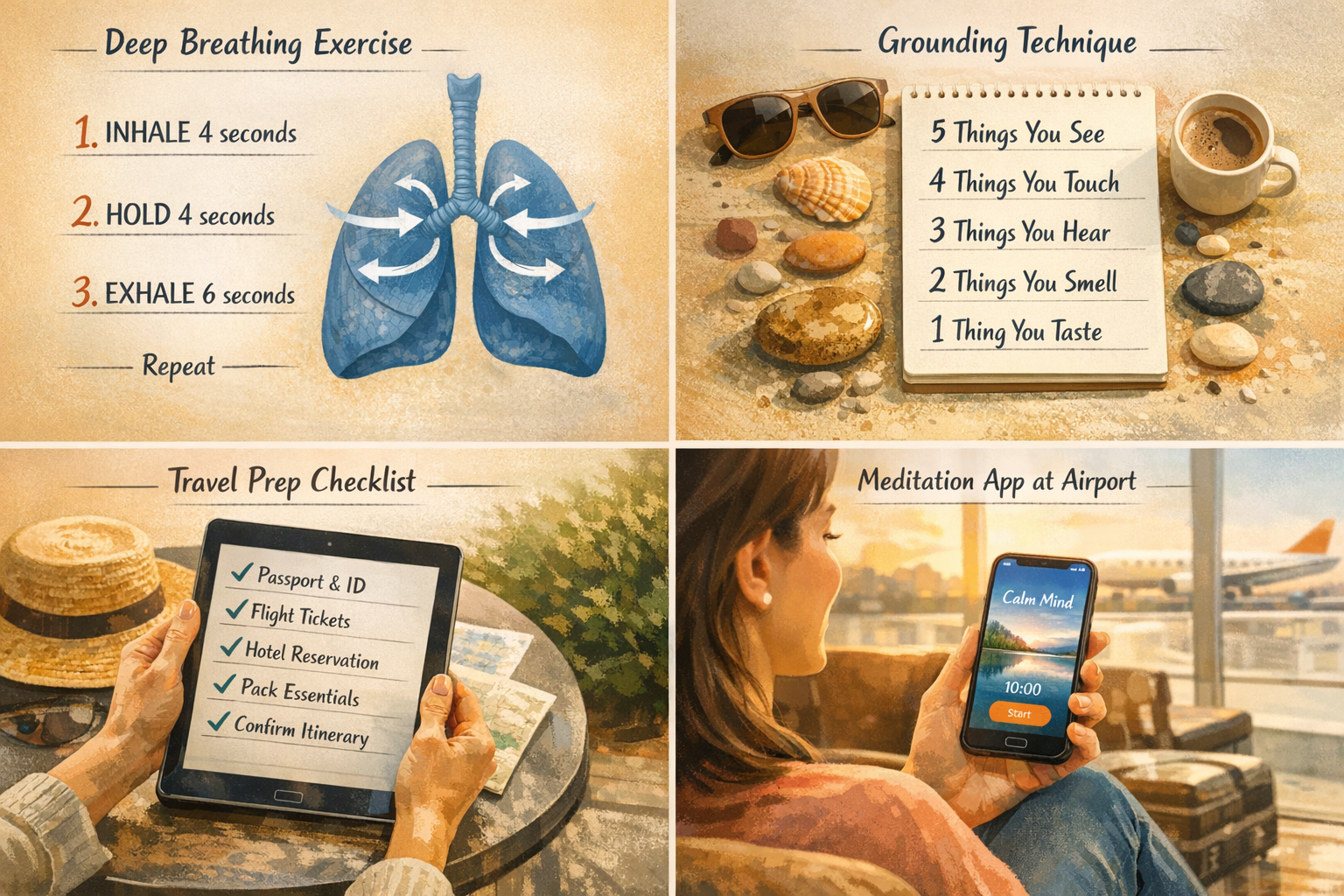
The 5-4-3-2-1 grounding method pulls your attention away from anxious thoughts and into the present moment:
- Name 5 things you can see (gate number, person in blue shirt, coffee shop sign)
- Name 4 things you can touch (armrest texture, phone case, fabric of your clothes)
- Name 3 things you can hear (announcement, rolling luggage, conversation)
- Name 2 things you can smell (coffee, someone’s perfume)
- Name 1 thing you can taste (gum, water, lingering flavor from a snack)
Box breathing calms your nervous system in about two minutes:
- Breathe in for 4 counts
- Hold for 4 counts
- Breathe out for 4 counts
- Hold empty for 4 counts
- Repeat for 5-10 cycles
Progressive muscle relaxation releases physical tension:
- Tense your feet for 5 seconds, then release
- Tense your calves for 5 seconds, then release
- Continue up through legs, stomach, chest, arms, hands, shoulders, neck, and face
- Notice the difference between tension and relaxation
Cognitive Strategies for Loss of Control
Thought challenging helps when your mind spirals into worst-case scenarios:
| Anxious Thought | Reality Check | Balanced Thought |
|---|---|---|
| “This delay will ruin everything” | What’s the actual impact? | “This is frustrating, but I can reschedule or adjust” |
| “I can’t handle this uncertainty” | Have I handled uncertainty before? | “I don’t like this, but I’ve managed similar situations” |
| “Something terrible will happen” | What evidence supports this? | “Delays are common and usually just inconvenient” |
| “I have no control at all” | What can I control right now? | “I can’t control the flight, but I can control my response” |
The control inventory helps you focus on what you actually can influence:
Things you cannot control:
- Weather conditions
- Mechanical issues
- Other passengers’ behavior
- Exact arrival time
- TSA procedures
Things you can control:
- Your breathing and physical tension
- What you focus your attention on
- How you interpret the situation
- Whether you ask for help or information
- Your self-talk and mental narrative
Edge case: If these techniques don’t reduce your anxiety within 10-15 minutes, consider speaking with a flight attendant, calling a supportive friend, or using a crisis text line. Prolonged, intense anxiety might need professional intervention.
Can Frequent Travel Help You Accept Less Control?
Frequent travel can reduce control-based anxiety by increasing familiarity with unpredictable situations and proving that you can handle uncertainty. However, this only works if you actively practice acceptance and flexibility rather than trying to control more with each trip.
How Exposure Builds Uncertainty Tolerance
Each travel experience provides evidence that you can survive and even thrive with limited control:
Familiarity reduces threat perception: The first time you experience a flight delay, your brain treats it as a novel threat. By the tenth delay, your brain recognizes the pattern and knows you’ve survived it before, which reduces the stress response.
Competence builds confidence: As you successfully navigate airports, handle rebookings, and solve travel problems, you develop a track record of competence. This history reminds you that you have skills to cope even when you can’t control outcomes.
Perspective shifts naturally: Frequent travelers often report that delays and inconveniences that once felt catastrophic now feel like minor annoyances. This shift happens because repeated exposure recalibrates your sense of what constitutes a real problem.
Making Frequent Travel Work for You
Start small: If you have severe control-based travel anxiety, begin with short, low-stakes trips where delays won’t have serious consequences. A weekend getaway teaches the same uncertainty tolerance lessons as a business trip, but with less pressure.
Reflect after each trip: Write down what went wrong, how you handled it, and what you learned. This reflection helps you recognize your growing competence and identify patterns in your anxiety triggers.
Celebrate flexibility: When you successfully adapt to a change (taking a different route, finding a new restaurant when your reservation falls through), acknowledge this as a skill you’re developing. Flexibility is the antidote to rigid control needs.
Avoid over-planning: If you respond to travel anxiety by planning more obsessively with each trip, you’re reinforcing the belief that control is necessary for safety. Instead, deliberately leave some aspects unplanned to practice tolerating uncertainty.
Choose frequent travel exposure if: You have opportunities to travel regularly, your anxiety is moderate (not severe), and you can afford low-stakes practice trips.
What Role Does Preparation Play When Travel Anxiety Isn’t About Flying — It’s About Control?
Preparation is a double-edged tool for control-based travel anxiety because it can either provide healthy structure or feed compulsive control-seeking behaviors. The key is distinguishing between reasonable preparation that addresses legitimate concerns and excessive planning that reinforces the belief that you must control everything to be safe.
Healthy Preparation Practices
Reasonable preparation addresses actual needs and reduces preventable problems:
Essential preparation checklist:
- ✅ Confirm flight details 24 hours before departure
- ✅ Check in online to select or confirm your seat
- ✅ Review TSA requirements for your specific items
- ✅ Charge devices and download offline entertainment
- ✅ Pack medications, important documents, and one change of clothes in carry-on
- ✅ Set up flight status alerts
- ✅ Verify passport validity for international trips (must have 6 months before expiration)
- ✅ Arrange transportation to and from airports
- ✅ Notify your bank of travel dates to prevent card blocks
This level of preparation is practical and addresses common travel disruptions without becoming obsessive.
When Preparation Becomes Problematic
Excessive preparation crosses into anxiety reinforcement when it:
- Takes more than 2-3 hours for a domestic trip or 4-5 hours for international travel
- Involves checking the same information repeatedly (flight status every 10 minutes)
- Creates elaborate backup plans for unlikely scenarios (what if the backup flight also cancels?)
- Prevents you from focusing on other life activities in the days before travel
- Doesn’t actually reduce your anxiety (you still feel anxious despite extensive planning)
Red flag behaviors:
- Arriving at the airport 4+ hours early for domestic flights
- Packing and repacking multiple times
- Creating detailed minute-by-minute itineraries with no flexibility
- Researching every possible thing that could go wrong
- Calling the airline multiple times to confirm the same information
If you notice these patterns, your preparation has shifted from helpful to harmful. The solution isn’t to stop preparing entirely but to set boundaries: prepare once thoroughly, then redirect your attention to other activities.
Decision rule: If preparation reduces your anxiety and you can stop once it’s complete, it’s healthy. If preparation temporarily reduces anxiety but you feel compelled to keep preparing, or if anxiety returns immediately after preparing, you’re reinforcing the anxiety cycle.
How Can You Support Someone Whose Travel Anxiety Isn’t About Flying — It’s About Control?
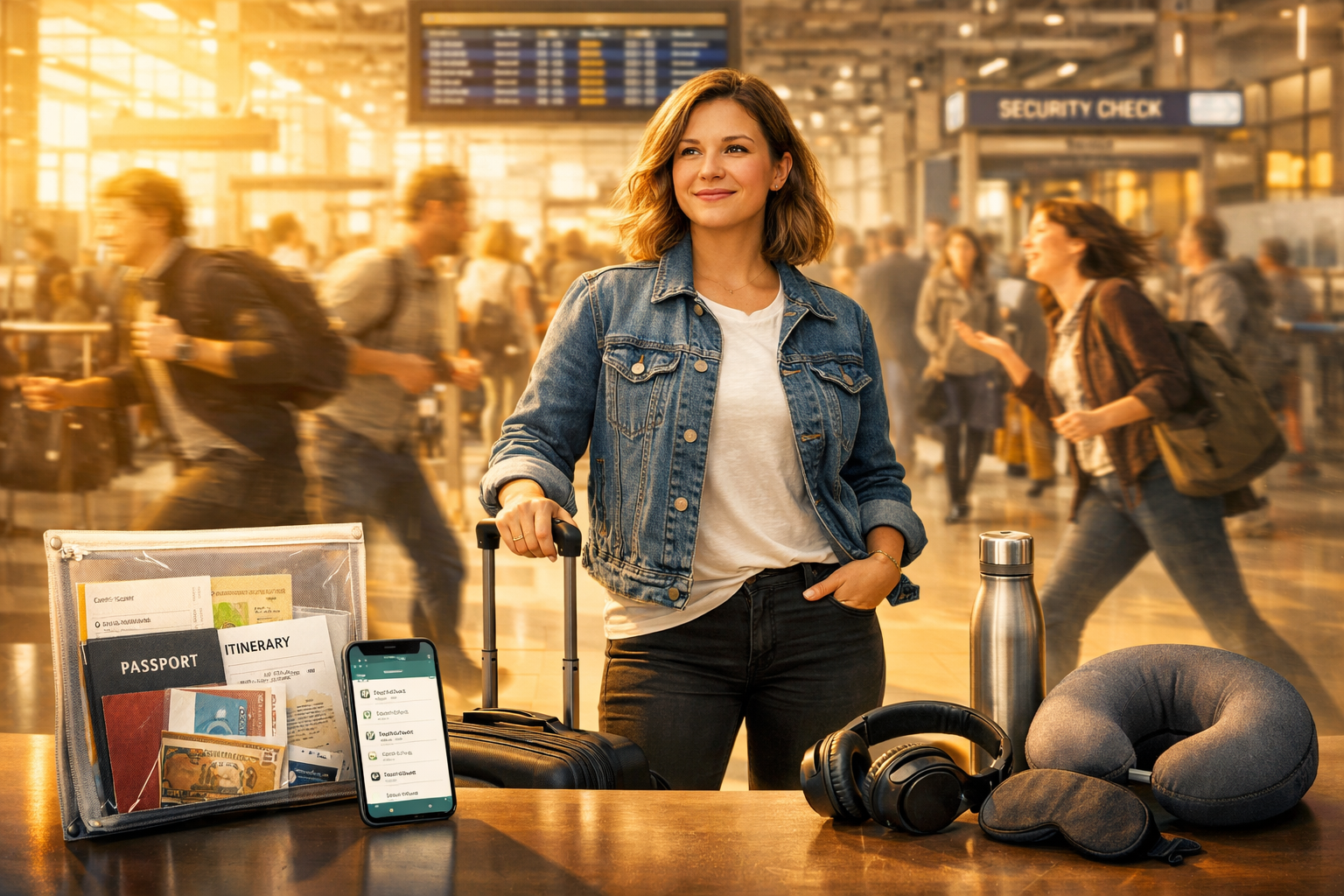
Supporting someone with control-based travel anxiety requires validating their feelings while gently encouraging flexibility and offering practical help without taking over completely. The goal is to provide support that empowers them rather than rescuing them, which would reinforce their belief that they cannot handle uncertainty.
What Helps
Validation without amplification: Acknowledge their feelings without agreeing that the situation is catastrophic. Say “I understand you’re feeling anxious about the delay” rather than “Yes, this is terrible, everything is ruined.”
Offer specific help: Instead of “Let me know if you need anything,” offer concrete assistance: “I can check for alternative flights while you grab some water” or “Want me to call the hotel and explain we’ll be late?”
Share control: If you’re traveling together, involve them in decisions where possible. “Would you prefer to wait at this gate or find a quieter area?” gives them agency over something controllable.
Model calm flexibility: When things go wrong, demonstrate that uncertainty is manageable. “The delay is frustrating, but we can use this time to grab dinner” shows that unpredictability doesn’t equal disaster.
Provide information: Many control-anxious travelers feel better with facts. Share relevant information you find: “The airline app says we’re third in line for takeoff” or “I found our new gate on the map.”
What Doesn’t Help
Taking over completely: If you handle everything for an anxious traveler, you confirm their belief that they cannot manage travel independently. This increases long-term anxiety even if it provides short-term relief.
Minimizing or dismissing: Statements like “You’re overreacting” or “It’s not a big deal” invalidate their experience and often increase anxiety. Their feelings are real even if the threat isn’t proportional.
Catastrophizing together: Joining in their worst-case scenario thinking (“Yes, we might miss the wedding entirely!”) amplifies anxiety rather than calming it.
Forcing exposure: Pushing someone into highly stressful travel situations before they’re ready can worsen anxiety and create traumatic associations with travel.
Constant reassurance: Repeatedly saying “Everything will be fine” teaches anxious travelers to seek external reassurance rather than developing internal coping skills.
Better approach: “I can see you’re worried. What would help you feel more prepared right now?” This acknowledges their feelings and empowers them to identify what they need.
What Professional Help Exists for Control-Based Travel Anxiety?
Cognitive-behavioral therapy (CBT), acceptance and commitment therapy (ACT), and sometimes medication can effectively treat control-based travel anxiety when self-help strategies aren’t sufficient. Professional help becomes important when anxiety prevents you from traveling for work, family events, or personal growth opportunities.
Therapy Approaches
Cognitive-behavioral therapy helps you identify and change thought patterns that fuel control anxiety:
- Cognitive restructuring: Learning to challenge catastrophic thoughts and replace them with realistic assessments
- Behavioral experiments: Testing your predictions (like “If I don’t check my flight status constantly, I’ll miss important updates”) to see if they’re accurate
- Graded exposure: Gradually facing travel situations that trigger control anxiety, starting with easier scenarios
- Skills training: Learning specific techniques for managing anxiety symptoms when they arise
Acceptance and commitment therapy focuses on accepting uncertainty rather than trying to eliminate it:
- Values clarification: Identifying what matters most to you (family, career growth, adventure) to motivate travel despite anxiety
- Defusion techniques: Learning to observe anxious thoughts without believing or acting on them
- Present-moment awareness: Practicing mindfulness to reduce worry about future uncertainties
- Committed action: Taking steps toward meaningful goals even when anxiety is present
When to Seek Professional Help
Consider therapy if you experience:
- Avoidance: Turning down job opportunities, missing important events, or limiting life choices because of travel anxiety
- Severe symptoms: Panic attacks, insomnia for days before travel, or physical symptoms that interfere with daily functioning
- Relationship impact: Travel anxiety creates significant conflict with partners, family, or colleagues
- Failed self-help: You’ve tried multiple strategies consistently for 2-3 months without improvement
- Worsening patterns: Your anxiety is increasing over time or spreading to other areas of life
Medication options: Some people benefit from anti-anxiety medication for travel, either as-needed (like short-acting benzodiazepines) or daily (like SSRIs for generalized anxiety). Discuss options with a psychiatrist or primary care physician who understands your specific situation.
Finding the right therapist: Look for providers who specialize in anxiety disorders and specifically mention travel anxiety, health anxiety, or control issues in their practice description. Ask potential therapists: “Have you worked with clients who have control-based anxiety around travel?” and “What approach do you typically use?”
Frequently Asked Questions
Is travel anxiety the same as fear of flying?
No, travel anxiety and fear of flying are different issues. Fear of flying (aviophobia) is specifically about the airplane itself, turbulence, or crashes. Travel anxiety is broader and often stems from loss of control over schedules, environments, and outcomes. You can have travel anxiety without any fear of the actual flight.
Why do I feel more anxious about travel than my friends do?
People vary in their tolerance for uncertainty and need for control based on genetics, past experiences, personality traits, and current stress levels. Some people naturally have higher anxiety sensitivity, while others have had negative travel experiences that created learned anxiety. Neither response is wrong, just different.
Can I overcome control-based travel anxiety completely?
Most people can significantly reduce control-based travel anxiety through practice, therapy, and mindset shifts, but complete elimination isn’t always realistic or necessary. The goal is managing anxiety so it doesn’t prevent you from traveling or enjoying trips, not achieving perfect calm in genuinely uncertain situations.
Should I avoid travel if it makes me anxious?
Avoiding travel entirely usually increases anxiety over time because it confirms the belief that travel is dangerous or unmanageable. However, you don’t need to force yourself into highly stressful travel situations immediately. Start with shorter, lower-stakes trips and gradually build your tolerance and skills.
Does medication help with control-based travel anxiety?
Medication can help manage anxiety symptoms, but it works best combined with therapy or skills training that addresses the underlying control issues. Anti-anxiety medication provides temporary relief, while therapy helps you develop long-term coping strategies and change the thought patterns that fuel anxiety.
How early should I arrive at the airport if I have travel anxiety?
For domestic flights, arriving 90 minutes before departure gives you adequate time without excessive waiting that increases anxiety. For international flights, 2-3 hours is standard. Arriving much earlier might seem like it provides control, but it often extends the anxiety period without adding real benefit.
What if I have a panic attack during travel?
Panic attacks are intensely uncomfortable but not dangerous. Use grounding techniques (5-4-3-2-1 method), focus on slow breathing, and remind yourself that panic attacks typically peak within 10 minutes and then subside. If you’re on a plane, you can tell a flight attendant you’re feeling anxious and they can provide water and reassurance.
Is it normal to feel anxious even when everything goes smoothly?
Yes, if you’ve developed conditioned anxiety around travel, you might feel anxious even during perfect trips because your brain has learned to associate travel with stress. This pattern improves with repeated positive travel experiences and cognitive work to break the automatic anxiety response.
Can travel anxiety get worse with age?
Travel anxiety can increase with age if you travel less frequently and lose familiarity, or if you develop health concerns that make you feel more vulnerable. However, many people find travel anxiety decreases with age as they gain life experience and perspective about what truly matters.
Should I tell airline staff about my anxiety?
You can discreetly mention to flight attendants that you feel nervous about flying, and they’re usually understanding and helpful. You don’t need to share details, but a simple “I get a bit anxious during flights” allows them to check on you or provide reassurance if needed.
How can I practice uncertainty tolerance in daily life?
Start small by deliberately leaving minor things unplanned: take a different route to work, try a new restaurant without reading reviews first, or leave weekend plans flexible. These low-stakes practices build your tolerance for uncertainty without the pressure of travel.
What’s the difference between healthy planning and anxiety-driven planning?
Healthy planning is time-limited, addresses realistic concerns, reduces your anxiety, and allows you to move on to other activities. Anxiety-driven planning is repetitive, focuses on unlikely scenarios, provides only temporary relief, and interferes with other parts of your life.
Key Takeaways
- Travel anxiety isn’t about flying — it’s about control, meaning your stress comes from unpredictability and powerlessness rather than the physical act of air travel itself
- The human need for control is evolutionary and normal, but modern travel creates situations where control is limited or impossible, triggering anxiety responses
- Identifying your specific control triggers (time, space, safety, information) allows you to create targeted coping strategies instead of generic anxiety management
- Healthy preparation addresses legitimate concerns and reduces preventable problems, while excessive preparation reinforces the belief that perfect control is necessary for safety
- Practical strategies include building schedule buffers, creating backup plans, using grounding techniques, and developing tolerance for uncertainty
- Frequent travel can reduce control-based anxiety by building familiarity and competence, but only if you practice flexibility rather than increasing control attempts
- Supporting someone with travel anxiety requires validation, specific help, and modeling calm flexibility without taking over completely or minimizing their feelings
- Professional help through CBT, ACT, or medication becomes important when anxiety prevents meaningful travel or when self-help strategies don’t provide sufficient relief
- The goal isn’t eliminating all travel anxiety but managing it so you can travel for work, relationships, and experiences that matter to you
- Distinguishing between control-based travel anxiety and flight phobia helps you choose the right treatment approach and set realistic expectations for improvement
Conclusion
Understanding that travel anxiety isn’t about flying — it’s about control transforms how you approach the problem. Instead of forcing yourself to “just get over it” or avoiding travel entirely, you can address the actual issue: your discomfort with uncertainty and limited agency over important outcomes.
The strategies outlined in this guide work because they acknowledge your legitimate need for predictability while helping you develop tolerance for situations you genuinely cannot control. Some preparation is helpful and appropriate. Learning about aviation safety can provide reassurance. Building in schedule buffers gives you real options when disruptions occur. These approaches work with your psychology rather than against it.
At the same time, developing uncertainty tolerance is essential because perfect control over travel simply doesn’t exist. Flights will be delayed. Plans will change. Unexpected situations will arise. The question isn’t whether you’ll face unpredictability, but whether you’ll have the skills to manage your response when it happens.
Your next steps:
- Identify your primary control triggers using the questions and categories in this guide
- Implement one preparation strategy that addresses your biggest trigger (schedule buffers, comfort items, information access)
- Practice one uncertainty tolerance technique in daily life before your next trip (try the 5-4-3-2-1 grounding method or box breathing)
- Book a low-stakes trip within the next 2-3 months to practice these skills in a real travel situation
- Seek professional help if anxiety prevents you from traveling for important opportunities or if self-help strategies don’t reduce your symptoms within 2-3 months
Travel anxiety rooted in control issues is common, understandable, and treatable. You don’t need to become someone who loves uncertainty or feels completely calm during delays. You just need to develop enough skills and tolerance to travel for the experiences, relationships, and opportunities that matter to you. That’s a realistic and achievable goal, and the journey toward it starts with recognizing what’s really driving your anxiety in the first place.