

You’ve just returned from your dream vacation, and instead of feeling refreshed, you’re completely drained. Your suitcase sits unpacked in the corner, you can barely keep your eyes open at your desk, and the thought of anything more demanding than Netflix feels impossible. Sound familiar?
You’re not alone. Across Reddit’s travel communities, thousands of travelers share the same confession: “I need a vacation from my vacation.” One user summed it up perfectly after a two-week trip: “I’m just kind of tired at this point. Tired of doing a new thing everyday, tired of being around my family, and tired of being in the hotel.”
The irony is painful. We save money, request time off, plan elaborate itineraries—all to escape our exhausting daily lives. Yet we often return more depleted than when we left. So what’s happening? And more importantly, how can we actually return from vacation feeling restored?
The Hidden Science Behind Vacation Exhaustion
Your Brain Is Running a Marathon
While it might seem like you’re barely doing anything on a plane or tour bus, your brain is working overtime. As one Redditor explained in r/explainlikeimfive: “It’s typically a highly stimulative environment. There are people everywhere. Lots of moving parts. Unknowns. Places you’ve never been before. It keeps your mind very active and paying attention to everything around it.”
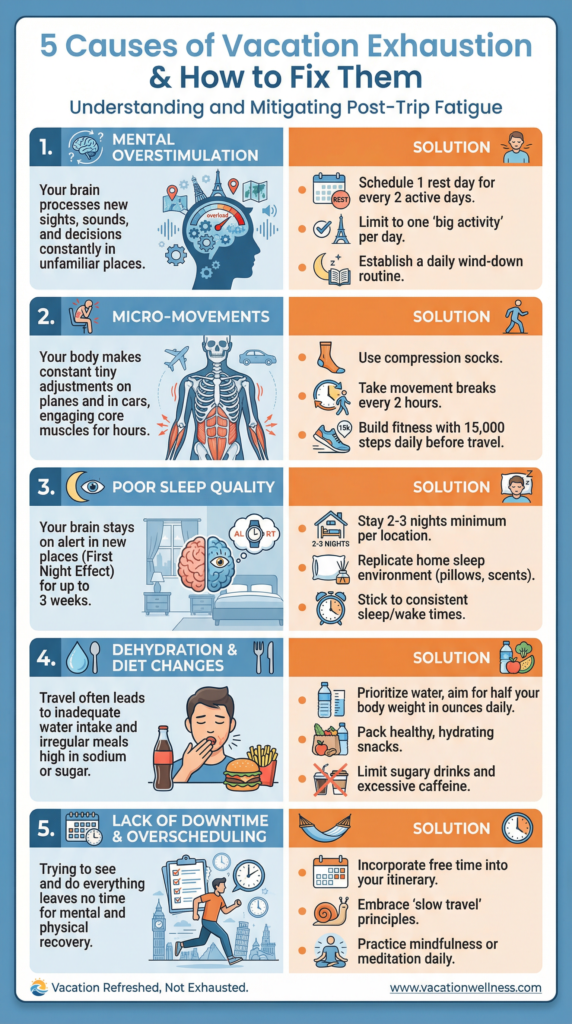
Your daily life operates largely on autopilot—your brain knows the route to work, the layout of your grocery store, which restaurant has good Thai food. But travel strips away all those mental shortcuts. Every decision, from navigating foreign streets to decoding menus, requires conscious mental processing. Research suggests this cognitive load is so intense that elite chess masters can burn up to 6,000 calories a day just thinking. Travel creates a similar mental demand, continuously processing new sights, sounds, and experiences.
The Micro-Movement Mystery
Even when you’re sitting still, your body is secretly working hard. “On a plane or car, it is constantly moving so you are constantly making small micro adjustments to stay upright,” explained one Reddit user. “If the plane/car turns to the right, your body will sway to the left so you have to use a little energy to stay upright and straight.”
These tiny muscular adjustments might seem insignificant, but they accumulate over hours. Your core muscles engage, your legs brace, your neck compensates—all without you consciously noticing. Add 25,000 steps per day exploring a new city (the average reported by travelers), and you’re physically exhausted even before factoring in jet lag.
The First Night Effect
Here’s where it gets fascinating: neuroscience research shows that your brain literally sleeps differently the first night in a new place. Your brain activity remains fundamentally altered, with one hemisphere staying more alert—similar to how dolphins sleep. As one seasoned traveler noted: “Your subconscious doesn’t fully get settled into an environment for like 3 weeks.”
This evolutionary adaptation meant survival for our ancestors in unfamiliar territory, but it also means you’re never fully resting in that hotel room, no matter how comfortable the bed. Combined with travel anxiety, disrupted eating schedules, and dehydration from dry airplane air, your body accumulates a sleep debt that leaves you running on fumes.
The Two-Week Threshold: When Vacation Stops Feeling Special
Through analyzing hundreds of Reddit posts, a clear pattern emerged: most travelers hit a wall around day 10-14. One travel industry veteran with 13 years of experience shared: “Based on my travels, the perfect length of a vacation is about 8 days. After about 11 days, vacations start to get old.”
The pattern is remarkably consistent:
- Days 1-3: Excitement and adjustment, high energy
- Days 4-7: Peak enjoyment, vacation sweet spot
- Days 8+: Diminishing returns, missing home
“Two weeks is pretty much my limit,” wrote one Redditor. “Humans are meant to be adaptable. Which means we adapt to this crazy cool environment and that becomes your new norm!” This hedonic adaptation means the novelty wears off. By day 14, exploring ancient ruins feels like just another Tuesday, and you’re craving your own bed, your dog, and the Thai restaurant that knows your order.
How to Fix It: The Strategic Vacation Formula
Before You Go: Build Your Foundation
The best defense against vacation exhaustion starts before you leave home. One Redditor’s advice resonated across multiple threads: “You should consider working on your fitness level before travelling. Go on some long walks regularly or something to build up your endurance.”
Start walking 15,000+ steps daily two weeks before your trip. This builds the physical stamina needed for exploration without paying the price in sore legs and depleted energy. Also adjust your sleep schedule gradually toward your destination’s time zone—one hour per day reduces the jarring impact of jet lag.
Most importantly, plan buffer days into your itinerary from the start. This prevents the trap of overcommitting and relieves the guilt when you need rest.
During Your Trip: The 2:1 Activity Rule
The single most effective strategy? “I now keep one rest day per week during long travels,” shared a frequent traveler. “Adrenalin and excitement takes you through trips but as soon as back home its exhausting.”
Implement the 2:1 rule: two active days followed by one rest day. On rest days, as one wise Redditor suggested, “Make the hotel the tourist thing you’re doing for the day. Stay somewhere that is beautiful or culturally relevant. Enjoy a soak in the bath in a Japanese ryokan. Watch the sunset over a castle from your balcony in France. Lounge by the pool.”
This doesn’t mean wasting your vacation. One traveler explained: “I think a lot of the times people feel pressured to be busy and going all the time while on vacation… But I don’t know anyone who lives at that pace at home. Sometimes you just sit and watch TV, or order cheap takeout, or nap.”
The Golden Rules:
- One “big thing” per day: Museum OR hike OR long excursion, never all three
- Use public transit strategically: “The long walks add up and take their toll”
- Schedule mandatory downtime: “Take a pass on a morning activity with everyone and sleep in”
- Honor introvert needs: “As a hardcore introvert, I need alone time even on vacation”
The Hydration-Nutrition Protocol
Reddit’s collective wisdom was clear: “Drink water folks, it almost always helps.” One traveler advised: “Stay hydrated. Avoid greasy and fried foods. Should all help.”
Buy groceries and keep lazy meals in your hotel mini-fridge. Not every meal needs to be a culinary adventure. Sometimes a simple sandwich in your room beats forcing yourself to another restaurant when you’re exhausted. As one practical traveler noted: “There are days you’ll come back to the hotel room super tired, and it’ll be nice not having to go out again to scrounge up dinner.”
The Noise Management Secret
Here’s an underrated game-changer: noise-canceling headphones. One business traveler who commuted monthly between the US and Asia reported: “I finally got noise cancelling headphones and feel 50% better after a flight.” The constant roar of jet engines, traffic noise, and general hubbub of travel creates mental fatigue even when you’re not consciously aware of it.
After You Return: The Buffer Day Rule
“Everyone is in that boat. Everyone,” wrote one Redditor about needing recovery time. The consensus was overwhelming: never return to work the day after vacation ends.
The optimal formula: “Come back on Thursday, have whole weekend to get refreshed before going back to work.” This gives you 1-2 buffer days to unpack, do laundry, sleep in your own bed, and mentally transition back to routine.
One traveler shared their hard-won wisdom: “I always try to have at least one full day of free time when I get back home. Going to work the next day sucks.” Use this time for gentle re-entry—no social obligations, no demanding tasks, just restoration.
Redefining Vacation Success
Perhaps the most profound insight from Reddit’s travel communities is this mindset shift: vacation success isn’t measured by how many sites you checked off a list. As one user beautifully articulated: “Travel is vacation for the brain, vacation at home is for the body. One needs both to be ready to go back to work.”
The travelers who reported the least exhaustion weren’t those who saw the most—they were those who found balance. They gave themselves permission to skip that fourth museum. They spent an afternoon doing “nothing” at a café. They listened to their bodies and rested when needed, without guilt.
“I like my regular life even though it is sometimes stressful,” wrote one reflective traveler. “Weekly dinners and happy hours, workout routine, cooking fun meals, getting takeout thai and watching trash TV all is fun to me the way travel is!” When vacation becomes just another form of exhaustion, it’s time to recalibrate.
Your Next Steps
Before your next trip, choose three strategies from this article to implement. Maybe it’s the 2:1 activity rule, scheduling buffer days, or simply giving yourself permission to spend a morning in bed reading while your travel companions explore.
Remember: you’re not failing at vacation if you’re tired. You’re human, navigating the biological reality that new experiences, while enriching, are inherently taxing. The goal isn’t to avoid all exhaustion—it’s to find the sweet spot where you return home slightly sad to leave, but genuinely happy to be back.
As one seasoned traveler wisely noted: “If you aren’t looking forward to only having to go to work or school after vacation, you aren’t doing it right.” Your vacation should be memorable and restorative, not something you need to recover from for weeks.
So pack lighter, plan less, rest more, and give yourself permission to vacation like you actually want to feel refreshed. Your future self—and your productivity when you return—will thank you.